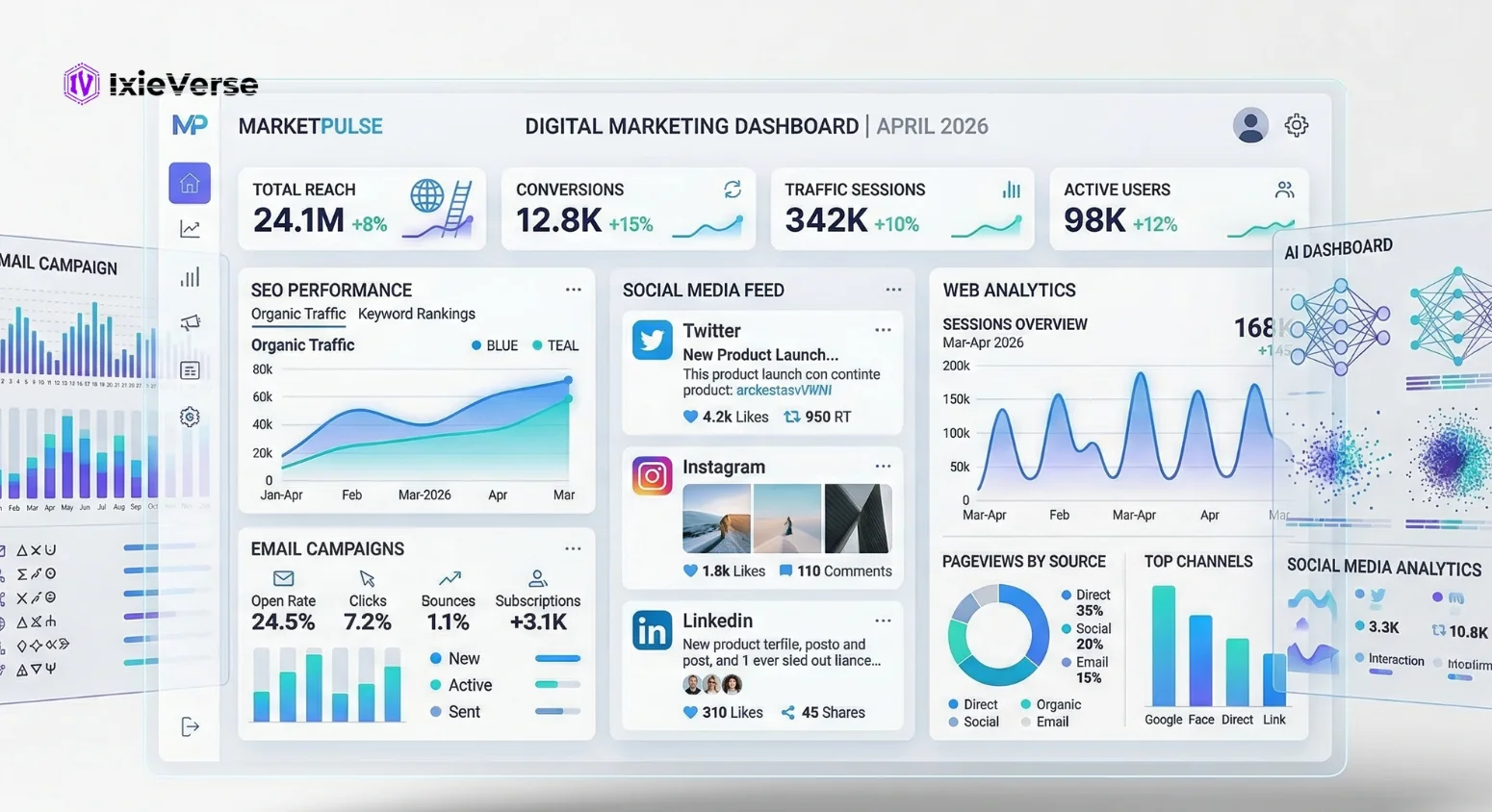
Digital marketing without the right software is like trying to run a Formula 1 race on a bicycle. In 2026, the gap between marketers who use smart tools and those who don’t has never been wider.
AI-powered platforms now automate campaign creation, audience targeting, content generation, and performance analysis — all in real time. Marketers who know how to stack and orchestrate these tools are generating 3–5x better ROI than those relying on manual workflows.
This guide covers the 30+ best digital marketing software tools available in 2026, organized by category, with honest comparisons, pricing insights, and practical recommendations for every team size and budget.
Whether you’re a solo founder, a growing startup, or an enterprise marketing team — you’ll find your ideal MarTech stack right here.
Quick Answer:
The 30+ best digital marketing software tools in 2026 fall into 8 categories: SEO, Email Marketing, Social Media, Content, CRM, Analytics, Paid Advertising, and AI Marketing. Top picks include HubSpot (all-in-one), Semrush (SEO), Mailchimp (email), Hootsuite (social), Salesforce Marketing Cloud (enterprise CRM), and Jasper (AI content). Choose tools based on your budget, team size, and primary marketing channel.
 ChatGPT
 Grok
Grok
 Claude
 Perplexity
 Google AI
- 1 What Is Digital Marketing Software?
- 2 Why Does Your Business Need Digital Marketing Software in 2026?
- Key Reasons to Use Digital Marketing Tools:
- 3 The 8 Categories of Digital Marketing Software
- 4 Best Digital Marketing Software: 30+ Top Tools for 2026
- Best SEO Software Tools
- Best Email Marketing Platforms
- Best Social Media Management Tools
- Best Content Marketing Software
- Best CRM & Marketing Automation Platforms
- Best Paid Advertising & PPC Tools
- Best Analytics & Data Platforms
- Best AI Marketing Tools (2026-Specific)
- 5 Comparison Table: Best Digital Marketing Software at a Glance
- 6 How to Build Your Digital Marketing Software Stack in 2026
- Step-by-Step MarTech Stack Framework
- Recommended Stacks by Team Size
- 7 Conclusion
- 8 Frequently Asked Questions
- Q1: What features should I look for in digital marketing software?
- Q2: How much does digital marketing software cost?
- Q3: Is HubSpot the best digital marketing software?
- Q4: What are the best AI marketing tools in 2026?
- Q5: What is the best digital marketing software for small businesses?
- Q6: What is the difference between SEO software and digital marketing software?
- Q7: How do I choose the right digital marketing software for my business?
- Q8: What are the most popular digital marketing tools used by agencies?
What Is Digital Marketing Software?
Digital marketing software refers to platforms and tools that help businesses plan, execute, automate, and analyze their online marketing activities. These tools cover SEO, email marketing, social media management, paid advertising, content creation, CRM, and analytics — enabling teams to reach the right audience, at the right time, through the right channel.
In 2026, the term extends to include AI-native platforms that generate content, predict audience behavior, automate A/B testing, and optimize campaign spend autonomously. The best digital marketing software is no longer just a tool — it’s a strategic growth system.
Why Does Your Business Need Digital Marketing Software in 2026?
The digital landscape in 2026 is defined by four major forces: AI automation, first-party data dependency, omnichannel fragmentation, and hyper-personalization demands. Manual marketing processes simply can’t keep up.
Key Reasons to Use Digital Marketing Tools:
- Save time with automation — Schedule campaigns, trigger follow-ups, and run A/B tests without manual effort.
- Scale personalization — Deliver 1:1 experiences to thousands of prospects simultaneously.
- Make data-driven decisions — Real-time dashboards replace guesswork with insights.
- Compete with larger brands — SMBs can access enterprise-grade tools at affordable prices.
- AI-powered execution — Generative AI drafts content, predicts churn, and optimizes bids 24/7.
- Unified customer view — Integrate email, social, ads, and CRM into a single source of truth.
According to industry benchmarks, businesses using integrated marketing software report 30–40% higher lead conversion rates and 25–35% lower customer acquisition costs compared to those using disconnected manual tools.
The 8 Categories of Digital Marketing Software
Before choosing tools, you need to understand the digital marketing ecosystem. Here’s how the software landscape breaks down in 2026:
| Category | Core Functions |
|---|---|
| 1. SEO Software | Keyword research, backlink analysis, technical audits, rank tracking |
| 2. Email Marketing Platforms | Automated campaigns, list segmentation, A/B testing, deliverability |
| 3. Social Media Management Tools | Scheduling, monitoring, analytics, social listening |
| 4. Content Marketing Software | Blog management, AI content creation, editorial calendar, distribution |
| 5. CRM & Marketing Automation | Lead nurturing, lifecycle automation, pipeline management |
| 6. Paid Advertising & PPC Tools | Google Ads management, bidding automation, campaign analytics |
| 7. Analytics & Data Platforms | Web analytics, conversion tracking, attribution modeling, dashboards |
| 8. AI Marketing Tools | Generative content, predictive analytics, AI ad creative, chatbots |
Best Digital Marketing Software: 30+ Top Tools for 2026
Each tool below has been evaluated on features, pricing, ease of use, AI capabilities, integrations, and value for money in 2026.
Best SEO Software Tools
1. Semrush — Best All-in-One SEO Platform
- Best for: Agencies, enterprise SEO, content marketing teams
- Key Features: Keyword research, competitor analysis, site audits, rank tracking, backlink analysis, AI-assisted content writing
- Pricing: From $139.95/month | Free trial available
- Why it stands out in 2026: Semrush’s AI-powered content tools now include SERP feature intent mapping and AI-native competitor tracking, making it the most comprehensive SEO suite available.
2. Ahrefs — Best for Backlink Intelligence
- Best for: Link building, content gap analysis, technical SEO
- Key Features: Backlink database, Keywords Explorer, Content Explorer, Site Audit, Rank Tracker
- Pricing: From $129/month
- Why it stands out in 2026: Ahrefs has the largest backlink index in the industry and delivers unparalleled competitive link intelligence for content strategists and SEOs.
3. Google Search Console — Best Free SEO Tool
- Best for: Website owners, developers, SEO fundamentals
- Key Features: Core Web Vitals, index coverage, search performance reports, structured data validation
- Pricing: Free
- Why it stands out in 2026: Non-negotiable for any website. GSC’s integration with AI Overview performance data makes it essential for AEO and featured snippet optimization.
4. Moz Pro — Best for Beginners & Mid-Market SEO
- Best for: SMBs, in-house SEO teams, local SEO
- Key Features: Domain Authority scoring, local SEO tools, keyword explorer, page optimization
- Pricing: From $99/month | 30-day free trial
5. Screaming Frog SEO Spider — Best Technical SEO Crawler
- Best for: Technical SEO audits, large site analysis, developers
- Key Features: Site crawling, broken links, redirect mapping, duplicate content, schema analysis
- Pricing: Free up to 500 URLs | £259/year for unlimited
Pro tip: Before launching your next digital marketing campaign, make sure every link is properly tagged. Use IxieVerse UTM Builder to generate accurate UTM parameters in seconds — so your analytics actually tell the truth.
Best Email Marketing Platforms
6. Mailchimp — Best for Small Business Email Marketing
- Best for: Startups, e-commerce, solopreneurs
- Key Features: Drag-and-drop builder, audience segmentation, automated journeys, A/B testing, AI-generated subject lines
- Pricing: Free plan (up to 500 contacts) | Essentials from $13/month
- Why it stands out in 2026: Mailchimp’s AI email assistant now generates entire campaign sequences based on product descriptions and audience data, dramatically cutting setup time.
7. ActiveCampaign — Best Marketing Automation + Email Combo
- Best for: SMBs, SaaS companies, e-commerce brands
- Key Features: Advanced automation workflows, CRM, predictive sending, behavioral tracking, site messaging
- Pricing: From $15/month (1,000 contacts)
- Why it stands out in 2026: ActiveCampaign blends email and CRM automation better than any competitor at its price point. Ideal for teams wanting enterprise power without enterprise cost.
8. Klaviyo — Best for E-Commerce Email & SMS Marketing
- Best for: Shopify/WooCommerce brands, DTC marketers
- Key Features: Deep e-commerce integrations, SMS automation, predictive analytics, segmentation by purchase behavior
- Pricing: Free up to 250 contacts | Paid from $20/month
9. HubSpot Email Marketing — Best Integrated Email Tool
- Best for: Teams already using HubSpot CRM
- Key Features: Personalization tokens, smart lists, CRM-integrated tracking, automated sequences
- Pricing: Free tier available | Marketing Hub from $45/month
10. Brevo (formerly Sendinblue) — Best Budget Email Platform
- Best for: Budget-conscious teams, transactional email, B2B newsletters
- Key Features: SMTP relay, SMS, email campaigns, automation, landing pages
- Pricing: Free up to 300 emails/day | Starter from $25/month
Pro tip: Before launching your next digital marketing campaign, make sure every link is properly tagged. Use IxieVerse UTM Builder to generate accurate UTM parameters in seconds — so your analytics actually tell the truth.
Best Social Media Management Tools
11. Hootsuite — Best Enterprise Social Media Platform
- Best for: Agencies, large teams, multi-brand management
- Key Features: Multi-platform scheduling, social listening, analytics, team workflows, AI caption generator
- Pricing: Professional from $99/month
12. Buffer — Best Simple Social Media Scheduler
- Best for: Freelancers, small teams, content creators
- Key Features: Post scheduling, analytics, AI assistant, link-in-bio tool, engagement tracking
- Pricing: Free plan | Essentials from $6/month per channel
13. Sprout Social — Best for Social Analytics & Listening
- Best for: Mid-market brands, social-first companies, customer care teams
- Key Features: Advanced analytics, social listening, CRM integration, Smart Inbox, influencer tools
- Pricing: From $249/month per seat
14. Later — Best for Visual Content & Instagram Marketing
- Best for: E-commerce brands, Instagram/TikTok marketers, influencers
- Key Features: Visual content calendar, Instagram-first features, link-in-bio, TikTok scheduling
- Pricing: Free plan | Starter from $18/month
15. Brandwatch — Best Social Listening & Intelligence Platform
- Best for: Enterprise brand monitoring, PR teams, market researchers
- Key Features: Real-time social listening, sentiment analysis, competitive benchmarking, trend detection
- Pricing: Custom pricing (enterprise-tier)
Best Content Marketing Software
16. HubSpot CMS & Blog Tools — Best Content + CRM Integration
- Best for: B2B companies, inbound marketing teams
- Key Features: Blog, SEO recommendations, CTAs, smart content, lead conversion forms
- Pricing: Included in Marketing Hub | From $45/month
17. Jasper AI — Best AI Content Generation Platform
- Best for: Content teams, copywriters, growth marketers
- Key Features: Long-form AI writing, brand voice settings, 50+ content templates, SEO mode, team collaboration
- Pricing: From $49/month
- Why it stands out in 2026: Jasper now integrates with Surfer SEO and Google Search Console for real-time optimization scoring, making it the top choice for AI-assisted content marketing at scale.
18. Surfer SEO — Best On-Page SEO Content Optimizer
- Best for: Content teams optimizing for Google rankings
- Key Features: SERP analysis, NLP keyword suggestions, content score, outline builder, AI drafts
- Pricing: From $89/month
19. CoSchedule — Best Marketing Calendar Platform
- Best for: Marketing managers, editorial teams, multi-channel planning
- Key Features: Marketing calendar, headline analyzer, campaign planning, social scheduling
- Pricing: Free tier | Marketing Suite from $29/month
20. Canva — Best Visual Content Creation Tool
- Best for: Teams needing fast, on-brand visual content at scale
- Key Features: 250,000+ templates, AI image generation, brand kit, Magic Write, video editor, social media publishing
- Pricing: Free | Pro from $15/month per user
- Why it stands out in 2026: Canva’s Magic Studio AI now powers full campaign creation from a single brief — generating copy, images, and layout variations simultaneously.
Best CRM & Marketing Automation Platforms
21. HubSpot — Best All-in-One Marketing + CRM Platform
- Best for: SMBs to mid-market, inbound marketing, SaaS companies
- Key Features: Free CRM, email marketing, automation, landing pages, live chat, SEO tools, reporting dashboard
- Pricing: Free CRM | Marketing Hub from $45/month | Enterprise from $3,600/month
- Why it stands out in 2026: HubSpot’s Breeze AI assistant now handles campaign creation, contact scoring, and meeting scheduling, making it the most accessible all-in-one platform for growth-focused teams.
22. Salesforce Marketing Cloud — Best Enterprise CRM & Automation
- Best for: Enterprise brands, large marketing teams, omnichannel journeys
- Key Features: Journey Builder, Email Studio, Advertising Studio, Einstein AI, Data Cloud integration
- Pricing: Custom pricing (enterprise)
- Why it stands out in 2026: Salesforce’s Einstein Copilot now generates entire multi-channel journey maps based on business goals, a significant leap in enterprise marketing automation.
23. Marketo Engage (Adobe) — Best B2B Marketing Automation
- Best for: B2B enterprises, demand generation, ABM campaigns
- Key Features: Lead management, revenue attribution, account-based engagement, predictive content
- Pricing: Custom pricing (mid-to-enterprise)
24. Klaviyo — Best E-Commerce CRM
- Best for: D2C brands, online stores, retention marketers
- Key Features: Purchase-based segmentation, predictive CLV, SMS + email automation, Shopify integration
- Pricing: Free for small lists | Scales with contact count
Pro tip: Before launching your next digital marketing campaign, make sure every link is properly tagged. Use IxieVerse UTM Builder to generate accurate UTM parameters in seconds — so your analytics actually tell the truth.
Best Paid Advertising & PPC Tools
25. Google Ads — The Foundation of Paid Digital Marketing
- Best for: All business sizes running search, display, or YouTube ads
- Key Features: Smart campaigns, Performance Max, AI bid optimization, audience targeting, conversion tracking
- Pricing: Pay-per-click (budget-based)
- Why it stands out in 2026: Google’s Performance Max campaigns now use multimodal AI to generate ad assets, select placements, and optimize bids across Search, YouTube, Gmail, and Display simultaneously.
26. Meta Ads Manager — Best Social Paid Advertising Platform
- Best for: B2C brands, e-commerce, DTC marketers, lead generation
- Key Features: Facebook/Instagram ads, Advantage+ automation, lookalike audiences, retargeting, conversion API
- Pricing: Pay-per-click/impression (budget-based)
27. WordStream by LocaliQ — Best SMB PPC Management Tool
- Best for: Small businesses, local companies, agencies managing SMB clients
- Key Features: Google/Facebook Ads management, performance grader, smart alerts, automation suggestions
- Pricing: Custom pricing
28. AdRoll — Best Retargeting & Display Ad Platform
- Best for: E-commerce brands, awareness campaigns, retargeting-heavy strategies
- Key Features: Cross-channel retargeting, dynamic product ads, prospecting, email + ads integration
- Pricing: Free plan | Marketing + Ads packages from $36/month
Best Analytics & Data Platforms
29. Google Analytics 4 (GA4) — Best Free Web Analytics Tool
- Best for: All website owners, marketers, developers
- Key Features: Event-based tracking, funnel exploration, predictive audiences, BigQuery integration, AI-generated insights
- Pricing: Free | GA4 360 for enterprise pricing
- Why it stands out in 2026: GA4’s AI-powered insights now proactively surface anomalies, revenue opportunities, and predicted churn risk without requiring custom reports.
30. Hotjar — Best User Behavior Analytics Tool
- Best for: CRO teams, UX designers, product marketers
- Key Features: Heatmaps, session recordings, feedback polls, funnels, AI summaries of user behavior
- Pricing: Free plan | Plus from $32/month
31. Tableau (Salesforce) — Best Enterprise Data Visualization
- Best for: Enterprise data teams, BI analysts, marketing operations
- Key Features: Drag-and-drop dashboards, real-time data connections, predictive modeling, AI-assisted analytics (Tableau Next)
- Pricing: Tableau Creator from $75/month per user
Best AI Marketing Tools (2026-Specific)
32. Jasper AI — Best for AI-Powered Content Creation
Already covered in Content Marketing. Jasper leads the AI content category for output quality, brand voice consistency, and SEO integration.
33. Persado — Best AI for Emotional Language Optimization
- Best for: Enterprise brands optimizing email, ads, and landing page copy
- Key Features: AI-generated language variants, emotional motivation mapping, performance prediction, enterprise API
- Pricing: Custom (enterprise)
34. Drift / Salesloft AI — Best AI Conversational Marketing
- Best for: B2B brands, SaaS, demand generation teams
- Key Features: AI chatbots, intent-based routing, account-based personalization, conversation analytics
- Pricing: Premium from $2,500/month
35. Sixth Sense — Best AI-Powered Account-Based Marketing
- Best for: B2B sales and marketing teams running ABM programs
- Key Features: Intent data, predictive account scoring, AI orchestration across channels, revenue impact reporting
- Pricing: Custom (enterprise B2B)
Explore: How to Use AI to Make Money Online in 2026
Comparison Table: Best Digital Marketing Software at a Glance
| Tool | Category | Best For | Starting Price | AI Features |
|---|---|---|---|---|
| Semrush | SEO | Agencies & Enterprise SEO | $139.95/mo | Yes — AI content, audits |
| Ahrefs | SEO | Backlink & Gap Analysis | $129/mo | AI content explorer |
| Google Search Console | SEO | All Website Owners | Free | AI Overview data |
| Mailchimp | Small Business | Free / $13/mo | AI subject lines | |
| ActiveCampaign | Email + CRM | SMBs & SaaS | $15/mo | Predictive sending |
| Klaviyo | Email + CRM | E-commerce Brands | Free / $20/mo | Predictive CLV |
| Hootsuite | Social Media | Agencies & Enterprise | $99/mo | AI captions |
| Buffer | Social Media | Small Teams | Free / $6/mo | AI assistant |
| Sprout Social | Social + Analytics | Mid-Market Brands | $249/mo | Social listening AI |
| HubSpot | All-in-One CRM | SMB to Mid-Market | Free / $45/mo | Breeze AI |
| Salesforce Mktg Cloud | Enterprise CRM | Enterprise Brands | Custom | Einstein AI Copilot |
| Jasper AI | AI Content | Content Teams | $49/mo | Core product |
| Surfer SEO | Content/SEO | Content Optimization | $89/mo | NLP + AI outlines |
| Canva | Visual Content | All Team Sizes | Free / $15/mo | Magic Studio AI |
| Google Ads | Paid Ads | All Business Sizes | Pay-per-click | Performance Max AI |
| GA4 | Analytics | All Website Owners | Free | Predictive AI insights |
| Hotjar | UX Analytics | CRO Teams | Free / $32/mo | AI session summaries |
Discover: AI Agents Explained: What They Are & How Americans Use Them (2026)
How to Build Your Digital Marketing Software Stack in 2026
Building the right MarTech stack isn’t about using the most tools — it’s about using the right tools in the right combination. Follow this framework:
Step-by-Step MarTech Stack Framework
- Identify Your Primary Marketing Channel — Are you SEO-led, paid-first, or social-native? Start with the tool that powers your #1 channel.
- Choose a CRM as Your Data Hub — HubSpot (SMB), Salesforce (enterprise), or ActiveCampaign (mid-market) should anchor your stack.
- Add Channel-Specific Tools — Layer in email marketing, social scheduling, and paid ad management based on your active channels.
- Integrate Analytics — GA4 is the baseline. Add Hotjar for UX insights or Tableau for advanced reporting.
- Layer in AI Tools — Add Jasper for content, Surfer for SEO optimization, and Canva for visual creation.
- Audit Integrations — Every tool in your stack should integrate with your CRM. Disconnected tools create data silos.
- Review Quarterly — MarTech evolves fast. Audit your stack every 90 days to identify redundancies and gaps.
Recommended Stacks by Team Size
| Team Size | Recommended Stack | Estimated Monthly Cost |
|---|---|---|
| Solo Marketer / Freelancer | Google Search Console + Mailchimp Free + Buffer Free + Canva Free + GA4 | $0–$30/month |
| Small Business (2–10 people) | HubSpot Free CRM + Mailchimp + Buffer + Semrush Basic + GA4 + Hotjar | $150–$250/month |
| Growing Startup (10–50 people) | HubSpot Marketing Hub + ActiveCampaign + Semrush + Sprout Social + Surfer SEO + Jasper | $500–$1,200/month |
| Mid-Market (50–200 people) | HubSpot Enterprise or Marketo + Salesforce CRM + Semrush + Hootsuite + Tableau + Jasper | $2,000–$5,000/month |
| Enterprise (200+ people) | Salesforce Marketing Cloud + Marketo + Semrush Enterprise + Brandwatch + Adobe Analytics + Persado | $10,000+/month |
Pro tip: Before launching your next digital marketing campaign, make sure every link is properly tagged. Use IxieVerse UTM Builder to generate accurate UTM parameters in seconds — so your analytics actually tell the truth.
Conclusion
The best digital marketing software in 2026 isn’t a single tool — it’s an intelligently assembled stack that grows with your business, connects your channels, and leverages AI at every stage of the customer journey.
Start with the free tools that cover your basics: GA4, Google Search Console, HubSpot free CRM, and Canva. Then scale into paid platforms as your budget, team, and ambitions grow.
The marketers who win in 2026 are those who treat their MarTech stack as a strategic asset — regularly audited, integrated, and optimized — not a collection of siloed subscriptions.
Choose tools that talk to each other, invest in platforms with strong AI capabilities, and always keep the customer journey at the center of your software decisions.
Frequently Asked Questions
Q1: What features should I look for in digital marketing software?
Key features to look for include: automation capabilities, CRM integration, analytics and reporting, AI-assisted content or optimization, multi-channel support (email, social, ads, SEO), ease of use, customer support quality, and scalable pricing. In 2026, AI-native features like predictive analytics, generative content, and automated A/B testing are increasingly important differentiators.
Q2: How much does digital marketing software cost?
Digital marketing software costs vary widely. Free tools like GA4, Google Search Console, Mailchimp’s free tier, and HubSpot’s free CRM cover the basics. Paid tools range from $6–$99/month for SMB-tier platforms (Buffer, Mailchimp, Moz) to $100–$500/month for professional platforms (Semrush, ActiveCampaign, Hootsuite) to enterprise pricing of $1,000–$10,000+/month for platforms like Salesforce Marketing Cloud and Marketo.
Q3: Is HubSpot the best digital marketing software?
HubSpot is the best all-in-one digital marketing platform for SMBs and mid-market companies in 2026. It combines CRM, email marketing, SEO tools, landing pages, automation, and analytics under one roof with strong AI capabilities via Breeze. However, for pure SEO, Semrush and Ahrefs outperform it. For enterprise needs, Salesforce Marketing Cloud offers deeper customization and data integration.
Q4: What are the best AI marketing tools in 2026?
The top AI marketing tools in 2026 include: Jasper (AI content generation), Surfer SEO (AI-powered on-page optimization), Canva Magic Studio (AI visual creation), HubSpot Breeze (AI marketing automation), Salesforce Einstein (enterprise AI CRM), Persado (AI emotional language optimization), and Google Performance Max (AI-driven paid advertising). AI capabilities are now standard features rather than premium add-ons across most major platforms.
Q5: What is the best digital marketing software for small businesses?
The best digital marketing software for small businesses in 2026 is HubSpot (free CRM + email + landing pages), combined with Mailchimp (affordable email campaigns), Google Analytics 4 (free web analytics), Buffer (low-cost social scheduling), and Google Search Console (free SEO monitoring). This stack can be assembled for under $50/month and covers all core digital marketing activities.
Q6: What is the difference between SEO software and digital marketing software?
SEO software specifically focuses on improving organic search visibility — covering keyword research, backlink analysis, technical audits, and rank tracking. Digital marketing software is a broader category that includes SEO tools alongside email marketing, social media management, paid advertising, content management, CRM, and analytics platforms. Most comprehensive digital marketing stacks include at least one dedicated SEO tool.
Q7: How do I choose the right digital marketing software for my business?
To choose the right digital marketing software:
(1) Define your primary marketing channels.
(2) Set a realistic budget.
(3) Identify your team’s technical skill level.
(4) Check integration compatibility with existing tools.
(5) Prioritize platforms with strong AI capabilities for 2026.
(6) Start with free tiers before committing to paid plans.
(7) Verify the vendor’s customer support quality and training resources.
Q8: What are the most popular digital marketing tools used by agencies?
The most popular digital marketing tools used by agencies in 2026 are: Semrush or Ahrefs (SEO), Google Ads and Meta Ads Manager (paid advertising), HubSpot or Salesforce (CRM and automation), Hootsuite or Sprout Social (social media management), Jasper or Copy.ai (content creation), GA4 (analytics), and Canva (design). Agencies typically maintain a broader tool set than in-house teams to serve diverse client needs.


![50 Best Website Design Examples for Inspiration [2026]](https://ixieverse.com/wp-content/uploads/2026/08/Best-Website-Design-Examples-150x150.webp)
Add a Comment