
Ask most people to name an AI tool and they’ll say ChatGPT. Ask them if they’ve used an AI agent and they’ll pause.
Here’s the twist: they probably already have.
Every time your bank flags a suspicious transaction before you notice it. Every time a travel app rebooks your flight after a cancellation. Every time your email drafts a reply that sounds exactly like you — those are AI agents doing their job.
In 2026, AI agents are no longer a research lab concept. They are embedded in everyday American life, enterprise workflows, and consumer apps across every major industry. According to industry analysis from firms tracking AI adoption, the global AI agent market crossed $20 billion in 2025 and is projected to grow past $100 billion by 2030 — a trajectory driven almost entirely by enterprise adoption in the United States.
This guide breaks down exactly what AI agents are, how they differ from chatbots and basic automation, the real types that exist, and how Americans are actually using them right now.
Quick Answer:
AI agents are software programs that can perceive inputs, reason through goals, use tools, and take multi-step actions — often without human input at every step. In 2026, over 150 million Americans regularly interact with AI agents through apps, business software, smart home devices, and AI-powered services. They are not chatbots. They are not just automation. They are the next layer of how AI works in the real world.
 ChatGPT
 Grok
Grok
 Claude
 Perplexity
 Google AI
- 1 What Is an AI Agent?
- 2 How Do AI Agents Work? (Step-by-Step)
- AI Agent Execution Loop — How It Works
- What Tools Do AI Agents Use?
- 3 Types of AI Agents: A 2026 Breakdown
- 4 AI Agent vs. Chatbot vs. Automation: What’s the Difference?
- 5 How Americans Are Using AI Agents in 2026
- 1. Workplace Productivity
- 2. Personal Finance & Banking
- 3. Healthcare & Wellness
- 4. E-Commerce & Retail
- 5. Education
- 6. Real Estate
- 7. Home & Daily Life
- 6 Major AI Agent Platforms & Tools in 2026
- 7 Benefits of AI Agents: Why They Matter
- 8 Risks & Limitations of AI Agents in 2026
- 9 How to Get Started with AI Agents: A Step-by-Step Guide
- 10 AI Agent Adoption in America: Key Statistics (2025–2026)
- 11 Conclusion: The Agent Era Is Here — And It’s Just Getting Started
- 12 Frequently Asked Questions
- What is an AI agent in simple terms?
- What is the difference between an AI agent and a chatbot?
- Are AI agents safe to use?
- Can AI agents work without human supervision?
- What is a multi-agent system?
- How do AI agents use memory?
- What are some free AI agents I can use today?
- Are AI agents the same as autonomous AI or AGI?
What Is an AI Agent?
An AI agent is a software system that perceives its environment, sets or receives goals, plans and executes multi-step tasks, and uses external tools — like the internet, APIs, or databases — to complete those tasks with minimal or no human intervention at each step.
The word “agent” comes from the Latin agere — “to do.” That’s the key difference. While a chatbot responds, an AI agent acts.
Three things define an AI agent in 2026:
- Perception — it receives information (text, data, sensor inputs, web pages)
- Reasoning — it interprets that information and plans toward a goal
- Action — it takes real-world steps to achieve that goal, using tools, APIs, or other systems
How Do AI Agents Work? (Step-by-Step)
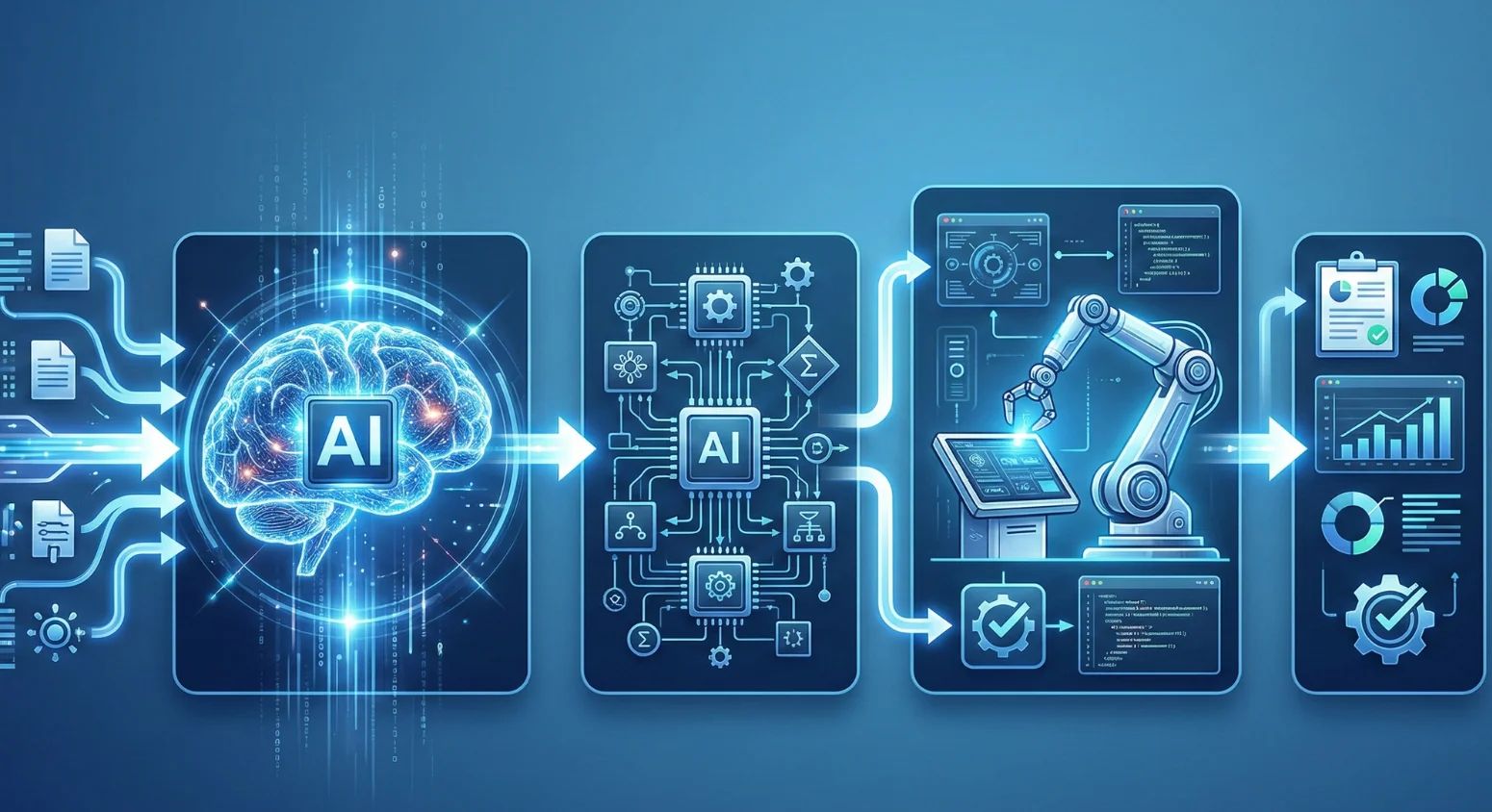
Most AI agents in 2026 are built on large language models (LLMs) like GPT-5, Gemini Ultra, or Claude 4 — but the model itself is just the brain. The agent architecture is what makes it act.
AI Agent Execution Loop — How It Works
Step 1: Receive Goal: The agent receives a task or goal from a user, system trigger, or another agent.
Step 2: Perceive Context: It reads available data — files, websites, databases, conversation history.
Step 3: Plan Actions: The LLM core reasons through the steps required to achieve the goal.
Step 4: Use Tools: It calls external tools: web search, code execution, email, calendar, APIs.
Step 5: Act & Observe: It executes actions, observes results, and adjusts if needed.
Step 6: Complete or Escalate: It finishes the task, reports back, or asks for human input only when stuck.
What Tools Do AI Agents Use?
In 2026, most capable AI agents have access to some combination of these tools:
- Web browsing and real-time search
- Code writing and execution environments
- File reading, writing, and management
- Email, calendar, and scheduling systems
- API calls to third-party services
- Memory systems (short-term session memory + long-term vector databases)
- Other AI agents (multi-agent orchestration)
Types of AI Agents: A 2026 Breakdown
Not all AI agents are the same. Here’s a clear taxonomy of the types you’ll encounter:
| Agent Type | How It Works | Real 2026 Example |
|---|---|---|
| Simple Reflex Agent | Acts on current input only; no memory or reasoning | Smart home thermostat that adjusts based on temperature reading |
| Model-Based Agent | Maintains internal state to understand context over time | AI (Artificial Intelligence)that tracks your conversation history to follow-up appropriately |
| Goal-Based Agent | Plans actions to achieve a defined goal | Travel agent AI that books flights, hotels, and cars for a trip |
| Utility-Based Agent | Optimizes for the best possible outcome among options | AI investment tool that weighs risk vs. return across a portfolio |
| Learning Agent | Improves performance over time through feedback and data | Personalized content recommendation engine that learns your taste |
| Multi-Agent System | Multiple agents collaborate, specialize, and hand off tasks | Enterprise AI where one agent researches, another drafts, another sends |
AI Agent vs. Chatbot vs. Automation: What’s the Difference?
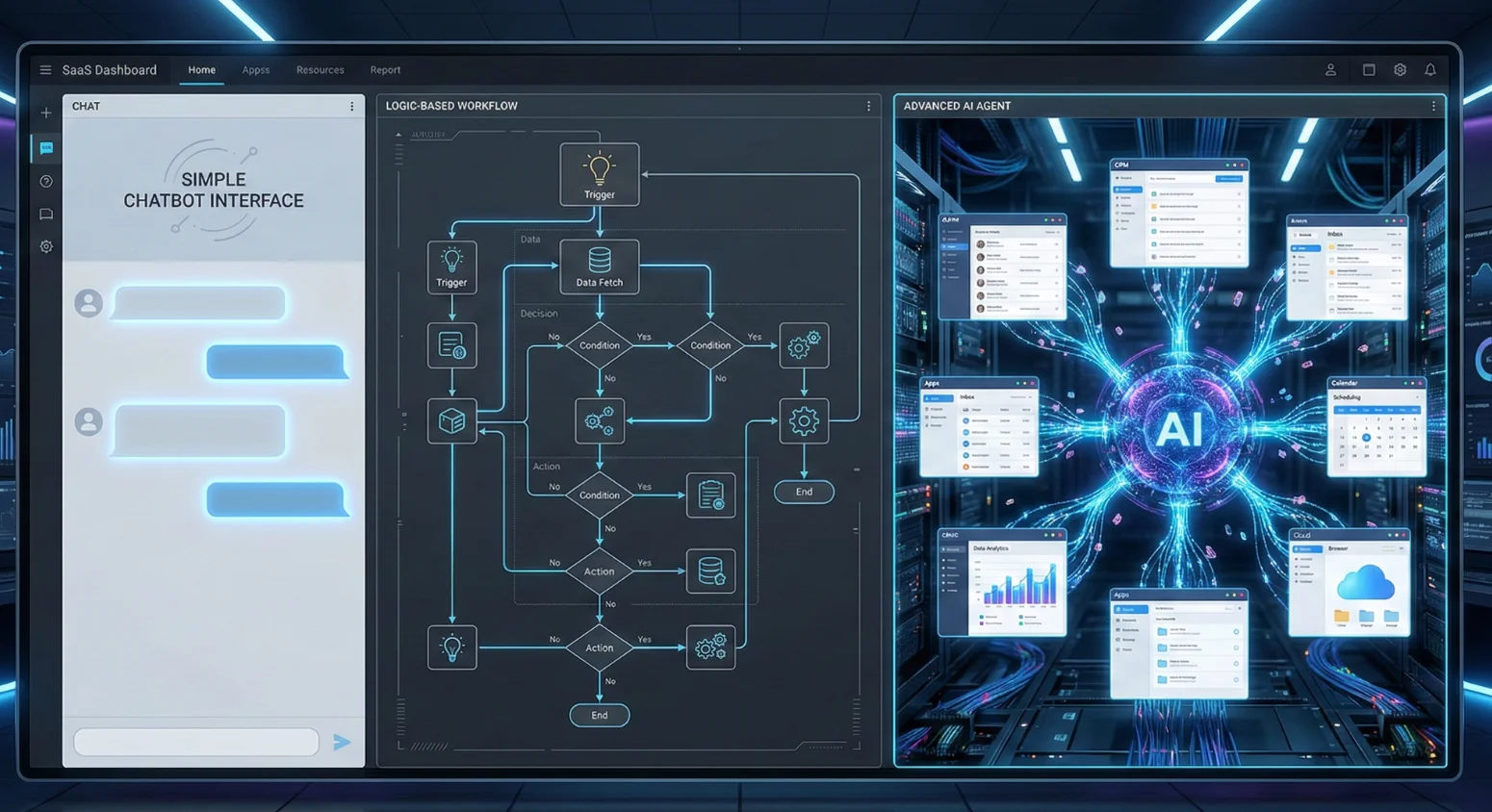
This is the most common point of confusion — and the most important to understand.
| Feature | Chatbot | RPA / Automation | AI Agent |
|---|---|---|---|
| Acts on goals | No | Partially | Yes |
| Multi-step reasoning | No | No | Yes |
| Uses external tools | Limited | Yes (rule-based) | Yes (intelligent) |
| Handles ambiguity | Poorly | No | Yes |
| Learns from feedback | Rarely | No | Yes (most) |
| Works autonomously | No | Partially | Yes |
| Can initiate actions | No | Triggered only | Yes |
| Examples | Customer FAQ bot | Invoice processing script | AI research assistant that books travel |
The One-Line Difference: A chatbot answers. Automation follows rules. An AI agent thinks, plans, and acts.
How Americans Are Using AI Agents in 2026

AI agents have crossed from novelty to utility. Here is where they are showing up in American life right now.
1. Workplace Productivity
American knowledge workers interact with AI agents an average of 14 times per workday in 2026, according to industry surveys from firms including Gartner and McKinsey. The most common uses:
- Email drafting, triage, and automated follow-up (used by 63% of US office workers with access)
- Meeting notes, summaries, and action item extraction
- Research compilation and report generation
- Calendar management and scheduling optimization
- Customer data analysis and CRM updates
2. Personal Finance & Banking
Every major US bank — JPMorgan Chase, Bank of America, Wells Fargo, and the major fintech platforms — now deploys AI agents behind the scenes.
- Fraud detection agents analyze thousands of variables per transaction in milliseconds
- Financial planning agents build personalized budget recommendations based on spending patterns
- Investment agents at platforms like Robinhood, Fidelity, and Betterment manage risk-adjusted rebalancing autonomously
- Loan underwriting agents process and assess applications, cutting approval times from days to minutes
3. Healthcare & Wellness
Healthcare is one of the fastest-growing sectors for AI agent deployment in the US. With ongoing physician shortages and rising administrative burden, AI agents are filling critical gaps:
- Prior authorization agents handle 30–40% of insurance submissions at major US hospital systems
- Symptom-checker agents triage patient concerns before doctor visits
- Medication management agents track adherence and flag potential interactions
- Mental health support agents (like Woebot’s platform) deliver CBT-based conversations at scale
4. E-Commerce & Retail
Retail AI agents have become invisible but essential. In 2026, over 70% of Fortune 500 US retailers use at least three embedded AI agents in their customer journey.
- Product recommendation agents with >40% higher conversion than rule-based systems
- Inventory and supply chain agents that autonomously reorder stock
- Customer service agents that handle refunds, replacements, and complaints without human escalation
- Personalized pricing agents that adjust offers based on demand, competition, and user behavior
5. Education
American students from K–12 through higher education now regularly interact with AI agents as learning tools.
- Personalized tutoring agents (Khan Academy’s Khanmigo is a flagship example) adapt to each student’s pace
- Essay feedback agents review and suggest improvements in real-time
- Admissions assistant agents guide students through college applications step-by-step
- Learning management system agents track progress and automatically recommend next content
6. Real Estate
US real estate has seen notable AI agent adoption at both the consumer and broker level.
- Property search agents surface listings based on nuanced criteria including commute times, school ratings, and investment yield
- Document review agents scan purchase agreements for red flags
- Virtual staging and photography agents reduce listing preparation time
- Mortgage comparison agents compare live rates across lenders in real-time
7. Home & Daily Life
Consumer-facing AI agents have become the new app category. Americans use dedicated AI agents for:
- Grocery and meal planning (agent learns dietary preferences, budgets, and sale cycles)
- Travel planning and booking (end-to-end trip management without 10 browser tabs)
- Home maintenance scheduling and contractor coordination
- News and content curation that builds a personalized daily briefing
- Smart home management agents that orchestrate lighting, security, temperature, and energy
Explore: AI for Small Business: Tools, Costs & ROI Guide 2026
Major AI Agent Platforms & Tools in 2026
Here are the most widely used AI agent platforms shaping American adoption:
| Platform / Tool | Best For | Key Strength |
|---|---|---|
| OpenAI Agents (GPT-5 + Tools) | Enterprise & developer use | Most powerful reasoning; broad tool ecosystem |
| Microsoft Copilot Agents | Microsoft 365 users, enterprises | Deep Office/Teams integration; workflow automation |
| Google Gemini Agents | Google Workspace users, Android | Best web & data grounding; multimodal |
| Anthropic Claude Agents | Research, writing, safety-critical tasks | Strong reasoning, long context, reliability |
| Salesforce Agentforce | CRM, sales, and customer service teams | Pre-built enterprise sales & support workflows |
| AutoGPT / CrewAI (open-source) | Developers, technical users | Fully customizable multi-agent pipelines |
| Perplexity AI | Research & knowledge work | Real-time web-grounded answers + citations |
| Zapier AI Agents | Non-technical business users | No-code workflow automation between 6,000+ apps |
Discover: Best AI Tools for Students
Benefits of AI Agents: Why They Matter
AI agents matter because they eliminate the gap between knowing what to do and doing it. They compress hours of work into minutes, operate 24/7 without fatigue, handle multi-step tasks that require judgment, and learn from feedback — making them dramatically more valuable than static automation tools.
| Benefit | What It Means in Practice |
|---|---|
| Time compression | Tasks that took hours (research, drafts, analysis) complete in minutes |
| 24/7 operation | AI agents don’t sleep, take breaks, or get distracted |
| Scalability | One agent can handle 1,000 simultaneous tasks; a human cannot |
| Consistency | No variance in quality due to fatigue, mood, or context-switching |
| Learning over time | Agents improve with use; they build a model of what “good” looks like for your workflow |
| Cost reduction | Routine knowledge work that previously required headcount can be handled at minimal marginal cost |
| Error detection | Agents flag inconsistencies and anomalies faster than human review cycles |
Risks & Limitations of AI Agents in 2026
AI agents are powerful. They are not perfect. These are the real limitations Americans and businesses face:
- Hallucination risk: Even advanced LLM-based agents can generate confident but incorrect information, especially with poor tool design
- Data privacy concerns: Agents that access personal data, email, and financial systems require robust security architecture
- Autonomy drift: Agents given broad autonomy can take unexpected actions that create downstream problems
- Bias reproduction: Agents trained on biased data reproduce those biases in recommendations and decisions
- Over-reliance: Heavy dependence on agents can erode human skills in the areas they automate
- Cost and complexity: Enterprise agent deployment is still expensive and requires skilled engineering teams
- Regulatory uncertainty: US regulators (FTC, SEC, FDA) are actively developing agent-specific guidance as of 2026
How to Get Started with AI Agents: A Step-by-Step Guide
Step 1: Identify a repetitive task: Pick one workflow you do 3–5 times per week that involves clear inputs and outputs (e.g., summarizing reports, drafting emails, scheduling).
Step 2: Choose the right platform: For non-technical users: Copilot, Zapier AI, or Google Gemini Workspace. For technical users: OpenAI Assistants API, LangChain, or CrewAI.
Step 3: Define the goal clearly: AI agents perform best when given a precise goal, a defined output format, and clear constraints on what they should not do.
Step 4: Connect your tools: Grant the agent access to the specific tools it needs. Email, calendar, your CRM — but limit access to what’s strictly necessary.
Step 5: Test with low-stakes tasks first: Run the agent on non-critical work before deploying on anything important. Review its outputs and correct mistakes.
Step 6: Provide feedback and iterate: Most platforms support feedback loops. Train the agent on what good outputs look like by reviewing and annotating its work.
Step 7: Scale gradually: Expand the agent’s scope incrementally. Add new tool access. Introduce multi-step complexity only once the basics are reliable.
Suggested Read: Impact of AI on Jobs: Skills for the AI Era
AI Agent Adoption in America: Key Statistics (2025–2026)
The following data points reflect industry research and published analyst estimates as of 2025–2026:
| Statistic | Source / Context |
|---|---|
| ~150M+ Americans interact with AI agents monthly in 2026 | Composite estimate from AI adoption surveys; includes embedded agents in banking, retail, and platforms |
| Global AI agent market: ~$20B in 2025, projected $100B+ by 2030 | Multiple analyst firms including Gartner, IDC, and MarketsandMarkets trajectory models |
| 65% of enterprise software companies now ship at least one agent feature | Forrester 2025 enterprise AI adoption report |
| AI agents reduce administrative healthcare costs by 20–30% in early deployments | McKinsey Health Institute 2025 analysis |
| Enterprises using agents report 40–60% reduction in time-to-complete for routine tasks | Composite from Salesforce, Microsoft, and Google Workspace productivity reports |
| Multi-agent AI use cases grew 380% year-over-year in enterprise deployments (2024–2025) | OpenAI platform usage trends and developer surveys |
| 78% of US adults are aware of AI assistants; ~45% have knowingly used an AI agent tool | Pew Research Center AI awareness surveys (2025 baseline estimate) |
Conclusion: The Agent Era Is Here — And It’s Just Getting Started
AI agents are not a future technology. They are a present reality that is already reshaping how Americans work, spend, and live.
From the fraud detection algorithm that silently protected your debit card this morning, to the AI tutoring system helping a student in Phoenix understand algebra, to the supply chain agent reordering inventory at a warehouse in Ohio — AI agents are already deeply woven into American life.
The next 24 months will be defined by three shifts: greater agent autonomy, multi-agent collaboration at scale, and the democratization of agent tools for everyday consumers and small businesses.
The Americans who understand AI agents today will be the ones who know how to use them strategically tomorrow. That’s the real competitive advantage in 2026 — not just knowing that AI agents exist, but understanding how they work and where they fit into your life and work.
Frequently Asked Questions
What is an AI agent in simple terms?
An AI agent is a software program that receives a goal, figures out the steps to reach it, uses tools like the internet or apps, and takes action — all with minimal human involvement. Think of it as a capable assistant that doesn’t just answer questions but actually completes tasks.
What is the difference between an AI agent and a chatbot?
A chatbot responds to one message at a time and doesn’t take independent action. An AI agent can set a plan, perform multiple steps, use external tools, and complete a task from start to finish. Chatbots are reactive. AI agents are proactive.
Are AI agents safe to use?
Most commercial AI agents from major providers are designed with safety guardrails, data privacy protections, and human-in-the-loop options. That said, agents with access to email, finances, or sensitive data require careful scoping, minimal necessary permissions, and human review of high-stakes actions. The risk profile depends entirely on how they’re designed and deployed.
Can AI agents work without human supervision?
Yes, in well-defined, low-risk contexts. Fully autonomous operation (sometimes called Level 4 or Level 5 agent autonomy) is possible but is typically reserved for repetitive, reversible tasks. For consequential decisions — financial transactions, medical recommendations, legal actions — human-in-the-loop checkpoints are still standard practice in 2026.
What is a multi-agent system?
A multi-agent system is a setup where multiple AI agents work together, each handling a specialized role. One agent might do research, another drafts content, another reviews it, and another publishes it. They communicate, pass results between each other, and often outperform a single general-purpose agent on complex tasks.
How do AI agents use memory?
AI agents can use two types of memory: session memory (what happened in the current conversation or task) and long-term memory stored in vector databases. Long-term memory allows agents to remember your preferences, past work, and context across separate sessions — making them more useful over time.
What are some free AI agents I can use today?
As of 2026, free or freemium AI agent tools include Microsoft Copilot (integrated into free Windows accounts), Google Gemini (with Google account), Perplexity AI (free tier), HuggingFace’s open-source agent demos, and AutoGPT via GitHub. Most have paid tiers for advanced features and higher usage limits.
Are AI agents the same as autonomous AI or AGI?
No. AI agents are specific software systems designed to complete defined tasks. Autonomous AI broadly refers to systems that operate without human direction. AGI (Artificial General Intelligence) refers to a hypothetical AI with human-level reasoning across all domains — which does not yet exist. Current AI agents are powerful but narrow tools, not AGI.


![50 Best Website Design Examples for Inspiration [2026]](https://ixieverse.com/wp-content/uploads/2026/08/Best-Website-Design-Examples-150x150.webp)
Add a Comment