
If you’ve searched on Google recently, you’ve noticed something different. Before the list of blue links, Google now serves a fully-written summary — a synthesized, AI-generated answer sitting at the top of the page.
That’s a Google AI Overview. And in 2026, it’s no longer an experiment. It’s the new standard for how the world’s most-used search engine delivers information.
Whether you’re an SEO professional, content marketer, business owner, or simply a curious searcher, understanding what AI Overviews are, how they work, and how to appear in them is now one of the most important skills in digital marketing.
This guide covers everything: the definition, the mechanics, the impact data, and the exact optimization strategies to win citations in this new AI-powered search era.
Quick Answer:
Google AI Overviews (AIOs) now appear in approximately 60% of US Google searches. For pages NOT cited, organic CTR drops 61%. For pages that ARE cited, traffic increases by 35%. They are powered by Google Gemini, synthesize 6–14 sources per answer, and appear above all other results. Your 2026 SEO goal: earn a citation, not just a ranking.
 ChatGPT
 Grok
Grok
 Claude
 Perplexity
 Google AI
- 1 What Are Google AI Overviews?
- Key Characteristics of Google AI Overviews
- 2 What Is the History of Google AI Overviews? (From SGE to Today)
- 3 How Do Google AI Overviews Work?
- 4 What Types of Queries Trigger Google AI Overviews?
- What This Means for You
- 5 How Do Google AI Overviews Affect SEO and Organic Traffic?
- The CTR Impact — What Happens to Clicks
- The Citation Advantage — Why Being Cited Changes Everything
- Can I Appear in Google AI Overviews Without Ranking #1?
- Who Gets Cited in AI Overviews?
- 6 Why Does Google Use AI Overviews?
- 7 What Is the Difference Between Google AI Overviews and Featured Snippets?
- 8 Google AI Overviews vs Perplexity vs ChatGPT Search
- 9 How Do You Get Your Website Cited in Google AI Overviews?
- Content Formatting for Maximum AI Extractability
- Technical Optimization Checklist for AI Overview Citations
- 10 How Do You Track Whether Your Website Is Cited in Google AI Overviews?
- 11 How Do You Opt Out of Google AI Overviews? (Users & Website Owners)
- For Users (Turn Off AI Overviews in Your Google Account)
- For Website Owners (Remove Your Content from AI Overviews)
- 12 Which Industries Are Most Affected by Google AI Overviews?
- 13 How Accurate Are Google AI Overviews?
- 14 What Is Google AI Mode and How Is It Different from AI Overviews?
- 15 Google AI Overviews for Students and Beginners: Plain-English Summary
- As a user of Google:
- As a student or job seeker building a website or blog:
- 16 Are Google AI Overviews Permanent? What This Means for Your SEO Strategy
- 17 Frequently Asked Questions
- What is a Google AI Overview in simple terms?
- How does Google AI Overviews work?
- Is Google AI Overviews the same as SGE?
- Does Google AI Overviews hurt organic traffic?
- What types of queries trigger Google AI Overviews?
- How do I get my website cited in a Google AI Overview?
- Can I opt out of Google AI Overviews?
- Can a small website or beginner blog appear in AI Overviews?
- How accurate are Google AI Overviews?
- What is Google AI Mode?
- Are Google AI Overviews available worldwide?
- Does adding schema markup really help get cited in AI Overviews?
- How do I track if my website is appearing in AI Overviews?
What Are Google AI Overviews?
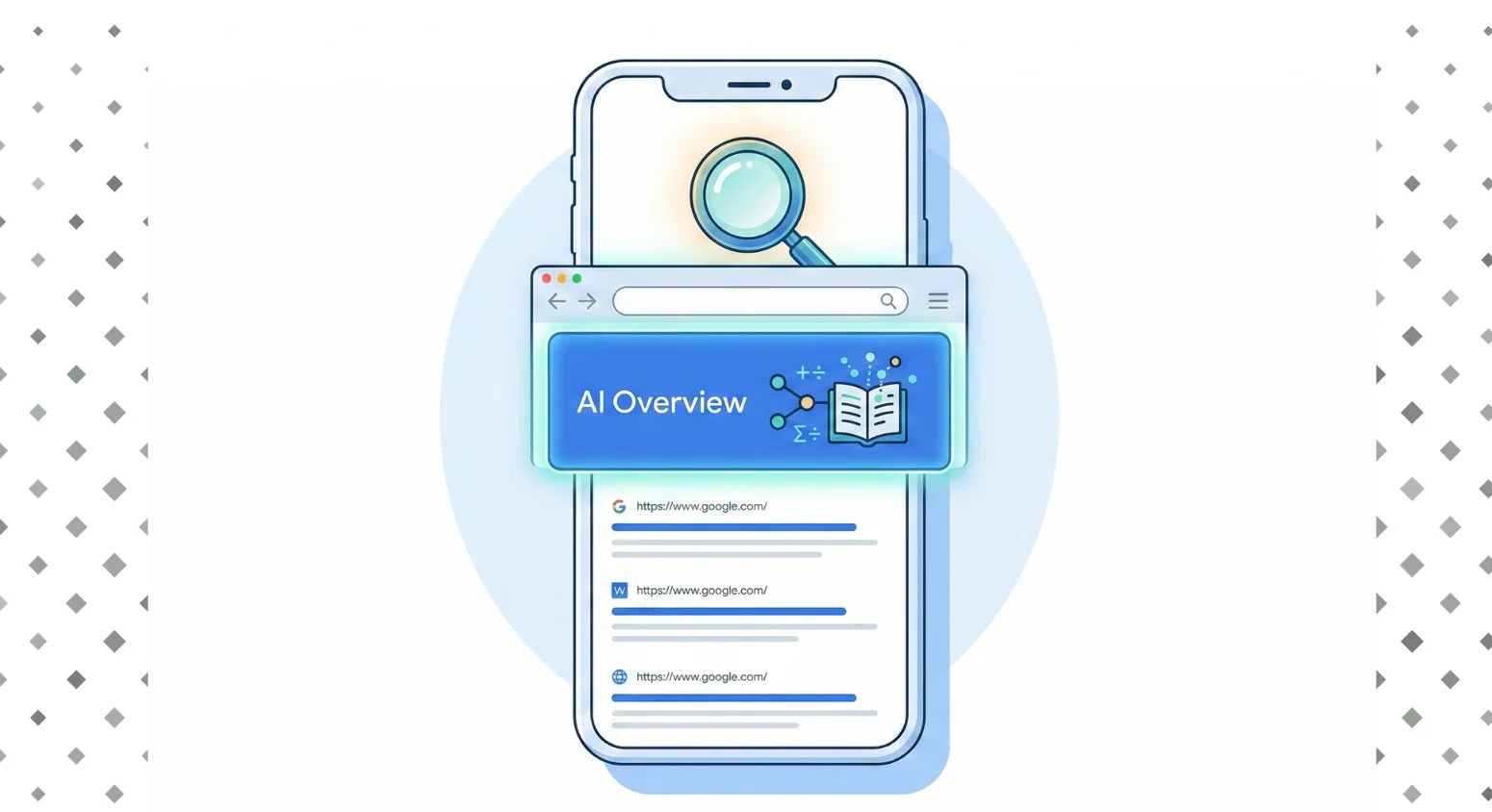
Google AI Overviews are AI-written answer summaries that appear at the very top of Google Search results — above all websites, ads, and links. Google’s Gemini AI reads multiple web pages, combines the most relevant information, and writes a direct answer for you. It then shows links to the sources it used. If your website is one of those sources, you get shown to millions of searchers. If it’s not, you become harder to find.
Think of it as Google becoming your research assistant. Instead of clicking five websites to find an answer, Google reads them for you and writes a summary right on the results page. The sources it read are shown as citation links — and being one of those citations is now one of the most valuable positions in all of search.
These summaries are also called AIOs, AI answers, or AI-generated overviews. They were previously called Search Generative Experience (SGE) during Google’s testing phase in 2023-2024 before their official launch in May 2024.
Key Characteristics of Google AI Overviews
Google AI Overviews have the following defining characteristics:
- Appear at position zero — above all organic results, featured snippets, and paid ads
- Generated by Google Gemini, Google’s multimodal large language model (LLM)
- Synthesize information from 6 to 14 web sources per summary
- Average approximately 169 words per response with 7 embedded citation links
- Present in approximately 60% of US Google searches as of late 2025
- Can include follow-up question suggestions, content carousels, and Google AI Mode links
- Can be accompanied by Google Ads when commercial intent is detected in the query
- Collapsible — users can minimize the AIO to see traditional search results
- Can be opted out of by website owners using nosnippet or max-snippet directives
What Is the History of Google AI Overviews? (From SGE to Today)
Google AI Overviews did not appear suddenly. Understanding the timeline explains why they have become so dominant — and why the pace of adoption in 2026 is accelerating.
| Date | Milestone |
|---|---|
| May 2023 | Google announces Search Generative Experience (SGE) at Google I/O — US-only beta |
| Late 2023 | SGE beta expands; SEO industry debates traffic and ranking implications |
| March–April 2024 | Broader rollout tests; first AI citation pattern data becomes available |
| May 2024 | SGE officially renamed ‘AI Overviews’; launched to all US users |
| Mid-2024 | International rollout begins; AIOs appear in 25%+ of US queries |
| Q1 2025 | AIO presence nearly doubles — from 6.49% to 13.14% of queries in one quarter (Semrush) |
| July 2025 | Peak AIO presence: ~25% of all tracked queries included an AI Overview |
| November 2025 | AIOs appear in ~60% of US searches after major rollout expansion |
| Early 2026 | BrightEdge: AIOs appearing in 48%+ of all tracked queries — 58% year-over-year increase |
| April 2026 | First randomized field experiment (Carnegie Mellon / ISB, SSRN) confirms AIO traffic impact |
| 2026 ongoing | Google AI Mode deepens conversational search; AIO scope expands into navigational queries |
How Do Google AI Overviews Work?

Google AI Overviews work by analyzing a search query, retrieving relevant web pages from Google’s existing index, and using the Gemini AI model to synthesize a direct answer from multiple sources. The system selects 6–14 high-authority pages, extracts key information, and generates a concise, cited summary displayed at position zero of the SERP — before all other results.
Here is the step-by-step process Google uses to generate an AI Overview:
- Query Analysis — Google identifies the search intent, key topic entities, and query complexity to determine whether an AI Overview is appropriate for this search.
- Web Crawl Retrieval (FastSearch + Query Fan-Out) — Google uses a technique called query fan-out to break one user query into multiple sub-queries, then rapidly retrieves top results for each. This is why AIO citations frequently come from pages that don’t rank on page one for your original query.
- Source Selection — Google’s Gemini model evaluates candidate pages using E-E-A-T signals, semantic completeness, schema markup, factual verifiability, and multi-modal content to select 6–14 citation sources.
- Synthesis & Generation — Gemini synthesizes information from selected sources into a coherent, natural-language summary. It does not copy text — it rewrites, combines, and condenses into a new answer.
- Citation Attribution — Each major claim within the AIO is linked to a source page, displayed as an expandable in-line citation panel that users can expand to see the full sources.
- Real-Time Display — The generated Overview is served at position zero of the SERP, before all other organic results, featured snippets, and ads.
Explore: 20 Best Free SEO Tools in 2026 (Tested, Ranked & Beginner-Friendly)
What Types of Queries Trigger Google AI Overviews?
Not every Google search produces an AI Overview. Google is selective — and understanding which queries trigger AIOs shapes your entire content strategy.
| Query Type | AIO Presence (2025–2026 Data) | Key Notes |
|---|---|---|
| Informational | 88–91% of all AIO triggers | Definitions, how-tos, explanations — the dominant AIO category |
| Commercial | 6–8% of AIO triggers | Product comparisons, ‘best X’ — growing throughout 2025 |
| Navigational | ~10%+ by late 2025 | Unexpected increase — brand searches now partially intercepted |
| Transactional | Less than 2% of AIO triggers | Buy-now queries mostly excluded; Shopping ads still served |
| YMYL (Health/Finance) | Up to 54% AIO share (healthcare up to 88%) | Highest saturation; medical credentials are non-negotiable to earn citations |
| Long-tail (8+ words) | 7x more likely to trigger AIO | Conversational and research queries strongly favor AI responses |
| Ecommerce/Shopping | 4–8% (declined from 29% at launch) | Google significantly pulled back on transactional shopping queries |
What This Means for You
Key takeaway for beginners: If you write content that answers questions (how-to guides, definitions, comparisons, explanations), you are writing in the category that triggers 88-91% of all AI Overviews. This is both the risk (AIOs may replace clicks) and the opportunity (get cited, earn more traffic).
How Do Google AI Overviews Affect SEO and Organic Traffic?
The CTR Impact — What Happens to Clicks
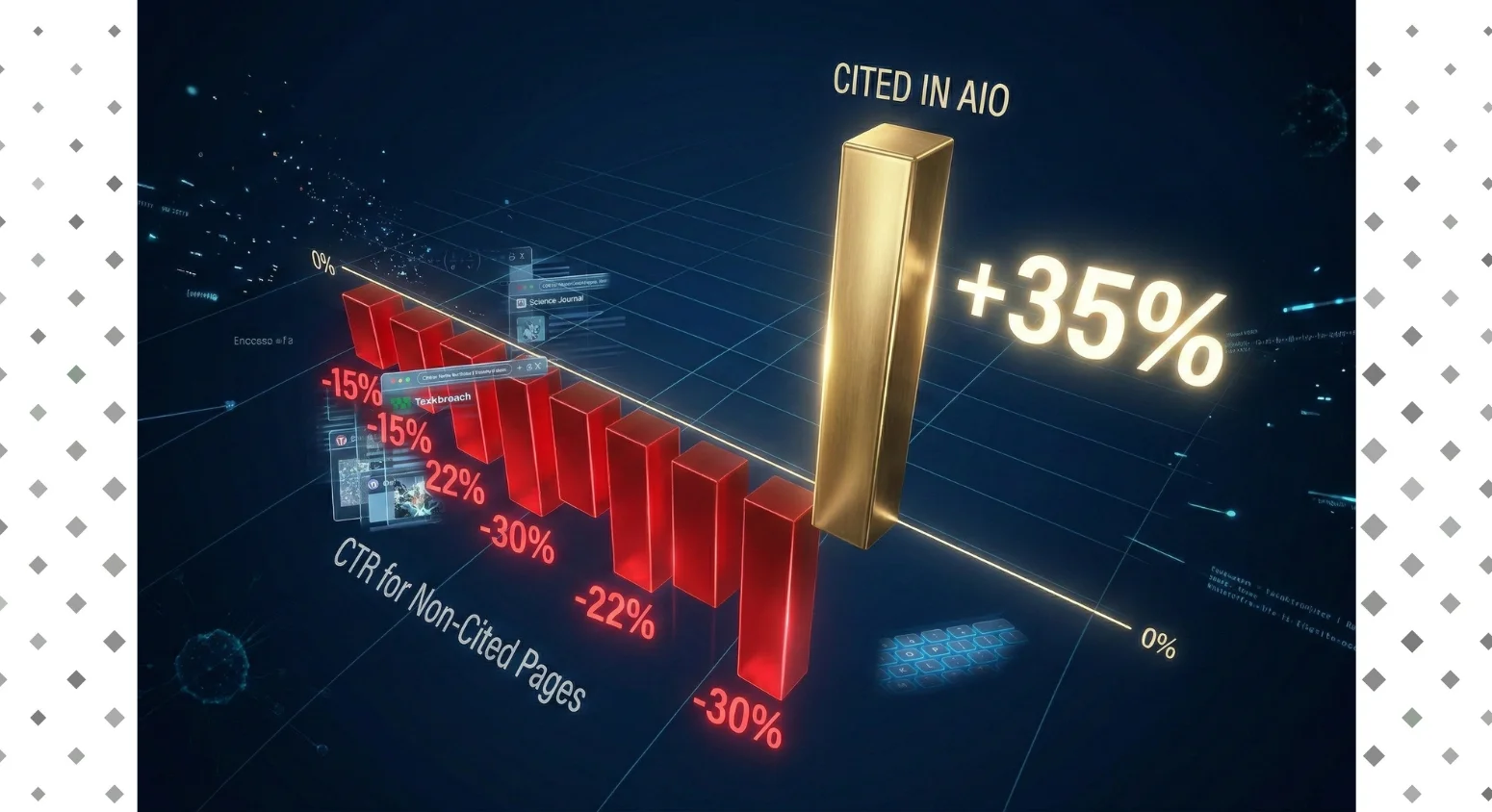
Organic CTR drops 61% on queries with AI Overviews — falling from 1.76% to 0.61% (Seer Interactive, September 2025, analyzing 3,119 informational queries across 42 organizations). The #1 organic position CTR falls from 7.3% to 2.6% when an AIO is present on the same SERP.
- Paid CTR also drops 68% on AIO queries — from 19.7% to 6.34% for the same dataset
- Users are 47% less likely to click a traditional organic result when an AI Overview answers the query
- Only approximately 8% of visits result in any click at all when an AIO is shown
- Session-ending zero-click behavior occurs 26% of the time with AIOs vs 16% without
The Citation Advantage — Why Being Cited Changes Everything
Pages cited inside Google AI Overviews earn 35% more organic clicks and 91% more paid clicks compared to non-cited competitors on the same query (Seer Interactive, 2025). One AI citation can outperform a #3 organic ranking in qualified traffic delivered.
Can I Appear in Google AI Overviews Without Ranking #1?
Yes — and this is one of the most important facts about AIO optimization. Nearly 47% of Google AI Overview citations come from pages ranked below position #5 in traditional search. One study found that 93.8% of AIO-cited sources do not appear on page one of organic results for the same query. AI Overviews select sources based on semantic completeness, E-E-A-T quality, and content structure — not raw ranking position.
Who Gets Cited in AI Overviews?
- 92.36% of AI Overview citations come from domains already in the organic top 10 — but not necessarily position #1
- 47% of AIO citations come from pages ranking below position #5 — proving AI uses different logic than traditional rankings
- Reddit (21%) and YouTube (18.8%) are cited most frequently — user-generated content and video rank highly with Google’s AI
- Pages with proper structured data markup are 3x more likely to earn AIO citations
- Multi-modal content (text + images + video) has the highest correlation with citation selection (r = 0.92, +156% selection rate)
Discover: Reddit SEO: How to Boost Your Visibility and Traffic
Why Does Google Use AI Overviews?
Google’s stated rationale is to help users get better answers faster — particularly for complex, multi-part questions where traditional blue-link results require significant effort to synthesize.
The strategic reality: Google is defending its search dominance against AI-native competitors. ChatGPT (projected 2.5 billion daily queries by 2026), Perplexity (780 million monthly queries as of May 2025), and AI-native browsers are capturing search intent that would historically have gone to Google. AI Overviews are Google’s defense — keeping users inside its ecosystem by delivering AI-grade answers within the familiar Google interface.
| Google’s Stated Intent | Observed User Reality (2025–2026 Data) |
|---|---|
| Help users get direct answers to complex queries | Users read AIO summaries and end searches 26% more often — zero-click rate increases |
| Surface authoritative, expert-vetted information | Healthcare and Finance see the highest AIO saturation — up to 88% and 54% of queries respectively |
| Reduce friction in the search experience | Paid CPCs hit a 6-year high as clicks become rarer and more commercially valuable |
| Complement — not replace — traditional results | Position #1 organic CTR dropped from 7.3% to 2.6% when an AIO is present on the same SERP |
What Is the Difference Between Google AI Overviews and Featured Snippets?
| Factor | Featured Snippets | Google AI Overviews |
|---|---|---|
| Source | Extracted from ONE URL | Synthesized from 6–14 sources |
| Generation Method | Text extracted directly from a single page | AI-generated and rewritten by Google Gemini |
| Citations | Single source attribution | Multiple in-line citation links |
| Typical Length | 40–60 words | ~169 words average |
| SERP Position | Position zero | Position zero (appears ABOVE featured snippets) |
| Opt-Out Option | nosnippet meta tag | Google Search Console opt-out tool |
| AI Model Used | None — direct extraction only | Powered by Google Gemini |
| Year Launched | 2014 | May 2024 (as ‘AI Overviews’) |
Google AI Overviews vs Perplexity vs ChatGPT Search
| Factor | Google AI Overviews | Perplexity AI | ChatGPT Search |
|---|---|---|---|
| Platform | Google Search | Perplexity.ai | ChatGPT (OpenAI) |
| User Access | Free — built into Google | Free + Pro tier | Free + Plus tier |
| Citations Per Answer | 6–14 inline links | Numbered citations, diverse sources | Inline links with hover previews |
| Source Diversity | 58.49% domain repeat rate | 25.11% repeat rate — more diverse | Moderate diversity |
| Monthly Volume | Billions of queries | 780M queries/month (May 2025) | ~2.5B queries/day projected 2026 |
| Ads Integration | Yes — AIO Ads for commercial queries | Sponsored answers (limited) | No ads currently |
| Optimization Focus | Schema, E-E-A-T, semantic completeness | Authoritative sources, fresh content | Credibility, entity clarity |
Discover: Claude vs Perplexity: Best AI for Research & Writing
How Do You Get Your Website Cited in Google AI Overviews?
Getting cited in an AI Overview is now the primary SEO objective for informational content. Here is the proven 7-factor framework based on analysis of 15,847 AI Overview results across 63 industries.
| Factor | Correlation / Impact | Plain-English Explanation |
|---|---|---|
| Semantic Completeness | r = 0.87 (strongest predictor) | Each section of your content should fully answer the question on its own — no assuming the reader read the previous section |
| Multi-Modal Content | r = 0.92 / +156% selection rate | Combine text with images, video embeds, and structured data — content with multiple formats is far more likely to be cited |
| Factual Verification | r = 0.89 / +89% citation probability | Back every major claim with a link to the original study or data source — AI systems check cross-references |
| Vector Embedding Alignment | r = 0.84 | Cover related concepts thoroughly around your main topic — AI ranks by meaning, not just by keywords |
| E-E-A-T Signals | 96% of AIO citations require this | Show who wrote the content, their credentials, when it was reviewed, and what experience backs the claims |
| Entity Knowledge Graph Density | 4.8x citation boost | Reference 15+ related concepts, people, tools, and technologies — and use schema to map those relationships |
| Structured Data Markup | 3x citation likelihood / +73% probability | Implement FAQ, HowTo, Article, and Breadcrumb schema on every page targeting AIO citations |
Practical rule of thumb: Before publishing any content, ask: ‘Could Google’s AI pull a clean, standalone answer from this section?’ If the answer requires reading the surrounding paragraphs to make sense, rewrite it. Every section should work as an independent answer block.
Suggested Read: Best Digital Marketing Software: 30+ Tools to Grow Your Business
Content Formatting for Maximum AI Extractability
- Front-load your answer — put the core answer in the first 2 sentences of every major section
- Write self-contained paragraphs — each should make sense without the reader having read the previous section
- Use question-based H2 and H3 headings — mirrors how AI systems parse content structure
- Keep paragraphs to 2–3 sentences — ideal chunk size for AI extraction and synthesis
- Use comparison tables — Google frequently cites structured tabular data in AI Overviews
- Add a 40–60 word definition block at the start of each major concept section
- Add FAQ sections with direct 60-80 word answers — directly feeds PAA boxes and AIO responses
Technical Optimization Checklist for AI Overview Citations
- Implement FAQPage schema markup for every Q&A content block
- Add Article schema with author, datePublished, and dateModified properties
- Add HowTo schema for all step-based instructional content
- Include Breadcrumb schema for site architecture clarity
- Add Speakable schema on key definition paragraphs for voice/AI assistant optimization
- Ensure all target pages are crawlable and indexed — Google cannot cite what it cannot access
- Optimize Core Web Vitals — page load speed is a trust signal for AIO source selection
- Use entity sameAs markup to connect content to Knowledge Graph representations
| Need to add schema to your pages? Use IxieVerse’s Free Schema Markup Generator to create valid JSON-LD for FAQs, HowTos, and Articles in seconds — no coding required. |
How Do You Track Whether Your Website Is Cited in Google AI Overviews?
Most standard rank tracking tools do not measure AI Overview citations. You need a different approach:
- Manual spot checks — search your target keywords in Google and look for the AIO panel; check if your domain appears in the citation links
- Google Search Console — monitor impressions and CTR for pages where you suspect AIO competition; a sudden drop despite stable rankings often signals AIO displacement
- AI visibility tools — platforms like Semrush (AI Visibility Toolkit), Nightwatch, and emerging GEO tracking tools specifically monitor AIO citation appearances
- UTM-tagged links — if you’re cited in an AIO, add UTM parameters to key landing pages to identify AIO-referred sessions in Google Analytics 4
| Track your AIO-driven traffic precisely. Use IxieVerse’s Free UTM Builder to tag your links and see AI Overview-referred sessions clearly in Google Analytics 4. |
How Do You Opt Out of Google AI Overviews? (Users & Website Owners)
Both individual users and website owners have options for controlling AI Overview appearances.
For Users (Turn Off AI Overviews in Your Google Account)
- Open Google Search and click ‘Settings’ (bottom right of results page)
- Select ‘Search Settings’ from the menu
- Scroll to ‘AI Overview and more’ section
- Toggle off ‘Show AI Overviews’ and save your preferences
For Website Owners (Remove Your Content from AI Overviews)
- Add the nosnippet meta tag to prevent your content from appearing in AIOs: <meta name=”robots” content=”nosnippet”>
- Use the max-snippet directive to limit how much text Google extracts: <meta name=”robots” content=”max-snippet:0″>
- Use the data-nosnippet HTML attribute on specific page sections you want excluded from AI summaries
Important trade-off: Opting out of AI Overviews also suppresses traditional featured snippets and removes your citation potential entirely. Given that cited pages earn 35% more organic clicks and 91% more paid clicks, most publishers should focus on optimization rather than opt-out — unless content sensitivity (medical liability, legal advice, financial guidance) makes exclusion appropriate.
| Want precise control over what Google crawls and extracts from your site? Use IxieVerse’s Free Robots.txt Generator to create a clean, error-free robots.txt file in under a minute — no technical knowledge needed. |
Which Industries Are Most Affected by Google AI Overviews?
| Industry | AIO Presence (Feb 2026) | Key Insight for Marketers |
|---|---|---|
| Healthcare & Medical | 88% of queries (BrightEdge, Feb 2026) | Highest saturation of all verticals — medical credentials and clinical citations are non-negotiable |
| Education | 83% of queries | Rapidly growing — directly affects students researching topics and job seekers learning skills |
| B2B Technology | 82% of queries | Thought leadership content is increasingly cited — first-mover authority advantage still available |
| Restaurants & Food | 78% of queries | Recipe, ingredient, and technique queries intercepted — recipe schema is now critical |
| Insurance | ~63% of queries | Brand visibility benefits established institutions — smaller brands can win niche, specific queries |
| Finance & Banking | High and growing | Credibility signals disproportionately favor established financial institutions |
| Technology / Science | 25.96% keyword saturation | Science and Computers & Electronics lead all non-health tech verticals |
| Ecommerce | 4–8% (declined from 29%) | Google significantly pulled back on transactional queries — focus AIOs on research-phase content only |
How Accurate Are Google AI Overviews?
This is one of the most common questions about AI Overviews — and a critical one for students and researchers relying on them for information.
Google AI Overviews are generally accurate for well-documented, established topics. However, several accuracy limitations are well-documented:
- Hallucinations — AI systems occasionally generate plausible-sounding but incorrect information, particularly for niche topics or recent events
- Source quality dependency — AIO accuracy is only as good as the sources it cites; if top-ranking sources contain errors, AIOs can repeat them
- Outdated information — AIOs may surface older data if fresher sources aren’t highly ranked or structured
- Misattribution risk — synthesizing multiple sources can occasionally blend information from different contexts incorrectly
Recommendation for students: Always click through to the cited sources in an AI Overview to verify information, especially for academic research, health topics, and financial decisions. Use AIOs as a starting point, not a final source.
Also Read: How to Use AI to Make Money Online
What Is Google AI Mode and How Is It Different from AI Overviews?
Google AI Mode is a separate, conversational search experience accessible via a dedicated ‘AI Mode’ tab in Google Search. Unlike AI Overviews (which appear automatically in standard results), AI Mode allows multi-turn, back-and-forth conversations with Google’s AI — similar to how you might use ChatGPT. AI Mode goes deeper on complex topics and uses a more advanced version of Gemini than standard AI Overviews.
| Factor | AI Overviews | Google AI Mode |
|---|---|---|
| Where It Appears | Automatically in main search results | Separate ‘AI Mode’ tab — user must click in |
| Interaction Style | One-shot answer per query | Multi-turn conversational (follow-up questions) |
| Depth of Response | ~169 words average | Much longer, more detailed responses |
| Availability | Available to most US users since 2024 | Rolling out in 2025–2026; broader access expanding |
| SEO Implication | Content cited in AIOs may also feed AI Mode | Optimize content for deep semantic completeness |
Google AI Overviews for Students and Beginners: Plain-English Summary
If you’re a student, job seeker, or someone new to this topic, here is everything that matters in simple terms:
As a user of Google:
- Google now shows an AI-written summary at the top of many searches — this is an AI Overview
- It’s usually accurate for common topics, but always verify the cited sources for important research
- You can turn it off in Google Settings if you prefer the traditional list of website links
- For academic research, click through to the source websites — don’t cite ‘Google AI Overview’ as a source
As a student or job seeker building a website or blog:
- AI Overviews reduce the chances that people click through to websites — this is why many blogs are losing traffic
- To get traffic in 2026, you need your content to be CITED inside an AI Overview, not just ranked
- The best way to get cited: write clear, well-structured content that fully answers specific questions
- Add FAQ sections to your content — these are the most commonly extracted elements in AI Overviews
- Use free tools like IxieVerse’s Schema Markup Generator to add the technical signals that increase your citation chances
Are Google AI Overviews Permanent? What This Means for Your SEO Strategy
Google AI Overviews are not a temporary experiment. By 2026, they appear in approximately 60% of US searches and are expanding into new query types — including navigational, commercial, and industry-specific searches — every quarter.
The search bargain that sustained the internet for two decades has changed. Previously: create content, rank on Google, earn clicks. Now: create content, earn a citation in Google’s AI answer, and earn clicks from users who want to go deeper.
The pages that thrive in 2026 are not necessarily the ones ranking #1. They are the ones that:
- Write self-contained, directly answering content that AI can extract without context
- Back every claim with verifiable, linked sources
- Demonstrate genuine author expertise and experience
- Use structured data to make their content machine-readable
- Offer something Google’s AI answer can’t: deeper expertise, original tools, actionable resources
The shift is permanent. The strategy is clear. Start optimizing for citations today.
Frequently Asked Questions
What is a Google AI Overview in simple terms?
A Google AI Overview is an AI-written summary that appears at the top of Google Search results. Google’s Gemini AI reads multiple websites and writes a direct answer with source links — so users can get information without clicking through to separate pages. It appears above all other results, including paid ads and organic links.
How does Google AI Overviews work?
Google AI Overviews function by analyzing your search query, retrieving relevant pages from Google’s index, and using the Gemini AI model to synthesize information from approximately 6–14 sources into a concise summary. This process uses a technique called ‘query fan-out’ to break your query into multiple sub-queries, gather results for each, and compile the best answer — displayed in real time at the top of the SERP.
Is Google AI Overviews the same as SGE?
No, but they are directly connected. Search Generative Experience (SGE) was the beta name used from May 2023 through early 2024. When Google officially launched the feature to all US users in May 2024, it was rebranded as AI Overviews. The core technology and Gemini-powered functionality remain the same — AI Overviews is simply the production release of what was tested as SGE.
Does Google AI Overviews hurt organic traffic?
It depends entirely on whether your content is cited. For non-cited pages, organic CTR drops by 61% on queries where an AI Overview appears — falling from 1.76% to 0.61% (Seer Interactive, 2025). However, pages cited inside an AI Overview earn 35% more organic clicks and 91% more paid clicks compared to non-cited competitors. The goal in 2026 is citation optimization, not just ranking.
What types of queries trigger Google AI Overviews?
Informational queries account for 88–91% of all AI Overview triggers — definitions, how-to guides, explanations, and comparison searches. Commercial queries represent 6–8%, while navigational queries reached 10%+ by late 2025. Long-tail searches of 8 or more words are 7 times more likely to trigger an AI Overview. Purely transactional buy-now queries rarely trigger AIOs.
How do I get my website cited in a Google AI Overview?
The top 7 citation factors are:
(1) Semantic completeness — self-contained answers per section
(2) Multi-modal content — text + images + video
(3) Factual verification — claims backed by linked sources
(4) E-E-A-T signals — author credentials, review dates, firsthand experience
(5) Entity density — 15+ related concepts covered
(6) Structured data — FAQ, HowTo, and Article schema
(7) Vector embedding alignment — deep topical coverage rather than keyword matching.
Can I opt out of Google AI Overviews?
Featured snippets extract text directly from one URL and display it at position zero. AI Overviews use Google’s Gemini model to synthesize and rewrite information from 6–14 sources into a new AI-generated answer — also at position zero, but appearing above featured snippets. AIOs average 169 words vs 40–60 words for featured snippets, include multiple citation links, and represent fundamentally different content aggregation logic.
Can a small website or beginner blog appear in AI Overviews?
Yes. Research shows that 93.8% of AI Overview citations come from sources outside the first page of organic results for the same query. What matters more than domain authority or ranking position is content quality: clear answers, structured formatting, factual citations, and schema markup. A well-structured beginner blog that fully answers a specific question can earn an AIO citation that a larger site with shallow content cannot.
How accurate are Google AI Overviews?
Google AI Overviews are generally accurate for well-documented, widely covered topics. However, AI systems can hallucinate — occasionally generating plausible-sounding but incorrect information — particularly for niche, recent, or complex topics. Students and researchers should always click through to the cited source pages to verify information before using it academically. Use AI Overviews as a discovery starting point, not as a citable source.
What is Google AI Mode?
Google AI Mode is a separate conversational search experience accessed via a dedicated ‘AI Mode’ tab in Google Search. Unlike standard AI Overviews — which appear automatically in regular search results — AI Mode allows multi-turn conversations with Google’s Gemini AI, similar to using ChatGPT. It produces longer, more detailed responses and is designed for complex, multi-step research queries. It is rolling out broadly in 2025–2026.
Are Google AI Overviews available worldwide?
Google AI Overviews were first launched in the US in May 2024 and have since expanded internationally. By 2026, they are available in over 100 countries and multiple languages. However, presence rates vary significantly by country and language — US, UK, Australia, and English-language markets have the highest AIO prevalence. Local language optimization and regional E-E-A-T signals affect citation eligibility in non-English markets.
Does adding schema markup really help get cited in AI Overviews?
Yes — significantly. Pages with structured data markup are 3x more likely to earn AI Overview citations than pages without schema. FAQPage schema directly feeds the question-answer format Google’s AI prefers for AIO generation. HowTo schema helps Google understand sequential instructional content. Article schema with proper author and dateModified properties strengthens E-E-A-T signals. Implement schema via Rank Math or Google’s recommended JSON-LD format.
How do I track if my website is appearing in AI Overviews?
Standard rank tracking tools do not capture AIO citations. Track appearances using: (1) Manual searches — search your target keywords and check AIO citation panels for your domain
(2) Google Search Console — sudden CTR drops despite stable impressions often signal AIO displacement
(3) AI visibility platforms — Semrush AI Visibility Toolkit, Nightwatch, and GEO-specific tools track AIO mentions
(4) UTM-tagged links — identify AIO-referred sessions in Google Analytics 4 by adding UTM parameters to key pages.



Add a Comment