Running a small business in 2026 means competing against companies using AI to respond faster, market smarter, and operate leaner. If you’re still doing everything manually — writing follow-up emails by hand, guessing inventory levels, or waiting days to review your financials — you’re working harder than your competitors, not smarter.
This guide explains what AI for small business actually means in plain English, which tools are worth paying for, what they cost, and exactly how to implement them without wasting money. Whether you run a restaurant, a service firm, a retail shop, or you’re a solo operator — there’s a practical AI solution for your situation.
Quick Answer:
AI for small business means using software that automates tasks, predicts outcomes, and personalizes customer experiences — without a tech team. In 2026, 72% of US small businesses use at least one AI tool (Freshworks, 2025). The average small business spends $200–$500/month on AI and sees 3x–7x ROI within 6 months. Start with one tool, one problem, and measure results before scaling.
Best starting tools: ChatGPT, HubSpot AI CRM, QuickBooks Intuit Assist, Tidio chatbot, Jasper AI
 ChatGPT
 Grok
Grok
 Claude
 Perplexity
 Google AI
- 1 What Is AI for Small Business?
- 2 Why AI Is No Longer Optional for Small Business in 2026
- 3 Top Benefits of AI for Small Business (With Real Numbers)
- 4 Best AI Tools for Small Business in 2026 (Named, Priced & Compared)
- 5 What Are the Risks of AI for Small Businesses?
- 6 AI by Industry: Real Use Cases for Small Businesses
- 7 How to Implement AI in Your Small Business: Step-by-Step
- Step 1: Identify Your Biggest Bottleneck (Time: 1 hour)
- Step 2: Match the Bottleneck to an AI Category (Time: 30 minutes)
- Step 3: Start With a Free or Trial Plan (Time: 1-2 days setup)
- Step 4: Run a 30-60 Day Controlled Test (Time: Ongoing)
- Step 5: Train Your Team (Time: 1-2 hours)
- Step 6: Measure ROI and Scale (Time: Monthly review)
- 8 What Is the ROI of AI for Small Business?
- 9 Is AI Right for Your Small Business? A Quick Checklist
- 10 Common Mistakes Small Businesses Make With AI
- 11 The Future of AI for Small Business (2026–2030)
- 12 Conclusion
- 13 FAQs
- 1. What is AI for small business in simple terms?
- 2. How much does AI cost for a small business?
- 3. What are the best AI tools for small business?
- 4. How can AI improve small business revenue?
- 5. Is AI worth it for small businesses?
- 6. How do I implement AI in my small business?
What Is AI for Small Business?
AI for small business is software that analyzes data, automates repetitive tasks, and makes predictions to help business owners save time, reduce errors, and grow revenue. It includes chatbots, CRM tools, marketing automation, and accounting software — most of which requires no coding to use.
Most small business owners picture expensive labs and data science teams when they hear ‘AI.’ The reality in 2026 is that AI is built into the tools you likely already pay for — your email platform, your accounting software, your CRM. You may already be using it.
Here’s the simplest breakdown of terms you’ll see in this guide:
| Term | What It Means for Your Business |
| AI (Artificial Intelligence) | Software that learns from data and improves over time — predicts, recommends, and automates |
| Machine Learning | A type of AI that gets smarter with use — e.g., your CRM learning which leads are most likely to close |
| Automation | Rules-based repetition — e.g., automatically sending a receipt after purchase. Not AI, but often paired with it |
| Generative AI | AI that creates content — writing, images, code. Tools like ChatGPT and Jasper are examples |
| AI Agent | AI that takes independent actions across multiple steps — e.g., researching, writing, and sending an email autonomously |
Why AI Is No Longer Optional for Small Business in 2026
According to a 2025 Freshworks survey of 1,200 small businesses, 72% of US SMBs now use at least one AI-powered tool — up from 48% in 2024. That’s not a trend. That’s a new competitive baseline.
What’s changed is cost and accessibility. Three years ago, AI required developers and enterprise budgets. Today:
- ChatGPT Business costs $25/month and replaces hours of manual content and research work
- Google Gemini is now bundled free into every Google Workspace plan
- QuickBooks AI (Intuit Assist) auto-categorizes transactions with 92% accuracy at $35/month
- AI voice agents handle after-hours calls for $0.07–$0.12 per minute vs. $1.50–$3.00 for an answering service
Top Benefits of AI for Small Business (With Real Numbers)
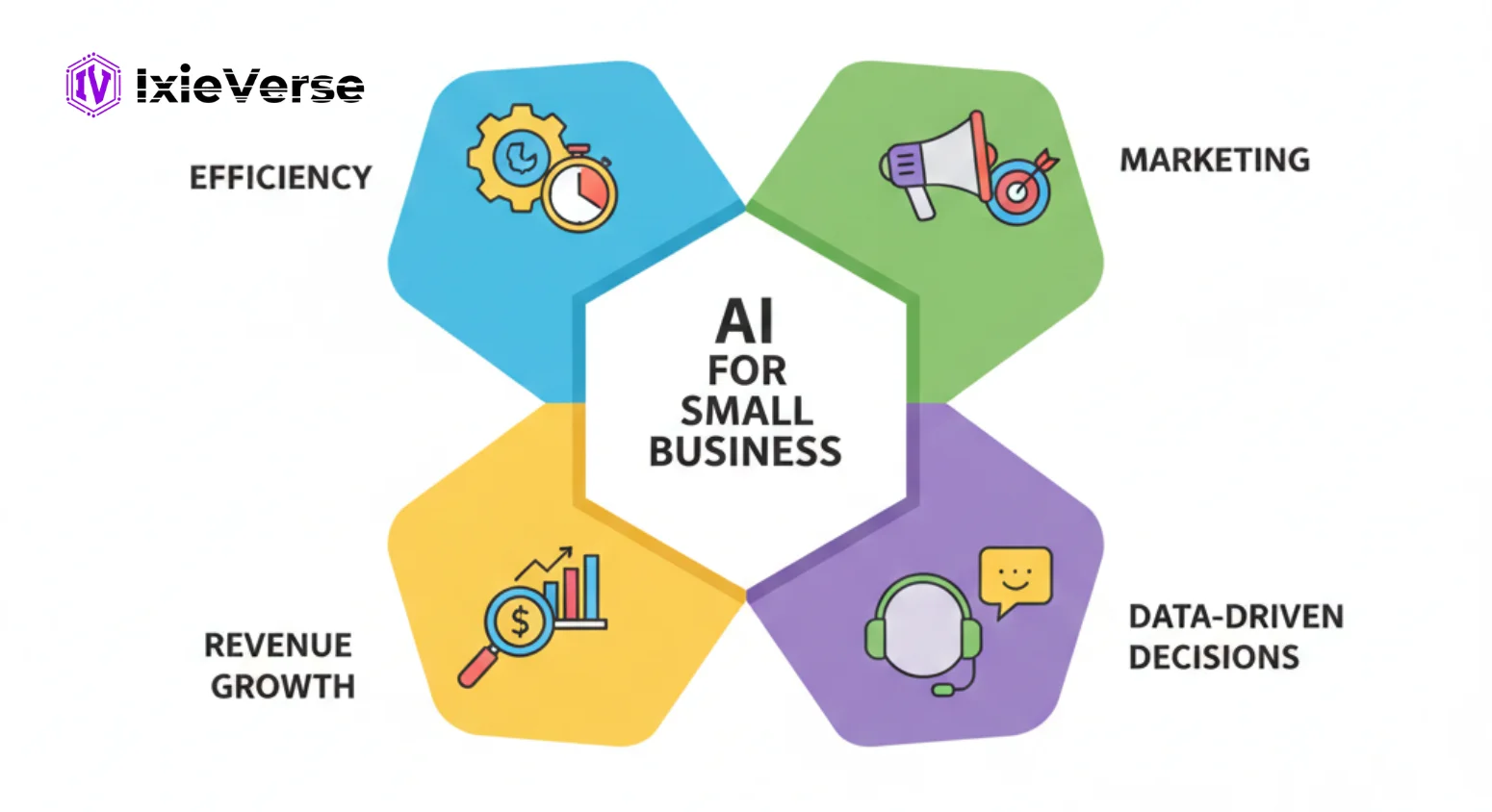
Here’s what properly implemented AI delivers, with data from McKinsey’s 2025 SMB Technology Report and Freshworks’ SMB survey:
| Benefit | What It Looks Like | Avg. Impact |
| Time Savings | Automated email follow-ups, scheduling, invoicing | 12–15 hrs/week saved |
| Cost Reduction | Fewer support staff hours, reduced ad waste | 20–30% operational cost drop |
| Revenue Growth | Better lead targeting, higher retention | 10–30% revenue increase in Year 1 |
| Customer Service | 24/7 chatbot handles FAQs, routes complex issues | 40% reduction in support load |
| Marketing Efficiency | AI-optimized email subject lines, ad targeting | 20–35% better open rates |
| Financial Accuracy | Auto-categorization, fraud alerts, cash flow forecasts | 50%+ billing time reduction |
Best AI Tools for Small Business in 2026 (Named, Priced & Compared)
The following table covers the most widely used AI tools by small businesses in 2026, organized by use case. All pricing reflects plans as of early 2026.
| Category | Tool | Starting Price | Best For | Free Tier? |
| AI Assistant | ChatGPT (OpenAI) | $20/mo (Plus) | Content, research, strategy, customer emails | Yes |
| AI Assistant | Claude (Anthropic) | $20/mo (Pro) | Long documents, analysis, writing | Yes |
| AI Chatbot | Tidio | Free–$29/mo | Website customer service, lead capture | Yes |
| AI Chatbot | Intercom Fin | $39/mo+ | Advanced support automation | No |
| CRM AI | HubSpot AI | Free–$800/mo | Lead scoring, email automation, sales forecasting | Yes |
| CRM AI | Zoho CRM AI (Zia) | $14/mo/user | Sales predictions, anomaly detection | Free tier |
| Marketing AI | Jasper AI | $49/mo (Pro) | Blog posts, ad copy, social content | 7-day trial |
| Marketing AI | Mailchimp AI | Free–$20/mo | Email optimization, audience segmentation | Yes |
| Accounting AI | QuickBooks Intuit Assist | $35/mo | Auto-categorization, cash flow forecasts | No |
| Accounting AI | FreshBooks AI | $19/mo | Invoicing, expense tracking, freelancers | 30-day trial |
| Scheduling AI | Calendly AI | Free–$16/mo | Automated booking, reminders, no-shows | Yes |
| Content AI | Copy.ai | Free–$49/mo | Templates, workflows, bulk content | Yes |
| Voice AI | Bland AI | $0.09/min | After-hours phone calls, appointment booking | Trial |
What Are the Risks of AI for Small Businesses?
The main risks of using AI in a small business are data privacy exposure, over-reliance on automation without human oversight, tool costs adding up with low ROI, and employee resistance. These are manageable with the right vendor choice, clear processes, and gradual implementation.
- Data privacy: AI tools process customer data. Always choose GDPR/CCPA-compliant platforms and review data storage policies.
- Over-automation: AI chatbots that can’t escalate to humans frustrate customers. Always include a human handoff option.
- Tool bloat: Signing up for too many tools without measuring ROI wastes budget fast. Start with one, prove it works.
- Hallucinations: Generative AI tools like ChatGPT can produce confident but wrong information. Always review AI-generated content before publishing.
- Employee resistance: Staff who feel replaced by AI disengage. Frame AI as an assistant, not a replacement.
AI by Industry: Real Use Cases for Small Businesses
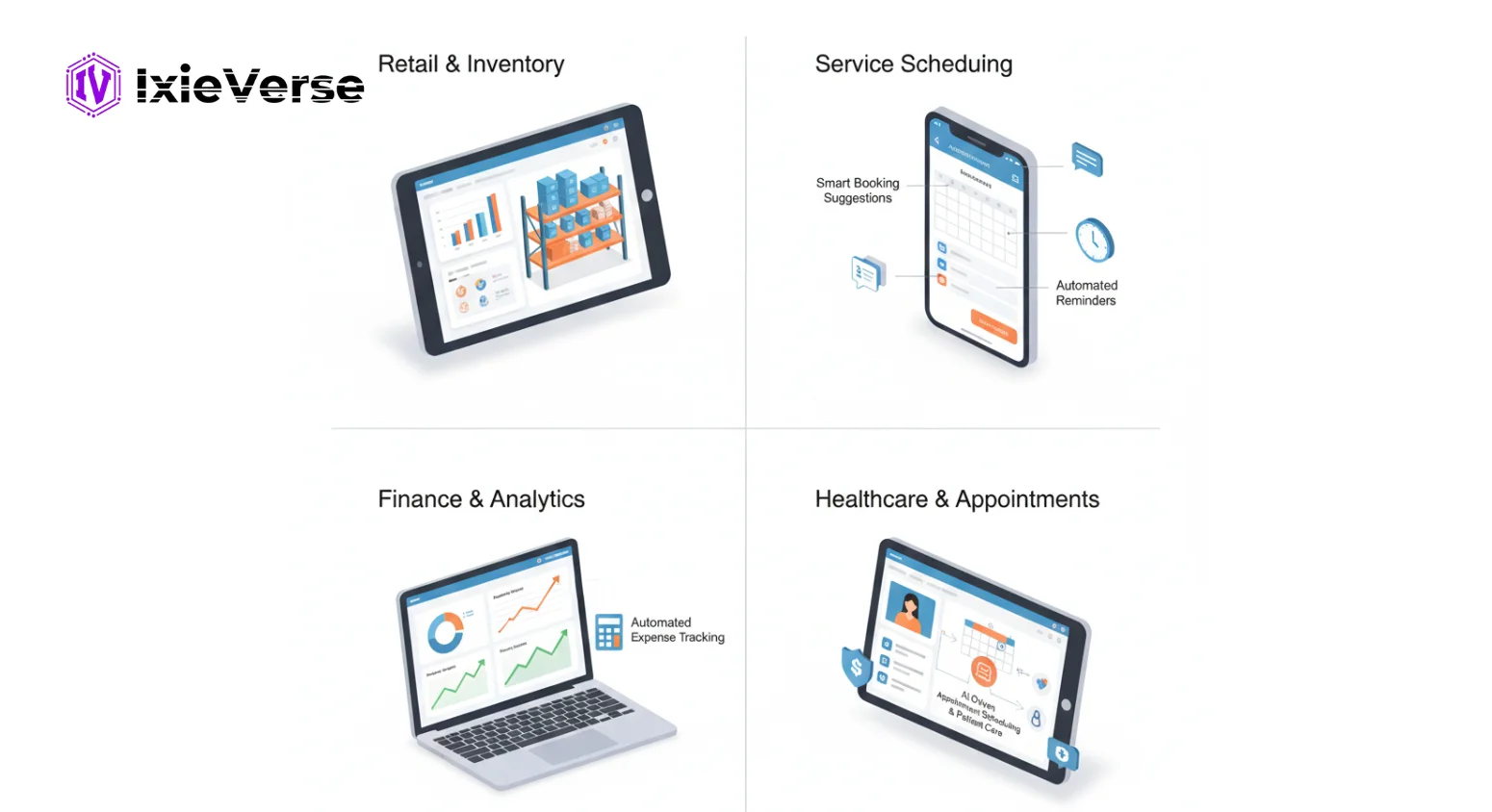
Here’s how businesses in specific industries are using AI tools today, with realistic outcomes:
| Industry | AI Use Case | Result |
| Restaurant | AI scheduling + inventory prediction | 15-20% food waste reduction |
| Retail / eCommerce | Product recommendations + demand forecasting | 10-25% higher average order value |
| Healthcare / Clinic | Appointment automation + patient reminders | 25-35% fewer missed appointments |
| Law Firm / Consultant | Document summarization (Claude AI) | 50-70% faster contract review |
| Real Estate Agency | CRM AI lead scoring (HubSpot) | 15-20% higher lead close rate |
| Salon / Beauty | AI booking + review response automation | 30% fewer no-shows |
| Accounting / Bookkeeping | QuickBooks Intuit Assist | 50%+ billing time saved |
| Marketing Agency | Jasper AI + Surfer SEO | 3x content output without new hires |
How to Implement AI in Your Small Business: Step-by-Step
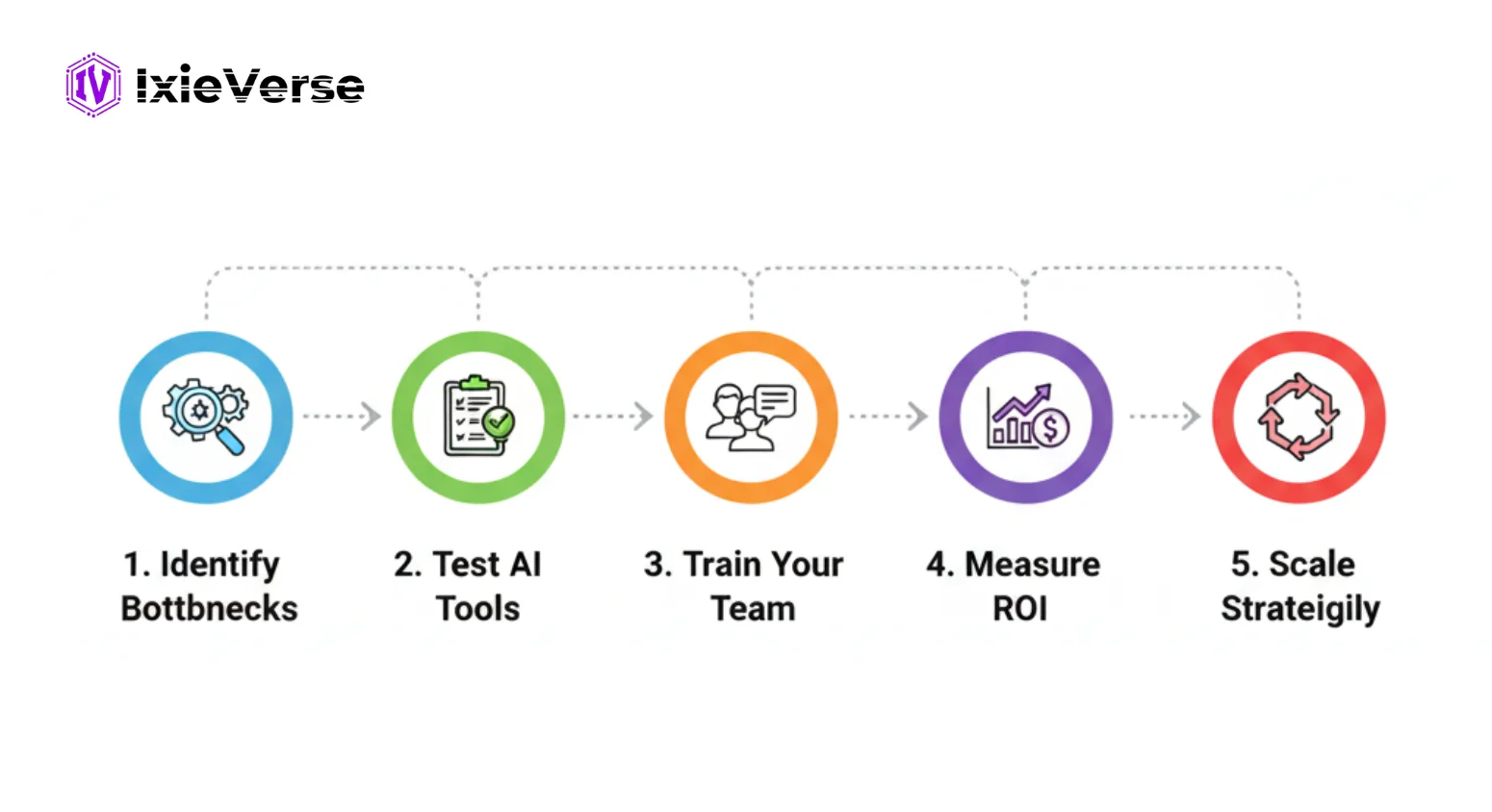
Implementing AI in a small business takes 6 steps — identify your biggest time drain, pick one use case, test a free or low-cost tool for 30-60 days, track KPIs, train your team, and scale only what proves ROI. Most businesses see measurable results within 30-90 days.
Step 1: Identify Your Biggest Bottleneck (Time: 1 hour)
Look at where your team spends the most manual hours. The top bottlenecks for small businesses in 2026 are: lead follow-up, customer support, social media content, invoicing, and scheduling. Write down your top one or two.
Step 2: Match the Bottleneck to an AI Category (Time: 30 minutes)
Don’t pick a tool first — pick a problem first. If your bottleneck is customer support, look at AI chatbots. If it’s lead follow-up, look at CRM AI. If it’s content, look at generative AI tools.
Step 3: Start With a Free or Trial Plan (Time: 1-2 days setup)
Most top AI tools offer free tiers or 14-30 day trials. Tidio, HubSpot CRM, Mailchimp, Copy.ai, and Calendly all have free plans. Sign up for one. Don’t pay until you’ve seen the tool work for your business.
Step 4: Run a 30-60 Day Controlled Test (Time: Ongoing)
Measure one specific metric before and after. If you’re testing a chatbot: track average response time and support ticket volume. If you’re testing email AI: track open rates and click rates. Keep it simple and data-driven.
Step 5: Train Your Team (Time: 1-2 hours)
Even the best tool fails without adoption. Run a short team walkthrough. Show the ‘why’ before the ‘how.’ The biggest AI implementation failures happen when staff don’t understand how the tool helps them, not just the business.
Step 6: Measure ROI and Scale (Time: Monthly review)
If the tool saves 5 hours/week at $50/hr = $1,000/month in labor costs, and the tool costs $49/month, ROI is clear. Scale only when ROI is proven. Add complementary tools only when the first tool is fully integrated.
What Is the ROI of AI for Small Business?
The average US small business spends $200–$500/month on AI tools and sees a 3x–7x return within 6 months, primarily through time savings and error reduction. Businesses that implement AI across marketing, support, and operations see 10–30% revenue growth in the first year, according to McKinsey (2025).
ROI varies by use case and speed of implementation. Here’s a realistic breakdown:
| AI Tool Type | Monthly Cost | Typical Monthly ROI |
| AI Chatbot (Tidio) | $29 | $160–$240 in support hours saved (8 hrs @ $20-30/hr) |
| Email AI (Mailchimp) | $20 | 15-25% better conversion = $300-500 in additional revenue per 1K list |
| CRM AI (HubSpot) | Free–$50 | 10-20% higher close rate on leads already in your pipeline |
| Accounting AI (QuickBooks) | $35 | 5-8 hrs/month saved = $150-400 in bookkeeper time |
| Content AI (Jasper) | $49 | Replace $500-1,500/mo in freelance writing costs |
Is AI Right for Your Small Business? A Quick Checklist
AI is most valuable when at least 3 of these apply to your business:
- You spend 5+ hours/week on tasks that follow a repeatable pattern
- You have a customer list or lead database of 100+ contacts
- Your team misses follow-ups or responds slowly to customer inquiries
- You’re spending on ads but conversion rates are inconsistent
- You want to scale output (content, support, sales) without immediately hiring
- You have monthly revenue of $5,000+ and a defined sales process
Common Mistakes Small Businesses Make With AI
- Buying multiple tools at once — stack overload kills adoption and burns budget
- No defined success metric — if you can’t measure it, you can’t scale it
- Skipping data privacy review — always check that your AI vendor is GDPR/CCPA compliant
- Expecting magic in week one — AI needs data and time to learn your business patterns
- No team training — poor adoption is the #1 reason AI investments fail
The Future of AI for Small Business (2026–2030)

| Trend | What It Means for Small Businesses | Timeline |
| AI Voice Agents | Handle after-hours calls, appointments, and FAQs automatically | Available now |
| Agentic AI | AI that completes multi-step tasks autonomously (research + write + send) | 2026-2027 |
| Hyper-personalization | Dynamic website content and emails tailored per visitor | Available now |
| Predictive sales | AI forecasts which leads will close before you even call | Available now |
| No-code AI apps | Build custom AI tools for your business without developers | 2026-2027 |
| AI bundled in productivity tools | Gemini in Google Workspace, Copilot in Microsoft 365 — at no extra cost | Available now |
Conclusion
AI is no longer a competitive advantage for small businesses — it’s the new baseline. The businesses winning in 2026 aren’t the ones with the biggest budgets. They’re the ones that picked one real problem, found the right tool, and measured what changed.
The path is straightforward:
- Start small. One tool, one bottleneck, one metric. Don’t buy five tools because they all look useful — buy one because it solves something specific.
- Test before you commit. Almost every tool worth using has a free tier or a trial. Prove the value before spending a dollar.
- Measure everything. If you can’t point to a number that moved — response time, conversion rate, hours saved — you haven’t implemented AI, you’ve just subscribed to software.
- Scale what works. Once one tool delivers measurable ROI, expand from there. Add a second tool in a different department. Integrate systems. Build the stack gradually and deliberately.
The small businesses that struggle with AI aren’t failing because the technology is too complex. They’re failing because they skipped the step that matters most — defining the problem before choosing the solution.
AI won’t run your business for you. But used correctly, it will give you back the time, clarity, and consistency to run it better. That’s the real promise — and in 2026, it’s entirely within reach for any business willing to start.
FAQs
1. What is AI for small business in simple terms?
AI for small business means using software that automates tasks, analyzes data, and improves decision-making without needing advanced technical skills.
2. How much does AI cost for a small business?
AI software for small business can range from free tools to $20–$300 per month depending on features. Many affordable AI solutions for small businesses offer strong ROI at low cost.
3. What are the best AI tools for small business?
The best small business AI tools include AI chatbots, CRM AI systems, marketing automation platforms, accounting AI software, and content creation tools.
4. How can AI improve small business revenue?
AI improves revenue by increasing lead conversion rates, reducing marketing waste, personalizing customer experiences, and improving retention. Many businesses see 10–30% growth after proper implementation.
5. Is AI worth it for small businesses?
Yes, if it solves a real problem. When used correctly, AI automation for small business saves time, reduces costs, and increases efficiency.
6. How do I implement AI in my small business?
Start by identifying a bottleneck, choose one use case, test a low-cost AI solution, track KPIs, and scale based on measurable AI ROI for small businesses.


![50 Best Website Design Examples for Inspiration [2026]](https://ixieverse.com/wp-content/uploads/2026/08/Best-Website-Design-Examples-150x150.webp)
Add a Comment