 ChatGPT
 Grok
Grok
 Claude
 Perplexity
 Google AI
- 1 TL;DR
- 2 What Is the Difference Between SEO, AEO, and GEO?
- What Is SEO?
- What Is AEO?
- What Is GEO?
- 3 SEO vs AEO vs GEO: Side-by-Side Comparison Table
- 4 Why Does This Distinction Matter in 2026?
- 5 How Do AI Search Engines Actually Choose What to Cite?
- 6 How to Optimize Content for SEO, AEO, and GEO at the Same Time
- The 7-Step Unified Optimization Framework
- 7 Examples of SEO, AEO, and GEO in Action
- 8 Which Matters More: SEO, AEO, or GEO?
- 9 Conclusion
- 10 Frequently Asked Questions
- What is the difference between GEO, AEO, and SEO in simple terms?
- Is GEO replacing SEO in 2026?
- Which is better for ecommerce: SEO or AEO?
- How do I optimize my content for ChatGPT and Gemini?
- What tools are used for GEO optimization?
- Do I need separate content for SEO, AEO, and GEO?
- How do I measure GEO success if there’s no click?
TL;DR
- SEO ranks your page in traditional search results. AEO gets your content chosen as the direct answer. GEO gets your brand cited inside AI-generated responses.
- They are not competing strategies — SEO is the foundation, AEO structures content for extraction, and GEO extends that content into AI-generated answers.
- In 2026, most search journeys blend all three: a user asks Google AI Mode a question, sees an AI Overview, and may never click a blue link at all.
- Winning requires one content strategy measured three ways: rankings (SEO), extraction rate (AEO), and citation share (GEO).
Type a question into Google in 2026 and there’s a good chance you won’t see ten blue links at all. You’ll see a generated answer, a handful of cited sources, and — if you’re lucky — a link buried underneath it.
That shift is why “SEO vs AEO vs GEO” has become one of the most searched comparison queries in marketing this year. Teams that spent a decade mastering rankings are suddenly being asked to also win “answers” and “citations” — and most explanations of the difference are either too vague or too academic to act on.
This guide breaks down exactly what SEO, AEO, and GEO each optimize for, how they overlap, where they diverge, and the step-by-step framework we use to build one piece of content that performs across all three.
What Is the Difference Between SEO, AEO, and GEO?
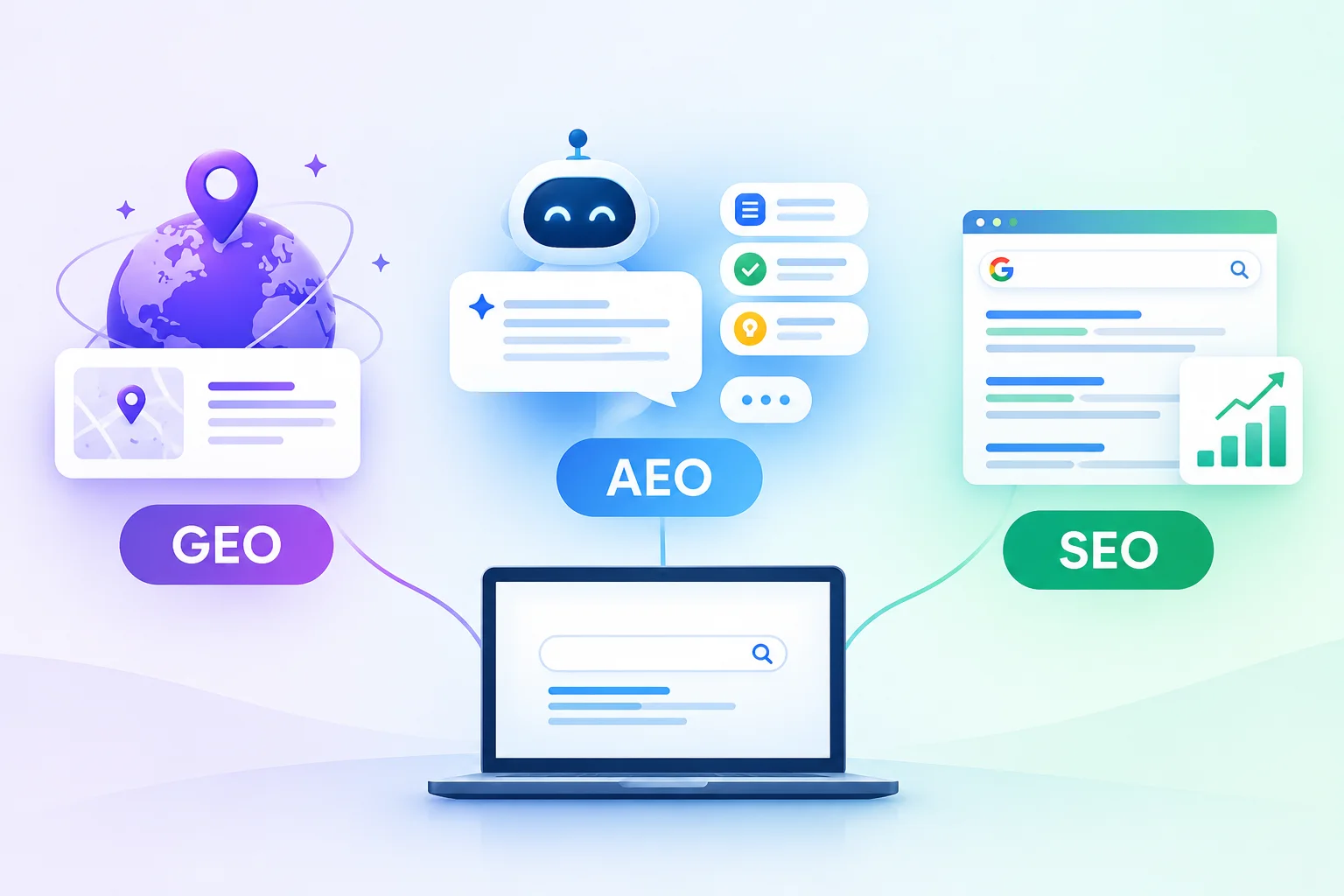
SEO optimizes content to rank in traditional search results. AEO optimizes content to be selected as a direct answer, like a featured snippet or voice response. GEO optimizes content to be cited or referenced inside AI-generated answers from tools like ChatGPT, Gemini, Perplexity, and Claude. They target three different outputs, but they run on overlapping signals — authority, structure, and relevance.
What Is SEO?
SEO (Search Engine Optimization) is the practice of improving a website’s visibility in a traditional search engine’s ranked results, primarily through keyword targeting, technical performance, content quality, and backlink authority. The goal is a click: a user sees your page in a list of results and chooses it over the competition.
Core SEO levers in 2026 still include:
- On-page relevance: keyword and entity coverage that matches search intent
- Technical health: Core Web Vitals, crawlability, mobile performance, site architecture
- Authority: backlinks, brand mentions, and third-party trust signals
- E-E-A-T: demonstrated experience, expertise, authoritativeness, and trustworthiness
What Is AEO?
AEO (Answer Engine Optimization) is the practice of structuring content so it can be extracted as a direct, self-contained answer by answer-driven search features — Google AI Overviews, featured snippets, People Also Ask boxes, and voice assistants. The goal is to become the answer itself, even when the user never clicks through.
Core AEO levers in 2026:
- Answer-first writing: the direct answer appears in the first 1–2 sentences under a heading
- Question-phrased headings that mirror how people actually ask
- Clean lists, tables, and step-by-step formatting that parsers can lift cleanly
- FAQ and HowTo schema markup that makes the answer machine-readable
What Is GEO?
GEO (Generative Engine Optimization) is the practice of shaping content so generative AI tools — ChatGPT, Gemini, Perplexity, Claude, and Google’s AI Mode — select it as a trusted source when synthesizing an answer that blends multiple references. The goal is citation and inclusion, since the AI is writing the response in its own words rather than displaying your page.
Core GEO levers in 2026:
- Topical depth and comprehensiveness on a subject, not just one keyword
- Clear, quotable, well-sourced statements an AI model can safely attribute
- Fresh, dated content — LLM-connected search tools favor recently verified information
- Consistent entity signals across your site, PR, reviews, and third-party mentions (what the model “knows” about your brand)
Not sure if your FAQ and HowTo markup is set up right? Try our free Schema Generator and get clean, error-free JSON-LD in seconds. Get cited-ready structured data now. Generate Your Free Schema Markup
SEO vs AEO vs GEO: Side-by-Side Comparison Table
| Factor | SEO | AEO | GEO |
| Primary goal | Rank in search results | Become the direct answer | Get cited in AI-generated answers |
| Output format | Ranked list of links | Snippet / voice answer / PAA box | Synthesized narrative response |
| Where it shows up | Google, Bing SERPs | Featured snippets, AI Overviews, voice assistants | ChatGPT, Gemini, Perplexity, Claude, AI Mode |
| Success metric | Rankings, organic traffic, CTR | Snippet ownership, extraction rate, voice-answer share | Citation frequency, AI referral traffic, share of voice |
| Core requirement | Authority, technical SEO, backlinks | Structure, clarity, schema markup | Topical depth, freshness, quotability, trust signals |
| Who typically owns it | SEO / content team | Content + technical SEO team | Content, PR, and brand/entity management |
| Does the user click? | Yes, if you rank well | Sometimes — often zero-click | Rarely — the AI answers directly |
Why Does This Distinction Matter in 2026?
Because click behavior has fundamentally changed. Industry research from 2025 (Pew Research Center) found users clicked a traditional organic result in only about 8% of visits when an AI summary was present, compared with roughly 15% when it wasn’t — and clicks on the AI summary itself were rarer still, around 1% of visits. Ranking #1 no longer guarantees traffic if an AI answer sits above it.
At the same time, industry analyses have repeatedly found meaningful overlap between what ranks organically and what gets pulled into AI Overviews — most cited sources still rank somewhere on page one, which is why SEO fundamentals still matter even as the outputs multiply.
How Do AI Search Engines Actually Choose What to Cite?
Unlike a traditional search engine, which returns a ranked list of links, generative engines synthesize an answer from multiple sources using retrieval-augmented generation (RAG) — pulling in relevant passages, then writing a new response around them.
What increases your odds of being one of those retrieved passages:
- Content is broken into clearly labeled, self-contained chunks (so a single paragraph can be lifted without losing meaning)
- Claims are specific, sourced, and dated rather than vague or evergreen-without-context
- The page demonstrates topical authority — comprehensive coverage, not a single thin post
- The brand has consistent entity signals across the web (Wikipedia/Wikidata-style consistency, review sites, press, structured data)
- The domain has existing organic authority — most AI Overviews still draw heavily from top-10-ranking, well-established pages
Want to make sure AI crawlers and search bots can actually read your site? Build a robots.txt file in under a minute with our free generator. Control who crawls your site. Create Your Free Robots.txt File
How to Optimize Content for SEO, AEO, and GEO at the Same Time
You do not need three separate content strategies. You need one strategy with three optimization passes. Here is the framework:
The 7-Step Unified Optimization Framework
- Start with one clear entity and intent. Pick a single topic and search intent — don’t blend informational and commercial intent in one page.
- Write the direct answer first. Open each section with a 40–60 word answer before any explanation or story.
- Structure for extraction. Use question-phrased H2/H3 headings, numbered steps, and comparison tables wherever two or more things are being contrasted.
- Back every claim with a source or a number. Cite a study, a benchmark, or a dated example — vague claims get skipped by both algorithms and AI models.
- Add schema markup. Implement FAQ, HowTo, and Article schema so both crawlers and LLM-connected retrieval systems can parse structure with certainty.
- Build topical depth around the page. Support the core article with 4–6 related pieces that establish comprehensive coverage of the topic cluster.
- Refresh on a fixed cadence. Update statistics, examples, and dates at least quarterly — freshness is a documented factor in what generative engines choose to cite.
Examples of SEO, AEO, and GEO in Action
| Scenario | What’s Happening |
| A user searches “best CRM for small business” and clicks the #3 organic result | SEO at work — ranking drove the click |
| A user searches “what is a CRM” and Google shows a featured snippet with no click needed | AEO at work — the page became the answer |
| A user asks ChatGPT “which CRM is best for a 5-person startup” and the model names a brand with a source link | GEO at work — the brand was cited inside a generated answer |
Tracking traffic from AI citations and referrals? Build clean, consistent UTM links with our free UTM Generator. Never lose track of a campaign again. Build Your Free UTM Link
Which Matters More: SEO, AEO, or GEO?
None of them independently — they solve different visibility problems at different stages of the search journey. SEO builds the authority that AEO and GEO both depend on. AEO captures visibility when users want a fast answer. GEO captures visibility when users delegate the research to an AI. Businesses that only invest in one are leaving two-thirds of modern search behavior uncovered.
Conclusion
SEO, AEO, and GEO aren’t three competing disciplines fighting for budget — they’re three lenses on the same goal: being found, trusted, and chosen, no matter how someone searches.
The brands winning in 2026 aren’t picking one. They’re building content that ranks, gets extracted, and gets cited, then measuring all three instead of just one. That’s the shift worth making now, before the gap between “ranked” and “referenced” becomes the gap between growth and invisibility.
Frequently Asked Questions
What is the difference between GEO, AEO, and SEO in simple terms?
SEO gets your page ranked. AEO gets your content chosen as the direct answer. GEO gets your brand mentioned or cited when an AI tool writes a generated response.
Is GEO replacing SEO in 2026?
No. GEO depends on the same authority and relevance signals SEO builds — most AI-cited sources still have solid organic rankings. GEO extends SEO’s reach into AI-generated answers; it doesn’t replace the groundwork.
Which is better for ecommerce: SEO or AEO?
Neither alone. Product and category pages still need SEO to rank for commercial-intent searches, while comparison and “how to choose” content benefits from AEO structuring to win featured snippets and pre-purchase voice queries.
How do I optimize my content for ChatGPT and Gemini?
Publish comprehensive, well-sourced, clearly structured content with consistent entity signals (brand mentions, reviews, structured data) across the web, and keep statistics and examples current — generative engines favor verifiable, recently updated sources.
What tools are used for GEO optimization?
Common categories include AI-citation trackers, brand-mention monitoring tools, schema markup generators, and traditional SEO platforms that have added AI Overview and LLM-visibility tracking modules.
Do I need separate content for SEO, AEO, and GEO?
No. One well-structured, well-sourced page can satisfy all three when it leads with a direct answer, includes supporting depth, and uses schema markup — the formats overlap far more than they conflict.
How do I measure GEO success if there’s no click?
Track AI referral traffic in analytics, monitor brand-citation frequency across AI platforms using a citation-tracking tool, and periodically query the major AI engines directly to check whether and how your brand is mentioned.



![50 Best Website Design Examples for Inspiration [2026]](https://ixieverse.com/wp-content/uploads/2026/08/Best-Website-Design-Examples-150x150.webp)
Add a Comment