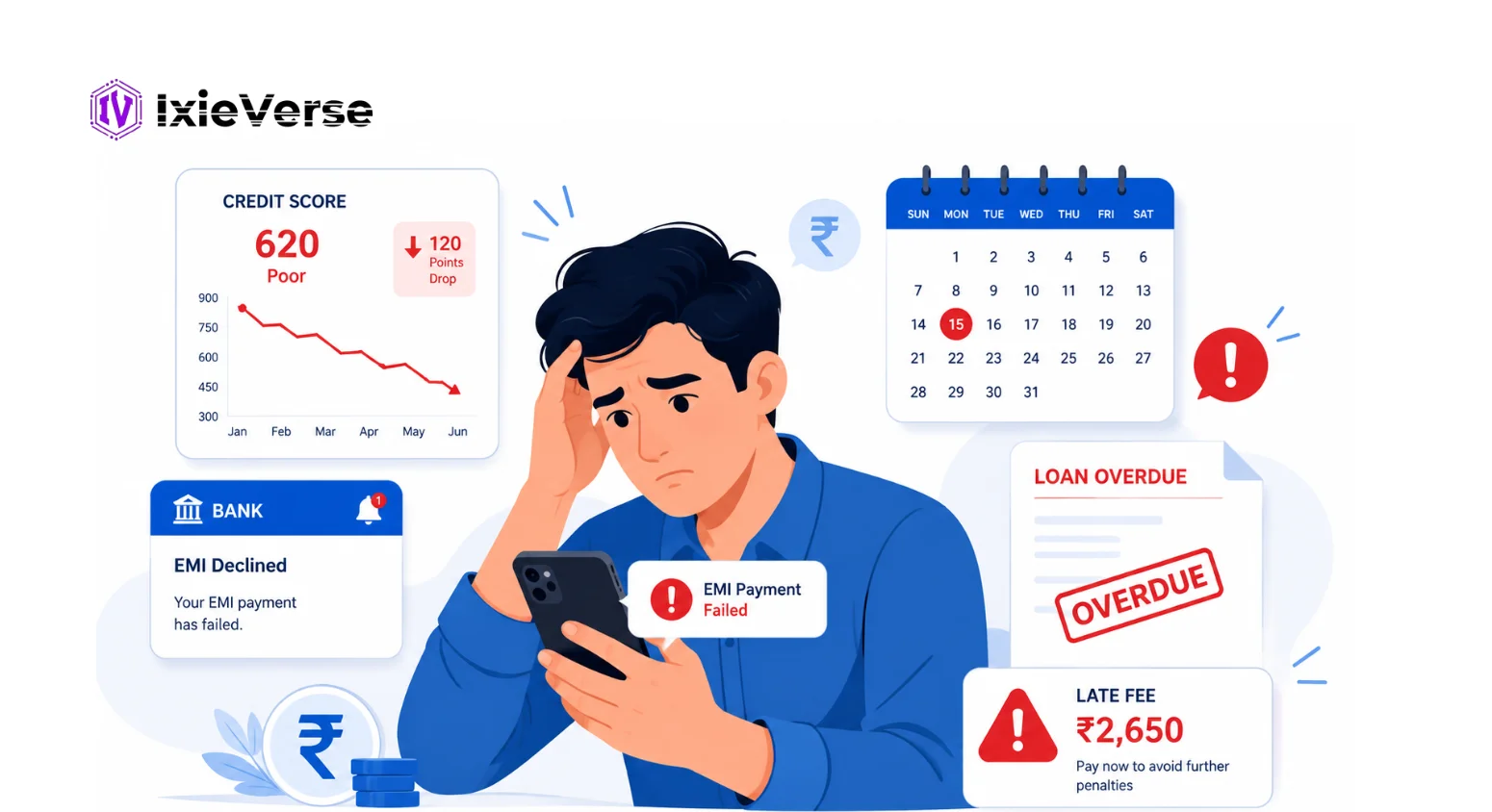
You set up auto-pay. Then a salary delay hits, or an unexpected bill drains your account — and your EMI bounces.
It happens to millions of borrowers every year. But what actually happens next? And how much time do you have before things get serious?
This guide gives you the exact consequences at each stage, what lenders do behind the scenes, and a clear 7-step plan to recover — fast.
TL;DR — Quick Answer
Missing an EMI triggers late fees (1–3% of the overdue amount), drops your credit score by 50–100 points, and can escalate to legal action or asset seizure after 90 days. Act within 30 days to minimize damage.
 ChatGPT
 Grok
Grok
 Claude
 Perplexity
 Google AI
- TL;DR — Quick Answer
- 1 What Is an EMI?
- 2 What Happens When You Miss an EMI Payment?
- Stage 1: Day 1–30 — Late Fee & Bounce Charge
- Stage 2: Day 30–90 — Credit Score Damage + Lender Calls
- Stage 3: Day 90+ — NPA Status & Legal Risk
- 3 Missed EMI Consequences: At a Glance
- 4 How Does a Missed EMI Affect Your Credit Score?
- 5 7 Steps to Recover After Missing an EMI Payment
- 6 Lender Hardship Options: What You Can Ask For
- 7 Conclusion
- 8 Frequently Asked Questions
- Q1: What happens if I miss one EMI payment?
- Q2: How long do I have before a missed EMI damages my credit score?
- Q3: Can I negotiate with my lender after missing an EMI?
- Q4: Will a missed EMI show up on my credit report permanently?
- Q5: What is the difference between a missed EMI and a loan default?
- Q6: Does missing an EMI affect future loan eligibility?
- Q7: What should I do immediately after missing an EMI?
What Is an EMI?
An EMI (Equated Monthly Installment) is a fixed monthly payment made to a lender on a set date, covering both principal and interest over the loan tenure.
What Happens When You Miss an EMI Payment?
The consequences escalate in stages. Here’s the exact timeline:
Stage 1: Day 1–30 — Late Fee & Bounce Charge
Within 24–48 hours of a missed payment, your lender triggers automatic penalties:
- Bounce charge: $15–$50 (or equivalent) for failed auto-debit
- Late payment fee: Typically 1–3% of the overdue EMI amount per month
- Penal interest: Added to your outstanding balance immediately
Your credit score is not yet reported. This is your window to act.
Stage 2: Day 30–90 — Credit Score Damage + Lender Calls
After 30 days, your lender reports the missed payment to credit bureaus (Equifax, TransUnion, Experian in the US; CIBIL equivalent internationally).
- Credit score drop: 50–100 points for a single missed payment
- Lender collections calls begin — typically starting around Day 15–30
- Some lenders flag the account as ‘Special Mention Account’ internally
- Loan restructuring options may be offered at this stage
This is your last low-cost opportunity to resolve the default before major damage.
Stage 3: Day 90+ — NPA Status & Legal Risk
After 90 days, most lenders classify your loan as a Non-Performing Asset (NPA).
- Guarantors (if any) become liable for full repayment
- Severely impacts credit score — NPA status visible for 7 years
- Lender can initiate legal recovery proceedings
- For secured loans (home, auto): lender may begin repossession or foreclosure
- For personal loans: case filed in civil/debt recovery tribunal
- Guarantors (if any) become liable for full repayment
Already missed an EMI? Start by understanding your numbers. Use the IxieVerse EMI Calculator to restructure your repayment plan, then call your lender today. Every day you wait adds more penalties — act now.
Missed EMI Consequences: At a Glance
| Stage | Timeline | Key Consequence | Credit Impact |
| Bounce & Late Fee | Day 1–30 | Charges added to account | None yet |
| Credit Reporting | Day 30–90 | Bureaus notified, calls begin | 50–100 point drop |
| NPA Classification | Day 90+ | Legal action possible | Severe / 7-year mark |
| Secured Loan Recovery | Day 90–180 | Asset repossession starts | Foreclosure record |
How Does a Missed EMI Affect Your Credit Score?
Payment history is the single largest factor in your credit score — accounting for roughly 35% of your FICO score.
- One missed payment: 50–100 point drop (exact amount depends on current score)
- Multiple missed payments: Can push your score below 580 (subprime range)
- NPA / charge-off record: Visible on your credit report for 7 years
- Future loan approvals, credit card limits, and even rental applications get affected
A borrower with a 720 credit score who misses one EMI can drop to 620–640 — potentially losing access to competitive interest rates for years.
Also Read: EMI vs Simple Interest: What’s the Difference? (Full 2026 Guide)
7 Steps to Recover After Missing an EMI Payment
Act fast. The earlier you move, the fewer consequences you’ll face.
- Contact your lender immediately — within 24–48 hours if possible. Explain the situation. Many lenders have hardship provisions.
- Pay the overdue amount plus any late fee as soon as funds are available. Even partial payment signals good faith.
- Request a grace period or payment deferral — especially if it’s your first missed payment.
- Ask about loan restructuring — lenders can extend tenure or reduce EMI temporarily.
- Check your credit report (AnnualCreditReport.com in the US) after 60 days to confirm reporting accuracy.
- Set up a backup payment method or overdraft protection to prevent future bounces.
- Dispute any incorrect entries on your credit report immediately with the bureau.
Already missed an EMI? Start by understanding your numbers. Use the IxieVerse EMI Calculator to restructure your repayment plan, then call your lender today. Every day you wait adds more penalties — act now.
Lender Hardship Options: What You Can Ask For
| Option | What It Does | Best For |
| EMI Deferral | Delay 1–3 months without penalty | Short-term cash crunch |
| Loan Restructuring | Lower EMI, extend tenure | Income reduction |
| Moratorium | Pause payments temporarily | Medical/emergency |
| Partial Payment | Pay what you can, clear rest later | Irregular income |
Conclusion
Missing an EMI is stressful — but it’s rarely catastrophic if you act quickly.
The first 30 days are your highest-leverage window. Pay the overdue amount, call your lender, and explore hardship options before the 90-day NPA clock starts running.
Your credit score will recover with consistent payments going forward. The key is not to wait and hope the problem resolves itself.
One missed EMI = manageable. Three missed EMIs = serious consequences. Act in the first 30 days and you can contain the damage entirely.
Already missed an EMI? Start by understanding your numbers. Use the IxieVerse EMI Calculator to restructure your repayment plan, then call your lender today. Every day you wait adds more penalties — act now.
Frequently Asked Questions
Q1: What happens if I miss one EMI payment?
You’ll be charged a late fee and bounce charge. Your credit score is not yet impacted if you pay within 30 days. Contact your lender immediately.
Q2: How long do I have before a missed EMI damages my credit score?
Most lenders report to credit bureaus after 30 days of non-payment. Paying before the 30-day mark can prevent credit reporting entirely.
Q3: Can I negotiate with my lender after missing an EMI?
Yes. Most lenders offer hardship programs, deferral options, or restructuring — especially for first-time defaulters with good prior history.
Q4: Will a missed EMI show up on my credit report permanently?
A missed payment stays on your credit report for 7 years in the US. However, its impact on your score fades over time as you build positive payment history.
Q5: What is the difference between a missed EMI and a loan default?
A missed EMI is a single skipped payment. A loan default (NPA) occurs after 90+ consecutive days of non-payment, triggering legal and collection action.
Q6: Does missing an EMI affect future loan eligibility?
Yes. A missed EMI record reduces your credit score, which lenders check before approving new loans. Multiple missed payments can disqualify you from competitive loan offers.
Q7: What should I do immediately after missing an EMI?
Call your lender, arrange payment ASAP, request fee waiver if it’s your first miss, and check your auto-debit setup to prevent recurrence.




![50 Best Website Design Examples for Inspiration [2026]](https://ixieverse.com/wp-content/uploads/2026/08/Best-Website-Design-Examples-150x150.webp)
Add a Comment