Every loan you take — car, home, personal, or education — comes with a cost. That cost is interest. But not all interest is calculated the same way.
Most borrowers in 2026 encounter two types: simple interest and EMI-based repayment. They sound interchangeable. They are not.
Choose the wrong loan structure and you could pay hundreds — or thousands — more than necessary over the life of a loan. Understand the difference and you become a smarter borrower.
This guide breaks down exactly how EMI and simple interest work, how to calculate both, and which makes more financial sense in different scenarios.
Quick Answer:
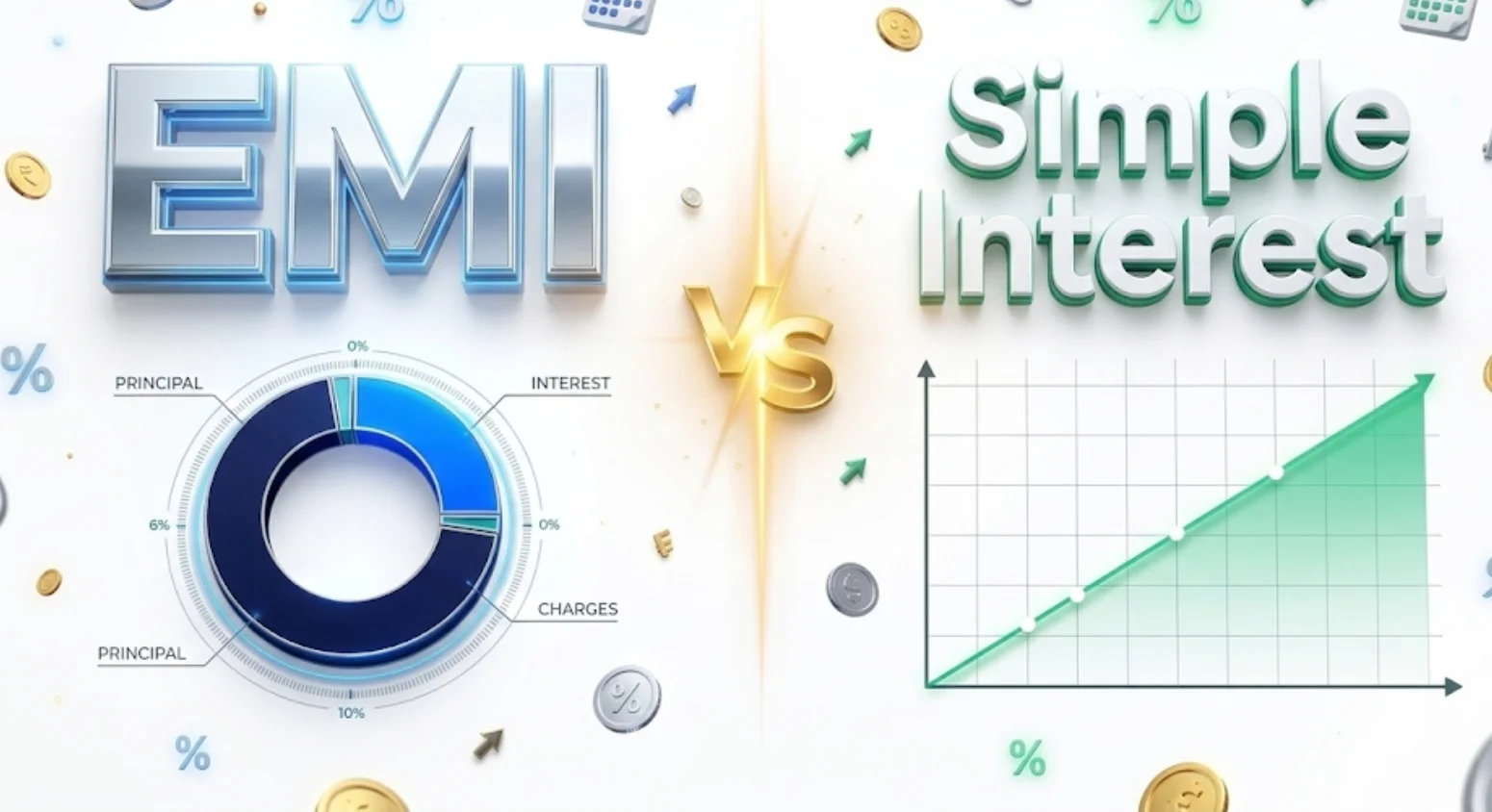
EMI (Equated Monthly Installment) and simple interest are both used in loan repayment, but they work very differently. Simple interest is calculated on the original principal for the full loan period. EMI distributes your total repayment (principal + interest) into equal monthly payments — often using the reducing balance method, where interest shrinks as you pay down principal. For most loans, EMI is cheaper over time than flat simple interest. A simple interest calculator can help you model either scenario before signing any loan agreement.
 ChatGPT
 Grok
Grok
 Claude
 Perplexity
 Google AI
- 1 What is Simple Interest?
- 2 What is EMI?
- 3 EMI vs Simple Interest: Side-by-Side Comparison
- 4 How is EMI Calculated? Step-by-Step
- Step-by-Step Framework (HowTo Schema Ready)
- 5 How is Simple Interest Calculated?
- 6 What is the Reducing Balance Method in EMI?
- 7 Which is Better: EMI or Simple Interest?
- 8 Is EMI Based on Simple Interest or Compound Interest?
- 9 Why Does Flat Interest Rate Look Lower but Cost More?
- 10 Examples of EMI vs Simple Interest Across Loan Types
- 11 EMI & Simple Interest Trends in 2026
- 12 Conclusion: Know Before You Borrow
- 13 Frequently Asked Question
- Q1: What is the difference between EMI and simple interest?
- Q2: Is EMI calculated on simple interest or compound interest?
- Q3: Which is cheaper — a flat simple interest loan or an EMI loan?
- Q4: How do I use a simple interest calculator?
- Q5: What is the simple interest formula?
- Q6: What does EMI stand for?
What is Simple Interest?
Simple interest is a method of calculating interest where the charge is applied only to the original principal amount for the entire loan duration. It does not compound over time. Formula: SI = (Principal × Rate × Time) / 100. It is straightforward, predictable, and most common in short-term personal and auto loans.
Simple interest means you always pay interest on your original loan amount — not on accumulated interest.
Formula: SI = (P × R × T) / 100
Where: P = Principal, R = Annual Rate (%), T = Time in years
Simple Interest — Numerical Example
| Principal | Rate | Tenure | Total Interest |
| $10,000 | 10% p.a. | 3 years | $3,000 |
Total repayment: $13,000 | Monthly payment: $361.11
What is EMI?
An EMI (Equated Monthly Installment) is a fixed payment made by a borrower to a lender on a specified date each month. EMIs are used to pay off both the principal and interest in equal amounts over a set period. The interest component is typically calculated using the reducing balance method, making early repayments financially advantageous.
EMI Formula: EMI = [P × r × (1 + r)^n] / [(1 + r)^n − 1]
Where: P = Principal, r = Monthly interest rate (Annual rate ÷ 12), n = Number of monthly installments
EMI — Numerical Example (Same Loan as Above)
| Principal | Rate | Tenure | Monthly EMI |
| $10,000 | 10% p.a. | 36 months | $322.67 |
Total repayment: $11,616 | Total interest paid: $1,616
Key Insight: EMI Saves You More
On the same $10,000 loan at 10% for 3 years: Simple interest costs $3,000 in interest. EMI (reducing balance) costs only $1,616 in interest. That’s a $1,384 difference — simply from the calculation method.
See it in action. Plug your loan details into the IxieVerse EMI Calculator and watch your amortization schedule build in real time.
EMI vs Simple Interest: Side-by-Side Comparison
| Feature | Simple Interest | EMI (Reducing Balance) |
| Interest Basis | Always on original principal | On outstanding balance (decreases monthly) |
| Monthly Payment | Can vary (interest + principal split) | Fixed throughout tenure |
| Total Interest Cost | Higher over same period | Lower (interest reduces as principal reduces) |
| Formula Complexity | Simple: SI = P×R×T/100 | Moderate: EMI = [P×r×(1+r)^n]/[(1+r)^n−1] |
| Transparency | Very transparent | Requires amortization schedule to fully understand |
| Best For | Short-term loans, student loans, personal finance modeling | Home loans, car loans, long-term personal loans |
| Early Repayment Benefit | Saves proportional interest | Significant savings — interest drops faster |
| Lender Preference | Less common for amortizing loans | Standard for most consumer loans in 2026 |
| Calculator Available? | Yes — simple interest calculator tools | Yes — EMI calculator tools |
How is EMI Calculated? Step-by-Step
Step-by-Step Framework (HowTo Schema Ready)
- Identify your loan details: Principal (P), Annual interest rate (R), Loan tenure in months (n)
- Convert annual rate to monthly: r = R / (12 × 100)
- Apply the EMI formula: EMI = [P × r × (1 + r)^n] / [(1 + r)^n − 1]
- Multiply EMI by n to get total repayment amount
- Subtract principal from total repayment to get total interest paid
- Use an online simple interest calculator or EMI calculator to verify results instantly
Worked Example: $15,000 Car Loan at 8% for 5 Years
| Variable | Simple Interest | EMI (Reducing Balance) |
| Principal | $15,000 | $15,000 |
| Rate | 8% p.a. | 8% p.a. |
| Tenure | 5 years (60 months) | 5 years (60 months) |
| Monthly Payment | $350.00 | $304.15 |
| Total Repayment | $21,000 | $18,249 |
| Total Interest | $6,000 | $3,249 — you save $2,751 with EMI! |
Skip the math. You just learned how EMI is calculated manually. The IxieVerse EMI Calculator does all of it instantly — principal, rate, tenure, monthly EMI, total interest, full schedule.
How is Simple Interest Calculated?
Simple interest is one of the most straightforward financial calculations. Here’s how it works:
- Identify: Principal (P), Annual Interest Rate (R), Time in years (T)
- Apply the formula: SI = (P × R × T) / 100
- Calculate Total Repayment: P + SI
- Divide total repayment by number of months for monthly payment
What is the Reducing Balance Method in EMI?
The reducing balance method (also called the diminishing balance method) calculates interest on the outstanding loan balance each month — not the original principal. As you make EMI payments and reduce your principal, the interest charged decreases accordingly. This is why EMI loans are typically cheaper than flat-rate simple interest loans over the same period.
Month-by-Month EMI Amortization Snapshot ($10,000 at 10% for 12 months)
| Month | EMI ($) | Interest ($) | Principal Paid ($) | Balance ($) |
| 1 | 879.16 | 83.33 | 795.83 | 9,204.17 |
| 3 | 879.16 | 69.94 | 809.22 | 7,585.56 |
| 6 | 879.16 | 49.74 | 829.42 | 5,144.18 |
| 12 | 879.16 | 7.29 | 871.87 | 0.00 |
Which is Better: EMI or Simple Interest?
The answer depends entirely on your context. Here is a structured breakdown:
Choose EMI When:
- Taking a long-term loan (home, car, education) — reducing balance saves significantly
- You want fixed, predictable monthly payments for budgeting
- You plan to make prepayments — EMI loans benefit more from early payoff
- Comparing multiple loan offers and need a standard repayment structure
Choose Simple Interest When:
- Taking a short-term loan (under 12 months) — minimal difference in cost
- Modeling financial scenarios and projections quickly
- Evaluating investment returns using simple interest as a baseline
- Working with informal or peer-to-peer lending agreements
For most consumer loans in 2026, EMI using the reducing balance method will cost you less total interest than a flat simple interest loan at the same stated rate. Always use a simple interest calculator or EMI calculator to compare both before committing to a loan.
Explore: Return on Investment (ROI): Formula & How to Calculate
Is EMI Based on Simple Interest or Compound Interest?
EMI is neither pure simple interest nor standard compound interest. Most EMI loans use the reducing balance method, which is a form of monthly compounding on the outstanding balance. However, the resulting interest cost is significantly lower than flat simple interest applied to the full original principal. In practical terms, EMI loans behave more like monthly compound interest on a diminishing balance.
Why Does Flat Interest Rate Look Lower but Cost More?
This is one of the most common financial traps borrowers fall into.
Lenders sometimes advertise a ‘flat rate’ of interest — which sounds lower than the EMI equivalent rate. But because flat rate is applied on the entire original principal for the full loan period, the effective annual rate (EAR) is nearly double the stated flat rate.
Flat Rate vs Reducing Rate: Real Cost Comparison
| Loan Type | Stated Rate | Effective Annual Rate | Total Interest on $10K, 2Y |
| Flat/Simple Interest | 8% flat | ~14.5% EAR | $1,600 |
| EMI Reducing Balance | 8% reducing | 8% EAR | $867 |
Always ask lenders: ‘Is this a flat rate or a reducing balance rate?’ — the difference can be thousands of dollars on larger loans.
Discover: How to Track Marketing Campaigns Like a Pro
Examples of EMI vs Simple Interest Across Loan Types
| Loan Type | Amount | Rate | Tenure | Simple Interest Cost | EMI Interest Cost |
| Personal Loan | $5,000 | 12% | 2 years | $1,200 | $648 |
| Car Loan | $20,000 | 7% | 5 years | $7,000 | $3,761 |
| Home Loan | $200,000 | 6.5% | 20 years | $260,000 | $154,197 |
| Student Loan | $30,000 | 5% | 10 years | $15,000 | $8,184 |
The larger the loan and longer the tenure, the greater the EMI advantage over flat simple interest.
EMI & Simple Interest Trends in 2026
The lending landscape has shifted meaningfully in recent years:
- AI-powered loan comparison tools now calculate both EMI and flat rate equivalents in real time, making it easier for borrowers to spot predatory flat-rate offerings
- Variable-rate EMI loans tied to central bank benchmarks have surged in popularity, requiring borrowers to model multiple interest rate scenarios
- Buy Now Pay Later (BNPL) products frequently use simple interest structures — often at higher effective rates than disclosed
- Embedded finance platforms integrate simple interest calculators directly into purchase flows, improving financial literacy at the point of decision
- Regulatory pressure in the US and EU in 2025–2026 has pushed for standardized APR disclosures, making flat vs. reducing rate comparisons mandatory in many lending contexts
Skip the math. You just learned how EMI is calculated manually. The IxieVerse EMI Calculator does all of it instantly — principal, rate, tenure, monthly EMI, total interest, full schedule.
Conclusion: Know Before You Borrow
The difference between EMI and simple interest is not just academic — it directly determines how much you pay for every loan you take in your lifetime.
Simple interest is transparent and predictable. But applied as a flat rate on the full principal, it can cost significantly more than an EMI loan that uses the reducing balance method.
EMI loans — the standard for home, auto, and personal lending in 2026 — spread your repayment into fixed monthly installments while calculating interest only on what you still owe. This is almost always the cheaper structure for medium- to long-term borrowing.
The smartest move before signing any loan agreement? Run the numbers on both. Use a simple interest calculator, compare it against an EMI calculation, and let the math guide the decision.
Financial institutions design loans. You get to choose which ones serve you.
Frequently Asked Question
Q1: What is the difference between EMI and simple interest?
Simple interest charges a fixed percentage of the original loan amount for the full tenure. EMI (Equated Monthly Installment) splits your total repayment into equal monthly payments, usually using the reducing balance method where interest is calculated on your declining outstanding balance. EMI typically results in lower total interest costs than flat simple interest on the same loan.
Q2: Is EMI calculated on simple interest or compound interest?
EMI is calculated using the reducing balance method, which is technically a form of monthly compounding on the outstanding principal — not flat simple interest. This means the interest portion of each EMI decreases every month as you repay principal. The effective cost is much lower than applying simple interest to the full original principal throughout the loan term.
Q3: Which is cheaper — a flat simple interest loan or an EMI loan?
An EMI loan using the reducing balance method is almost always cheaper than a flat simple interest loan at the same stated rate. With EMI, interest is charged only on your remaining balance, which shrinks with each payment. With flat simple interest, you pay interest on the full original loan amount regardless of how much you’ve already repaid.
Q4: How do I use a simple interest calculator?
Enter your loan principal, the annual interest rate, and the loan tenure in years. The calculator instantly returns your total simple interest, total repayment amount, and monthly payment. Compare this output against an EMI calculator using identical inputs to determine the lower-cost borrowing option.
Q5: What is the simple interest formula?
Simple Interest = (Principal × Rate × Time) / 100. For example: A $10,000 loan at 10% annually for 3 years = ($10,000 × 10 × 3) / 100 = $3,000 total interest.
Q6: What does EMI stand for?
EMI stands for Equated Monthly Installment. It is a fixed monthly payment made to a lender that includes both principal repayment and interest, typically calculated using the reducing balance method.




![50 Best Website Design Examples for Inspiration [2026]](https://ixieverse.com/wp-content/uploads/2026/08/Best-Website-Design-Examples-150x150.webp)
Add a Comment