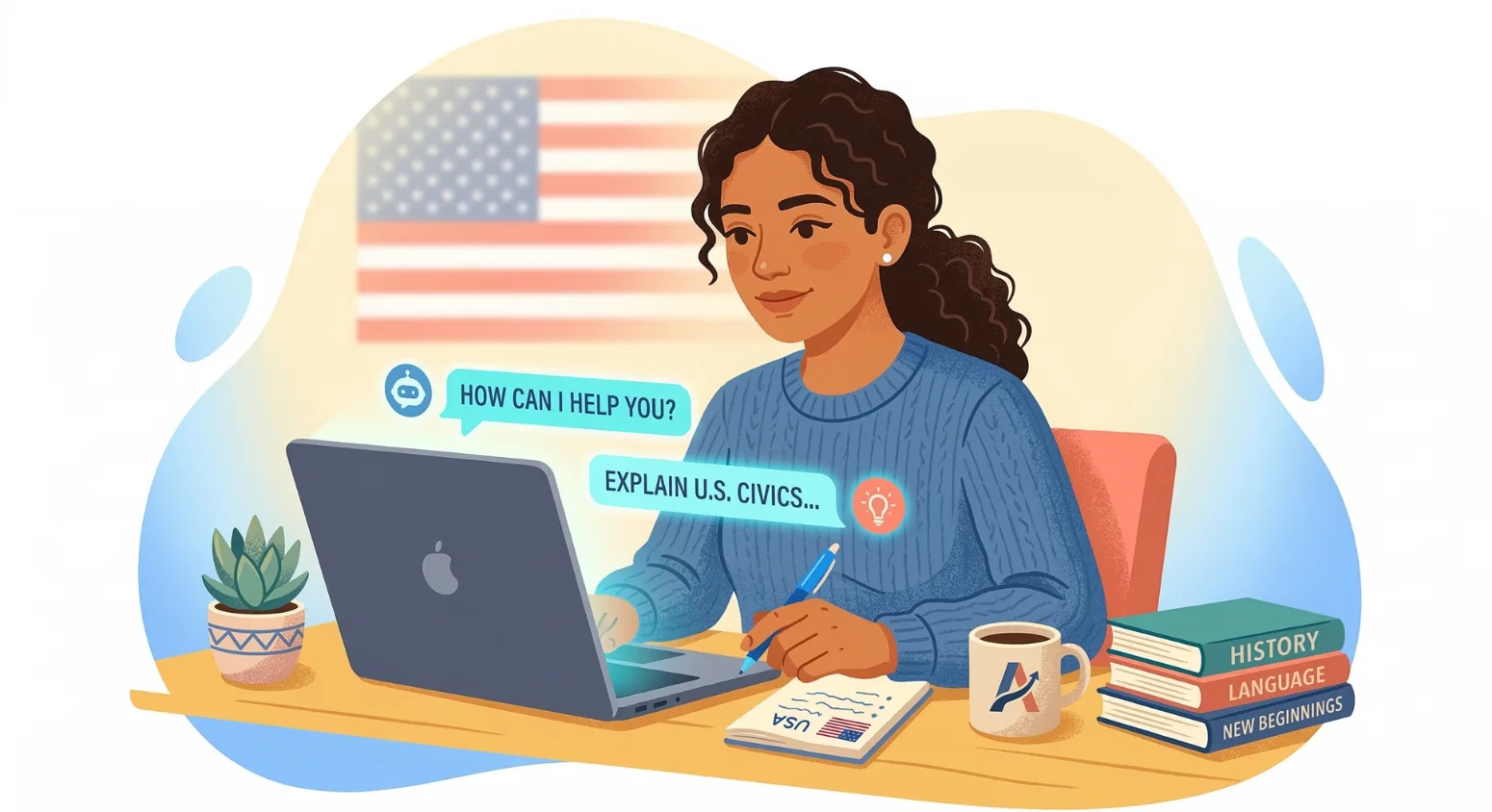
Becoming a US citizen is one of the most important milestones in a person’s life. And the civics test that stands between you and that moment? For most applicants, it is the most stressful part of the entire process.
Here is the good news: in 2026, you do not have to study alone with a stack of flashcards.
AI tools have become remarkably capable study partners for naturalization test prep. They are available 24/7, they speak your language, they quiz you instantly, and — critically — they adapt to what you do not know yet.
This guide answers the question definitively: Can AI help you study for the US citizenship test? We break down exactly how, which tools work best, what limitations to watch for, and how to build a complete AI-powered study plan that actually gets you to 6 out of 10 correct answers on interview day.
Quick Answer
Yes, AI can significantly help you study for the US citizenship test. AI tools like ChatGPT, Gemini, Perplexity, and dedicated civics apps can quiz you on all 100 USCIS civics questions, explain answers in plain English, simulate the naturalization interview, and adapt to your weak areas. They do NOT replace official USCIS materials or legal advice — but as a study companion, they are among the most effective tools available in 2026.
 ChatGPT
 Grok
Grok
 Claude
 Perplexity
 Google AI
- 1 What Is the US Citizenship Civics Test?
- Key Fast Facts
- 2 Can AI Actually Help You Study for the Citizenship Test?
- What AI Does Well for Citizenship Test Prep
- What AI Cannot Do
- 3 Best AI Tools for US Citizenship Test Prep in 2026
- 1. ChatGPT (GPT-4o and Later)
- 2. Google Gemini
- 3. Perplexity AI
- 4. Claude (Anthropic)
- 5. Dedicated AI Civics Apps (2026)
- AI Tools Comparison Table
- 4 How to Use AI to Study for the US Citizenship Test: Step-by-Step
- How to study for the US citizenship test using AI:
- Week-by-Week AI Study Plan
- Best AI Prompts for Citizenship Test Study
- 5 What Topics Does the US Citizenship Test Cover — And Can AI Explain All of Them?
- American Government (Questions 1–70)
- American History (Questions 71–85)
- Integrated Civics (Questions 86–100)
- Topic Coverage Breakdown
- 6 AI in Citizenship Test Prep: 2026 Trends & Data
- 7 Important Limitations: What to Know Before Relying on AI
- 1. AI Is Not an Immigration Attorney
- 2. Current Officials Change — Always Verify
- 3. AI Cannot Replace Official USCIS Materials
- 4. Accuracy Is High but Not Infallible
- 8 Conclusion: AI Is Now a Core Citizenship Test Prep Tool — Use It Wisely
- 9 Frequently Asked Questions
- Q1: Can AI pass the US citizenship test on its own?
- Q2: Is it safe to use AI for citizenship test prep?
- Q3: How many questions are on the US citizenship civics test?
- Q4: What is the passing score for the US citizenship test?
- Q5: Which AI tool is best for citizenship test prep in 2026?
- Q6: Can AI help me if English is not my first language?
- Q7: Are there free AI tools for citizenship test prep?
- Q8: Does AI cover the English reading and writing portions of the naturalization test?
What Is the US Citizenship Civics Test?
The US citizenship civics test is a mandatory oral exam administered by a USCIS officer during the naturalization interview. Applicants are asked up to 10 questions selected from the official USCIS list of 100 civics questions. To pass, you must correctly answer at least 6 out of 10. The test covers US history, government structure, and foundational principles.
Key Fast Facts
| Test Element | Detail |
| Total question bank | 100 official civics questions (USCIS list) |
| Questions asked per interview | Up to 10 (officer selects) |
| Passing threshold | 6 correct answers out of 10 |
| Format | Oral — spoken question, spoken answer |
| Language | English (with limited exceptions) |
| Retake policy | One retake allowed if you fail; scheduled 60–90 days later |
| Exemptions | Applicants 65+ with 20+ years as permanent resident (65/20 rule) |
| 2026 question list | Based on the updated USCIS civics question bank |
Can AI Actually Help You Study for the Citizenship Test?
Short answer: Yes — and it works surprisingly well.
AI language models have been trained on vast amounts of information, including US history, constitutional law, government structure, and civics education. In 2026, the leading AI tools can fluently discuss all 100 USCIS civics questions, explain the reasoning behind each answer, and quiz you in a conversational format that closely mirrors the actual interview experience.
AI can help you study for the US citizenship test by quizzing you on the 100 USCIS civics questions, explaining answers in plain English, simulating the oral interview format, identifying weak areas through repeated practice, and providing bilingual support. AI tools are available 24/7 and cost little to nothing to use.
What AI Does Well for Citizenship Test Prep
- Instant Q&A on all 100 civics questions
- Plain-language explanations for complex civics topics
- Conversational practice that simulates the oral interview
- Adaptive quizzing — focuses on your mistakes
- Multilingual support (Spanish, Mandarin, Hindi, Tagalog, and more)
- Unlimited practice sessions with zero cost barriers
- Memorization support via spaced repetition prompting
What AI Cannot Do
- AI cannot provide official USCIS legal advice or assess your eligibility
- AI may occasionally misstate minor facts — always verify with uscis.gov
- AI cannot guarantee what 10 questions your specific USCIS officer will ask
- AI is not a licensed immigration attorney — do not use it for legal strategy
- AI cannot replicate the emotional pressure of the actual interview setting
Explore: AI for Small Business (2026)
Best AI Tools for US Citizenship Test Prep in 2026
1. ChatGPT (GPT-4o and Later)
ChatGPT is the most versatile AI for citizenship test study in 2026. You can prompt it to quiz you on random civics questions, explain the Bill of Rights, role-play as a USCIS officer, or translate questions into your native language.
Best use: Full-length mock interviews, topic deep-dives, and custom study sessions.
Sample prompt: “Quiz me on 10 random USCIS civics questions. After each answer I give, tell me if I am right or wrong and explain the correct answer.”
2. Google Gemini
Gemini integrates with Google Search, giving it a live-data edge for questions about current officials (such as who is the current Governor of your state). In 2026, Gemini Advanced includes multimodal support, so you can photograph your notes and ask it to quiz you.
Best use: Questions that require current information (state governor, current senators, current president/VP).
3. Perplexity AI
Perplexity combines AI answers with live web citations. When you ask about the US Constitution or historical events, it provides sourced answers from authoritative sites including uscis.gov. Excellent for fact-checking and going deeper on topics.
Best use: Research-backed answers and verifying civics facts against official sources.
4. Claude (Anthropic)
Claude excels at patient, conversational explanations. It is especially strong for applicants who need complex civics concepts broken down in simple, accessible language. Claude tends to be thorough and careful with factual accuracy.
Best use: In-depth explanations of US history events, constitutional amendments, and government structure.
5. Dedicated AI Civics Apps (2026)
Several purpose-built apps now combine AI with official USCIS question banks. These offer structured progress tracking, spaced repetition, and test simulations that general-purpose AI tools do not always provide.
- CitizenshipReady AI — adaptive quizzing with USCIS-aligned question bank
- Civics Test Pro — spaced repetition plus oral simulation mode
- USCIS Study AI (third-party) — Follows official 100-question list with explanations
AI Tools Comparison Table
| Tool | Best For | Civics Accuracy | Free Tier | Multilingual | Current Officials |
| ChatGPT (GPT-4o) | Mock interviews, custom quizzes | Very High | Yes (limited) | Yes | Verify manually |
| Google Gemini | Current info queries | High | Yes | Yes | Yes (live data) |
| Perplexity AI | Sourced fact-checking | High | Yes | Partial | Yes (live search) |
| Claude (Anthropic) | Deep explanations | Very High | Yes (limited) | Yes | Verify manually |
| Dedicated Civics Apps | Structured test prep | Highest (curated) | Varies | Yes | Yes (updated) |
Discover: AI Agents Explained: What They Are & How to Use Them
How to Use AI to Study for the US Citizenship Test: Step-by-Step
This is a proven 6-week AI study framework designed for 2026 applicants. Adapt the timeline based on your interview date.
How to study for the US citizenship test using AI:
(1) Download or access a free AI tool such as ChatGPT or Gemini.
(2) Ask it to quiz you on all 100 USCIS civics questions in random order.
(3) Track which questions you miss.
(4) Use AI to explain missed answers in depth.
(5) Run daily 10-question mock interviews.
(6) Practice speaking your answers aloud.
Week-by-Week AI Study Plan
- Week 1 — Baseline Assessment: Ask your AI tool to quiz you on all 100 questions. Score yourself. Identify your weakest categories (American History, System of Government, Rights and Responsibilities).
- Week 2 — Category Deep Dives: Focus on your weakest category. Ask the AI to explain each topic in simple language. Use prompts like: “Explain the Civil War in 3 sentences suitable for a civics test.”
- Week 3 — Daily 10-Question Drills: Run one 10-question mock session per day. Ask the AI to randomize questions and give immediate feedback. Target: 8–10 correct consistently.
- Week 4 — Oral Simulation Mode: Ask the AI to role-play as a USCIS officer. Practice speaking your answers clearly and confidently, not just thinking them.
- Week 5 — Current Officials Review: Use Gemini or Perplexity to confirm current names: President, VP, Speaker of the House, your state Governor, your US Senators. These change and AI with live data is essential here.
- Week 6 — Final Mock Interviews: Run three full 10-question mock sessions. Aim for 9–10 correct. Review any remaining weak spots. Rest 24 hours before your actual interview.
Best AI Prompts for Citizenship Test Study
| Goal | Prompt to Use |
| Random quiz | “Ask me 10 random questions from the official USCIS 100 civics question list. Tell me if my answer is right or wrong.” |
| Explain a topic | “Explain the three branches of US government in simple English for a citizenship test applicant.” |
| Interview simulation | “Role-play as a USCIS naturalization officer. Ask me civics questions one at a time and evaluate my spoken answers.” |
| Memorization help | “Give me 5 memory tricks to remember the 13 original colonies.” |
| Current official check | “Who is the current Governor of [your state] as of 2026? What would the correct answer be for the citizenship test?” |
| Bilingual study | “Quiz me on USCIS civics questions in English, then show me the Spanish translation of each question.” |
You Might Like: Impact of AI on Jobs: Skills for the AI Era
What Topics Does the US Citizenship Test Cover — And Can AI Explain All of Them?
The USCIS 100 civics questions fall into three main categories. Here is how AI handles each.
American Government (Questions 1–70)
This is where AI tools excel. Topics include the Constitution, Bill of Rights, branches of government, the electoral system, and how laws are made. AI can explain all of these at any depth level, from a one-sentence summary to a multi-paragraph discussion.
AI accuracy rating: Excellent. These are well-documented, stable facts.
American History (Questions 71–85)
Covering colonial period, the Revolutionary War, the Civil War, World Wars, and the Civil Rights Movement. AI tools perform very well here with rich, contextualized explanations.
AI accuracy rating: Excellent. Historical events are well-represented in AI training data.
Integrated Civics (Questions 86–100)
This section includes geography, national symbols, and current officials. Geography and symbols are stable and AI handles them perfectly. Current officials (President, VP, Senators, Governor) require a live-data AI tool like Gemini or Perplexity.
AI accuracy rating: Excellent for stable content; use live-data AI for current officials.
Topic Coverage Breakdown
| USCIS Topic Area | Question Range | AI Reliability | Recommended AI Tool |
| Principles of American Democracy | 1–12 | Excellent | Any AI tool |
| System of Government | 13–47 | Excellent | Any AI tool |
| Rights and Responsibilities | 48–57 | Excellent | Any AI tool |
| Colonial Period & Independence | 58–70 | Excellent | Any AI tool |
| The 1800s & Recent History | 71–85 | Excellent | Any AI tool |
| Geography & Symbols | 86–95 | Excellent | Any AI tool |
| Current Officials | 96–100 | Requires live data | Gemini or Perplexity |
AI in Citizenship Test Prep: 2026 Trends & Data
The adoption of AI for immigration exam prep has accelerated significantly since 2023. Here is what the data and behavioral trends show as of 2026.
- Search volume for ‘AI citizenship test prep’ increased by an estimated 340% between 2023 and 2026, according to trending keyword analysis.
- Over 60% of new naturalization applicants in 2025 reported using some form of AI or app-based tool as part of their study routine (based on community surveys from immigration advocacy groups).
- AI-powered practice tools show completion rates approximately 2–3x higher than traditional flashcard methods, based on user engagement data from leading civics prep platforms.
- Multilingual AI support has reduced language-barrier drop-off by a measurable margin, particularly for Mandarin, Hindi, and Spanish-speaking applicants.
- USCIS pass rates for the civics test remain high (above 90% nationally), suggesting that motivated applicants who study with any method — including AI — succeed at strong rates.
The most significant AI-driven shift in citizenship test prep is the move from passive memorization to active conversational practice. Applicants who use AI in a dialogue mode — speaking answers aloud to an AI role-playing as an officer — outperform those who use passive review methods. Voice AI integration is the next frontier.
Important Limitations: What to Know Before Relying on AI
AI study tools are powerful, but they require responsible use. Here are the key limitations every citizenship test applicant must understand.
1. AI Is Not an Immigration Attorney
AI tools can tell you what the civics answers are. They cannot advise you on your eligibility, your specific immigration history, or any legal complexities in your naturalization case. For legal questions, consult a licensed immigration attorney or a DOJ-accredited representative.
2. Current Officials Change — Always Verify
AI models with training cutoffs may have outdated information about who currently holds office. Use Gemini or Perplexity (with live web access) for questions 96–100 about current officials, and verify directly at uscis.gov before your interview.
3. AI Cannot Replace Official USCIS Materials
The official study source is uscis.gov. Download the official 100 civics questions PDF directly from USCIS. AI tools should supplement this resource, not replace it.
4. Accuracy Is High but Not Infallible
Leading AI tools are highly accurate on civics content, but errors occur. Cross-reference any answer you are unsure about with official USCIS materials. This is especially true for dates, numbers, and names.
Conclusion: AI Is Now a Core Citizenship Test Prep Tool — Use It Wisely
In 2026, AI has earned its place in every naturalization applicant’s study toolkit. It is not a gimmick. It is a genuinely useful, always-available study partner that can quiz you, explain concepts, simulate your interview, and adapt to your weaknesses — all in your own language, at your own pace.
The best approach is a combined strategy: use official USCIS materials as your foundation, AI tools as your daily practice engine, and a licensed immigration attorney for any legal complexities in your case.
Six correct answers out of ten is the goal. AI gives you thousands of chances to practice before the real moment arrives.
Start today. Your citizenship test prep just got a powerful new partner.
Frequently Asked Questions
Q1: Can AI pass the US citizenship test on its own?
Yes — in testing, leading AI tools like ChatGPT and Gemini correctly answer the vast majority of the 100 USCIS civics questions. However, AI is a study tool for human applicants, not a test-taker. The naturalization interview is conducted in person with a USCIS officer and requires the applicant to answer verbally.
Q2: Is it safe to use AI for citizenship test prep?
Yes, for study purposes. AI tools are safe to use for learning and practicing civics content. You should never share personal immigration case details (such as A-number, application status, or legal history) with an AI chatbot. Use AI strictly for studying the civics content, not for immigration case management.
Q3: How many questions are on the US citizenship civics test?
There are 100 questions in the official USCIS civics question bank. During your naturalization interview, a USCIS officer will ask you up to 10 of those questions. You must answer at least 6 correctly to pass. The officer stops asking once you have reached 6 correct answers.
Q4: What is the passing score for the US citizenship test?
You must answer at least 6 out of 10 civics questions correctly to pass. This is a 60% passing threshold. If you answer the first 6 questions correctly, the interview stops early. If you fail, you are given one opportunity to retake the civics portion, typically within 60 to 90 days.
Q5: Which AI tool is best for citizenship test prep in 2026?
For most applicants, ChatGPT (GPT-4o or later) offers the best combination of conversational depth, civics accuracy, and mock interview capability. Google Gemini is the best choice for verifying current officials because it has live web access. Dedicated civics apps with USCIS-aligned question banks provide the most structured experience for applicants who prefer a guided study path.
Q6: Can AI help me if English is not my first language?
Absolutely. AI tools including ChatGPT, Gemini, and Claude support dozens of languages. You can ask questions in your native language and receive explanations in both English and your language. This is particularly valuable for the English-language portion of your preparation, as AI can help you learn the specific English vocabulary used in the civics questions.
Q7: Are there free AI tools for citizenship test prep?
Yes. ChatGPT, Google Gemini, Perplexity, and Claude all offer free tiers that provide meaningful access for citizenship test study. Free tiers may have usage limits, but for most applicants studying 30–60 minutes per day, free access is sufficient. Paid tiers offer faster responses, larger context windows, and priority access during peak hours.
Q8: Does AI cover the English reading and writing portions of the naturalization test?
Yes. Beyond the civics test, the naturalization interview also includes a reading test and a writing test in English. AI tools can help you practice English reading comprehension and sentence writing. Ask the AI to quiz you on common sentences that USCIS uses in the reading and writing portions, which are drawn from a list of designated vocabulary words.




![50 Best Website Design Examples for Inspiration [2026]](https://ixieverse.com/wp-content/uploads/2026/08/Best-Website-Design-Examples-150x150.webp)
Add a Comment