TL;DR — What You Need to Know
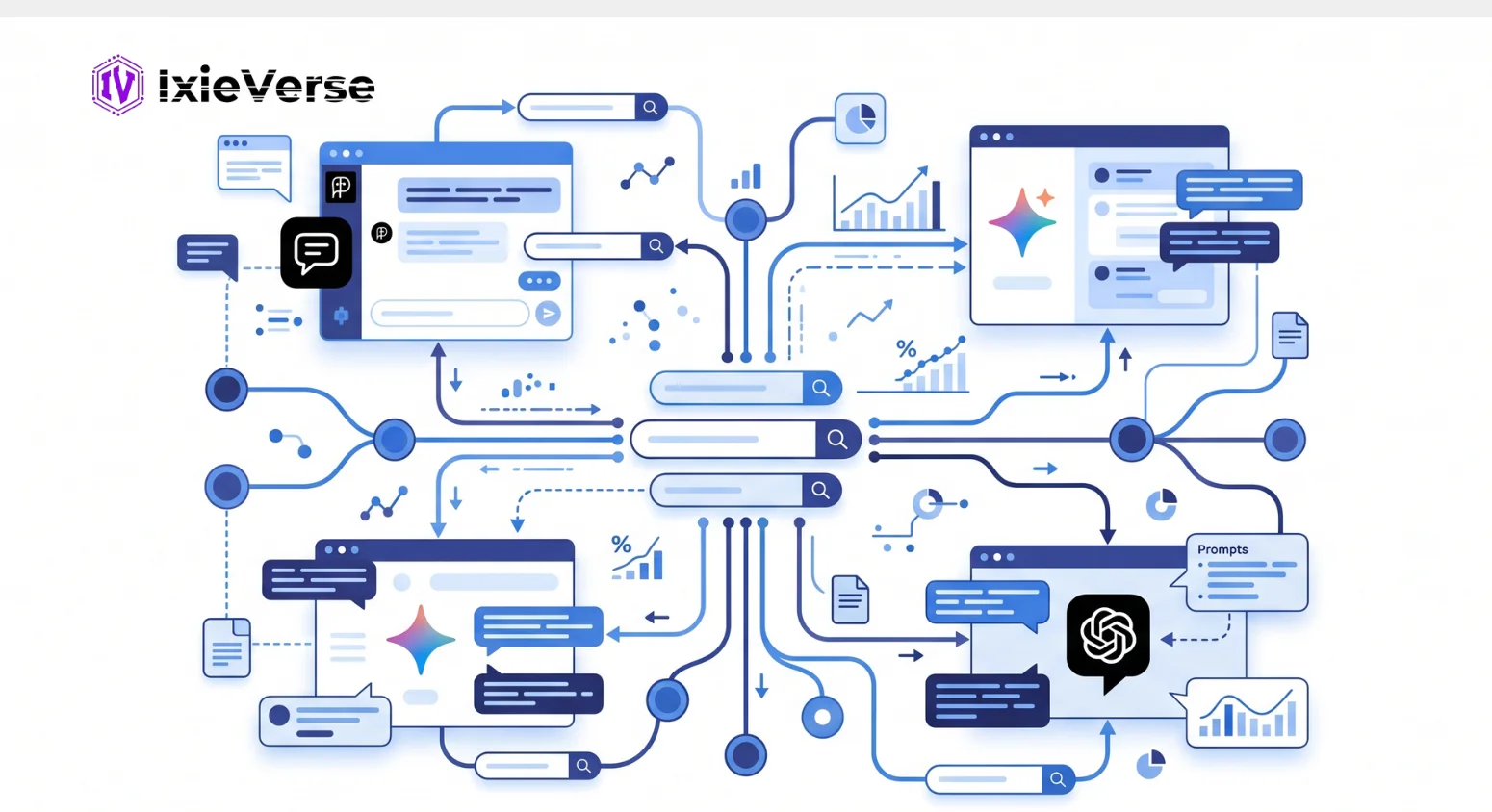
Prompt tracking has no search volume, no fixed ranking position, and no stable results, so choosing the right prompts matters far more than tracking a lot of them. This guide covers 5 prompt types, 3 buyer-journey stages, 6 ways to source prompts, a 4-criteria filter framework, query fan-out and citation drift explained simply, and a free checklist to build a focused list of 20-40 prompts worth tracking.
Most teams start prompt tracking the same way: they pick a handful of “best [category] tool” prompts and call it a strategy. Then they’re confused when the data doesn’t tell them much. The problem isn’t the tracking — it’s that most people are tracking the wrong prompts, for the wrong reasons, without a framework. Here’s one that works.
 ChatGPT
 Grok
Grok
 Claude
 Perplexity
 Google AI
- 1 Is Prompt Tracking the Same as Keyword Tracking?
- 2 What Is Query Fan-Out (and Why It Matters)?
- 3 What Is Citation Drift?
- 4 SEO vs GEO vs AEO, in Plain Terms
- 5 The 5 Prompt Categories to Track
- 6 Map Prompts to the Buyer Journey
- 7 How to Find the Right Prompts: 6 Sources
- 8 The 4-Criteria Filter Framework
- 9 How Many Prompts Should You Actually Track?
- 10 Can You Track AI Visibility for Free?
- 11 What Is a Citation Rate?
- 12 What to Do With Your Tracking Data
- 13 Frequently Asked Questions
- What is AI prompt tracking?
- How many prompts should I track?
- What’s the difference between prompt tracking and keyword tracking?
- Which AI platforms should I prioritize?
- How often should I update my prompt list?
Is Prompt Tracking the Same as Keyword Tracking?
No. Keyword tracking works because you have search volume and a fixed ranking position to measure. Prompt tracking has neither. There’s no reliable query volume, no fixed position, and the same question can return a different brand mention depending on the AI engine, the user’s location, session history, or even the time of day. A smaller, well-chosen prompt list beats a large generic one, because you’re sampling a moving system, not measuring fixed demand.
What Is Query Fan-Out (and Why It Matters)?
Query fan-out is what happens when an AI model breaks one prompt into several smaller retrieval tasks behind the scenes before generating an answer. Ask ChatGPT “best CRM for a small agency,” and it may silently research pricing pages, review sites, and comparison posts as separate sub-queries before combining them into one response. This matters for prompt selection because a single prompt you track is really a proxy for several underlying searches — which is exactly why broad, well-covered content ranks in more AI answers than narrow, single-angle pages.
What Is Citation Drift?
Citation drift is when the same prompt, run again days or even minutes later, returns different sources, different brand mentions, or a different framing entirely. Run “best project management tool for remote teams” in ChatGPT twice, and you may see two different top picks. Independent research on AI Mode queries found that only about 35% of cited domains repeat between runs — meaning roughly two-thirds change. Citation drift is why prompt tracking data is directional, not exact, and why you track trends over 30+ days instead of judging a single run.
SEO vs GEO vs AEO, in Plain Terms
SEO (Search Engine Optimization) is getting your page to rank in Google’s blue links. AEO (Answer Engine Optimization) is getting your content chosen as the direct answer in featured snippets and AI Overviews. GEO (Generative Engine Optimization) is getting your brand cited or recommended inside AI chat answers like ChatGPT and Perplexity. All three work together now — a page built well for AEO and GEO also tends to rank better in classic search.
| Term | What It Means | Goal |
| SEO | Getting your page to rank in Google’s standard search results | Rank in blue links |
| AEO | Getting your content chosen as the direct answer in featured snippets and AI Overviews | Win the answer box |
| GEO | Getting your brand cited or recommended inside AI chat answers (ChatGPT, Perplexity) | Get cited/recommended |
The 5 Prompt Categories to Track
Every buyer interacts with AI differently depending on where they are in their decision process. Cover all five categories below before adding volume, or you’ll end up with a list that’s heavy in one area and blind in the rest.
| Type | Example Prompt | Funnel Stage | Notes |
| Informational | “Is CRM software worth it for a 5-person team?” | Awareness | Shapes how buyers understand the problem |
| Comparative | “Best project management tools for remote teams” | Consideration | Most competitive category |
| Instructional | “How to reduce churn in a B2B SaaS product” | Consideration | Often generates rich citations |
| Brand-specific | “Is [Brand] worth it in 2026?” | Decision | Track separately from category data |
| Transactional | “Best running shoes under $100 near me” | Decision | Best for ecommerce/local brands |
A fast-growing sixth category worth watching: generative prompts, where users ask AI to build something for them, such as “Write me a content brief for X” or “Build me a 3-month SEO plan.”
Map Prompts to the Buyer Journey
The same prompt category means something different depending on the buyer’s stage. Track these three stages separately so your data reflects what it’s actually influencing:
- Awareness: “Are electric cars expensive to maintain?” — be the source that frames the problem before a shortlist even exists.
- Consideration: “HubSpot vs Pipedrive for a 20-person team” — win comparison and alternative-to prompts; this is where most buying decisions get shaped.
- Decision: “Is [Brand] worth it?” — track sentiment closely, separately from category prompts, since brand-name prompts almost always surface your brand and will skew broader metrics if mixed in.
Explore: AI Search Statistics 2026: 60+ Verified Numbers Every Marketer Should Know
How to Find the Right Prompts: 6 Sources
- Convert your top 30-50 SEO keywords into natural, conversational questions.
- Mine Google’s People Also Ask boxes for pre-validated phrasing people already use.
- Check which of your keywords trigger AI Overviews, and note the exact question being answered — Google has already flagged that query as “AI-answer-worthy.”
- Scan Reddit, Quora, and industry forums for how people actually phrase problems in their own words (Reddit is one of the most-cited domains across AI engines, so its phrasing patterns carry extra weight).
- Reverse-engineer competitor FAQ pages, comparison posts, and how they segment customers on their own site (by industry, team size, or use case).
- Ask ChatGPT or Perplexity directly: “What questions would a buyer ask before choosing [category]?” — then cross-check the results against real customer language from sales calls or support tickets before trusting them.
The 4-Criteria Filter Framework
Before adding any prompt to your tracking list, run it through these four filters. Cut anything that fails more than one.
- Competitive relevance — do AI answers to this prompt actually mention real brands, or is the answer purely generic and educational?
- Influenceability — check who AI currently cites for this prompt. If it’s dominated by government sites, Wikipedia, or sources you have no realistic path to outrank, deprioritize it.
- Business intent — does appearing in this answer create real pipeline or buying influence, not just passive education?
- Scope fit — is the prompt specific enough to be meaningful (not “best CRM”) but broad enough to matter (not so narrow it gets asked once a year)?
How Many Prompts Should You Actually Track?
- Start with 20-40 prompts total across 2-3 AI engines — ChatGPT, Google AI Overviews, and Perplexity are the priority set in 2026.
- Split roughly: 10-20 awareness prompts, 15-20 consideration prompts, 5-10 brand-evaluation prompts tracked separately.
- Track for at least 30 days before drawing conclusions — a single run tells you almost nothing because of citation drift.
- A focused list of 30 strong prompts consistently outperforms 200 generic ones, because it’s actually possible to act on the results.
Can You Track AI Visibility for Free?
Yes. Manually run 20-30 prompts weekly in ChatGPT, Perplexity, and Gemini, screenshot the answers, and log which brands and sources get cited in a simple spreadsheet. It costs time, not money, but it won’t scale past a few dozen prompts and won’t show automated trend data. Once you outgrow manual tracking, dedicated tools take over the heavy lifting.
| Method / Tool | Best For | Free Tier | Scales Past ~30 Prompts? |
| Manual tracking | Testing the idea before investing | Yes (free, time cost) | No |
| SE Visible | Sentiment + topic clustering | Limited trial | Yes |
| Ahrefs Brand Radar | SEO teams already on Ahrefs | No | Yes |
| Peec AI / Otterly.AI / Profound | Dedicated AI-visibility monitoring | Varies | Yes |
You Might Like: Best Ahrefs Alternatives in 2026 (Ranked, Compared & AI-Search Ready)
What Is a Citation Rate?
Citation rate is the percentage of times your brand or domain appears when a specific prompt is run repeatedly across an AI engine. If you run a prompt 20 times over a month and your domain shows up in 7 of those answers, your citation rate is 35%. It’s the closest equivalent GEO has to a keyword “ranking position,” and it’s the single most useful number for measuring whether your content changes are actually working.
What to Do With Your Tracking Data
- Not cited, but competitors are: rewrite your closest matching page to directly answer the prompt in a 40-60 word block near the top, and add FAQ or Article schema.
- Cited, but sentiment is negative: find the source shaping that narrative and publish a balanced, well-sourced counter-piece that addresses the concern directly.
- No brand cited at all: this is a brand-insertion opportunity — publish content that answers the query clearly, directly, and completely.
Frequently Asked Questions
What is AI prompt tracking?
It’s the practice of querying LLMs with natural-language questions to measure how often and how favorably your brand appears in AI-generated answers, using citation rate and sentiment instead of rank position.
How many prompts should I track?
Start with 20-40 prompts across 2-3 AI platforms and review results after 30 days minimum, since AI answers vary between runs.
What’s the difference between prompt tracking and keyword tracking?
Keyword tracking uses volume and rank position on a stable results page. Prompt tracking uses citation rate and sentiment on answers that change between runs and have no public volume data.
Which AI platforms should I prioritize?
ChatGPT, Google AI Overviews, and Perplexity cover most AI-driven buyer journeys in 2026. Add Gemini and Claude once you have a baseline.
How often should I update my prompt list?
Every 60-90 days. Buyer language, competitors, and AI training data all shift fast enough that a quarterly refresh keeps your tracking accurate.



![50 Best Website Design Examples for Inspiration [2026]](https://ixieverse.com/wp-content/uploads/2026/08/Best-Website-Design-Examples-150x150.webp)
Add a Comment