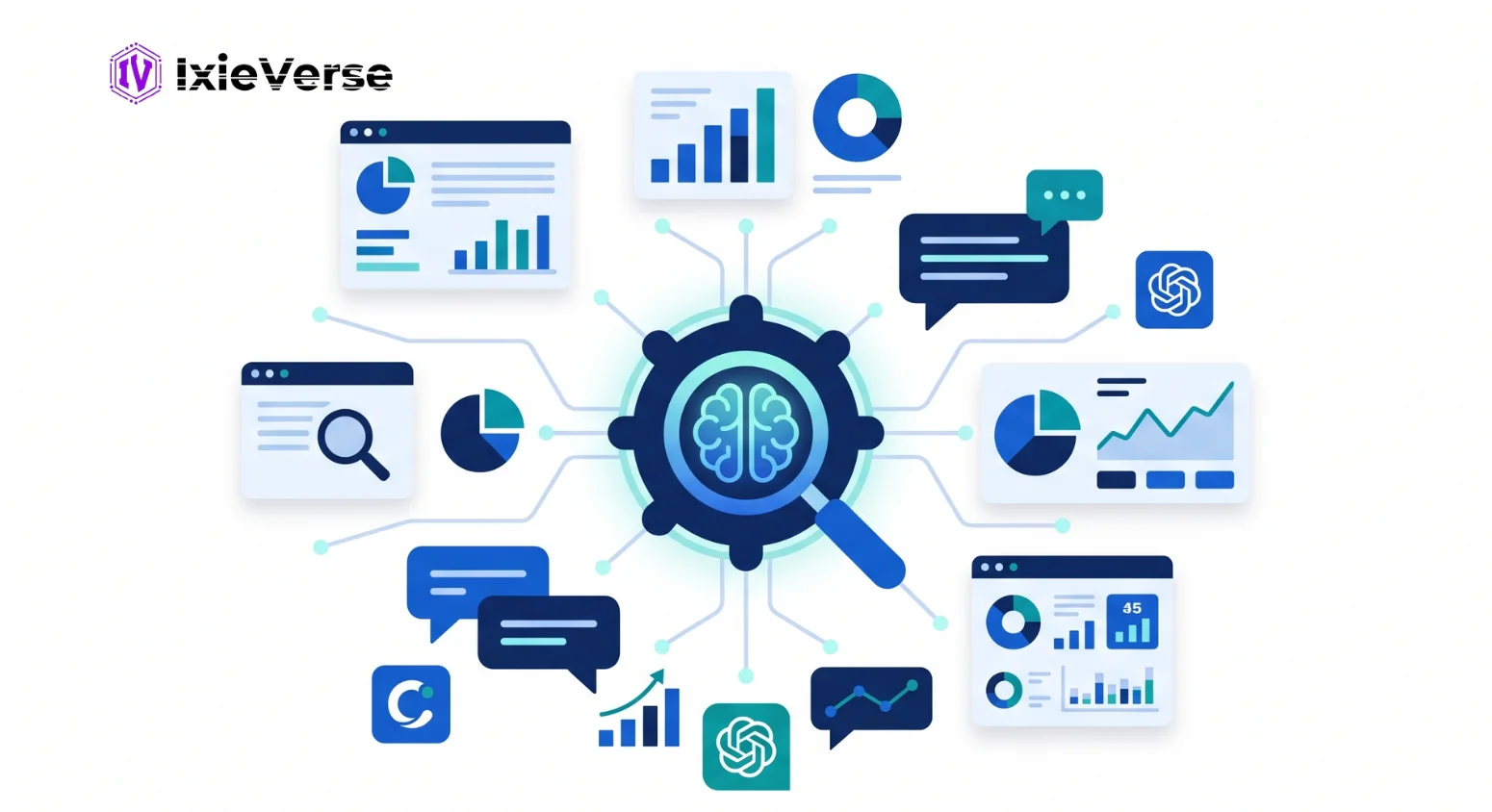
AI search has moved from experiment to default behavior. Google’s AI Overviews, ChatGPT, Perplexity, and Gemini now shape how millions of people find information — and how often your website gets the click. Below are the most current, sourced AI search statistics, organized so you can act on them immediately.
 ChatGPT
 Grok
Grok
 Claude
 Perplexity
 Google AI
- 1 TL;DR — Key Numbers
- 2 What Is AI Search?
- 3 How Often Do AI Overviews Appear in Google Search?
- 4 Which AI Platforms Send the Most Traffic?
- 5 What Makes Content Get Cited by AI?
- 6 How Is AI Changing Online Shopping?
- 7 Who Is Using AI Search, and How Fast Is Adoption Growing?
- 8 AI Search vs. Traditional SEO
- 9 How to Win AI Search Visibility in 2026
- 10 Frequently Asked Questions
- What percentage of Google searches trigger AI Overviews?
- Which AI platform sends the most website traffic?
- How do AI Overviews affect click-through rates?
- What is the best content length for AI citation?
- How often should content be updated for AI search?
- Is AI going to replace Google search?
TL;DR — Key Numbers
- AI Overviews appear on roughly 30% of US Google searches (SE Ranking, 2025).
- ChatGPT sends over 77% of all AI-referred traffic worldwide.
- AI Overviews cut clicks to outside websites by 34.5% (Ahrefs, 2025).
- Content over 2,900 words is 59% more likely to be cited by ChatGPT.
- Pages updated in the last 2–3 months are cited roughly twice as often.
- AI-referred visitors stay on-site 68% longer than typical organic visitors.
What Is AI Search?
AI search uses large language models to read a question, pull facts from multiple web sources, and hand back one written answer instead of ten blue links. It covers Google’s AI Overviews and AI Mode, plus ChatGPT, Perplexity, and Gemini. For marketers, being quoted inside that answer is now as valuable as ranking #1 used to be.
How Often Do AI Overviews Appear in Google Search?
About 30% of US keyword searches now trigger an AI Overview, and longer, more descriptive searches trigger them far more often than short ones — a 10-word query is over five times more likely to show an AI Overview than a single-word search (SE Ranking, 2025).
- Highest AI Overview coverage: Relationships (~61%), Business (~57%), Education (~50%), Food & Beverage (~46%)
- Average AI Overview answer length: about 1,766 characters (254 words)
- Most-cited sources: Google.com, YouTube, Reddit, Quora, Wikipedia
- A typical response cites 4–14 sources; longer answers cite up to 28
- Clicks to outside websites drop 34.5% once an AI Overview appears (Ahrefs, 2025)
- 39% of marketers report traffic loss since AI Overviews rolled out — tech (44%), travel (43%), and retail (35%) are hit hardest
Which AI Platforms Send the Most Traffic?
AI-referred visitors stay 68% longer on a site than organic visitors, and ChatGPT prompts average about 60 words — 18 times longer than a typical 3.4-word Google search — so people arrive already informed and stay engaged longer.
| Platform | Share of AI Referral Traffic | What It Means |
| ChatGPT | 77%+ | The dominant AI traffic source by far |
| Perplexity | ~15% | Growing quickly for research-style queries |
| Gemini | 6.4% | Underperforms relative to Google’s search share |
| DeepSeek | 0.37% | Small, mostly international |
| Claude | 0.17% | Mostly professional and enterprise use |
What Makes Content Get Cited by AI?
AI models favor content that is long, fresh, fast-loading, and already discussed elsewhere online. The strongest predictors are content length, update recency, page speed, and mentions on Reddit and Quora — not backlinks alone.
| Factor | ChatGPT Threshold | AI Mode Threshold |
| Content length | 2,900+ words = 59% more likely | 2,300+ words = 25–30% more likely |
| Section length | 120–180 words per section | 100–150 words per section |
| Freshness | Updated <3 months = 2x citations | Updated <2 months = +28% |
| Page speed | FCP <0.4s = 3x more likely | LCP >1.85s = worst performers |
| UGC mentions | 219K Reddit / 26K Quora = 3x | 35K Reddit / 3.8K Quora = 1.7x |
Google’s AI Mode is also highly unstable: more than 60% of cited domains and 80% of cited URLs change between identical, repeated searches — so appearing consistently across many queries matters more than dominating a single one.
How Is AI Changing Online Shopping?
89% of retailers are already using or piloting AI, and 87% say it has lifted revenue (NVIDIA, 2025). AI chat nearly quadruples conversion rate — 12.3% of AI-chat shoppers complete a purchase versus 3.1% of others — and cuts checkout time from 15 minutes to 8. Roughly 64% of AI-driven sales come from new shoppers, meaning AI functions as an acquisition channel, not just a retention tool. The global AI-enabled e-commerce market is projected to grow from $7.25 billion in 2024 to $64 billion by 2034 (Precedence Research).
Who Is Using AI Search, and How Fast Is Adoption Growing?
Nearly 40% of marketers use AI tools daily, and only 7% have never used one. Among 18–24-year-olds, 66% now use ChatGPT to find information — nearly matching Google’s 69% share in the same age group — while 66% of consumers overall believe AI will fully replace traditional search within five years.
AI Search vs. Traditional SEO
| Factor | Traditional SEO | AI Search (AEO) |
| Query length | 3.4 words average | ~60 words average |
| Click behavior | High CTR on top results | 1 click per 20 prompts |
| Ranking signal | Backlinks, on-page SEO | Freshness, structure, UGC mentions |
| Volatility | Relatively stable | 80% URL turnover in AI Mode |
How to Win AI Search Visibility in 2026
- Write 2,900+ word guides split into 120–180-word sections, each answering one clear question.
- Refresh core pages every 8–10 weeks — freshness alone roughly doubles citation odds.
- Build a genuine presence on Reddit and Quora; both carry outsized weight in AI source selection.
- Keep pages fast — a sub-0.4-second first paint measurably improves ChatGPT citation odds.
- Add direct-answer blocks, FAQs, and comparison tables that AI engines can lift cleanly into a summary.
Frequently Asked Questions
What percentage of Google searches trigger AI Overviews?
About 30% of US keyword searches trigger an AI Overview, with long, descriptive queries triggering them far more often than short ones (SE Ranking, 2025).
Which AI platform sends the most website traffic?
ChatGPT, with more than 77% of all AI-referred visits worldwide — well ahead of Perplexity (~15%) and Gemini (6.4%).
How do AI Overviews affect click-through rates?
They cut clicks to outside websites by about 34.5%, and 39% of marketers report a measurable traffic drop since launch (Ahrefs, 2025).
What is the best content length for AI citation?
Around 2,900+ words for ChatGPT and 2,300+ words for AI Mode, split into 120–180-word sections per heading.
How often should content be updated for AI search?
Every 2–3 months. Pages refreshed within that window are roughly twice as likely to be cited as older pages.
Is AI going to replace Google search?
Not fully, but the gap is closing — 66% of 18–24-year-olds already use ChatGPT for search nearly as often as Google.


![50 Best Website Design Examples for Inspiration [2026]](https://ixieverse.com/wp-content/uploads/2026/08/Best-Website-Design-Examples-150x150.webp)
Add a Comment