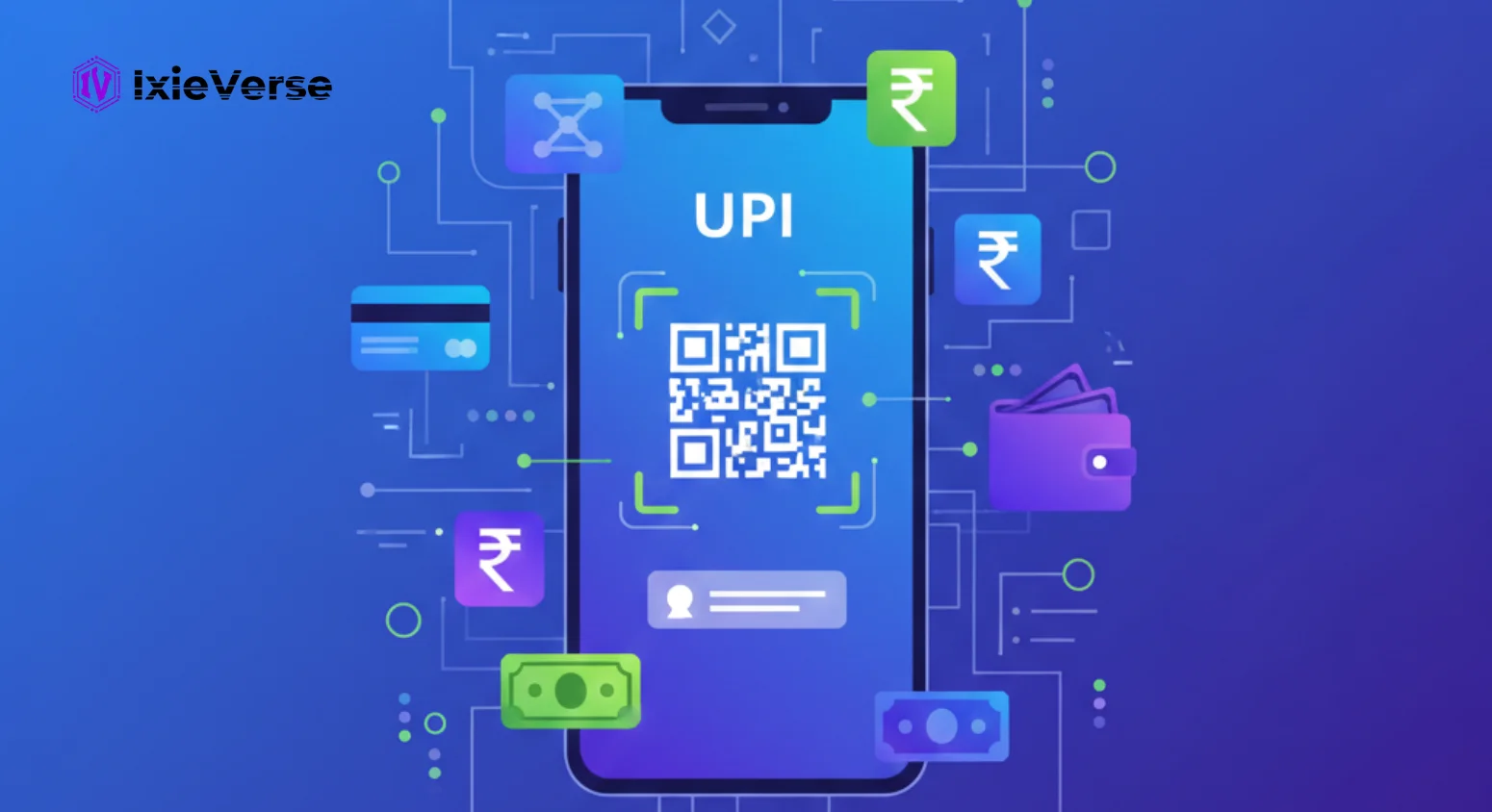
You’ve seen the stickers. Every shop, every street vendor, every auto driver has a UPI QR code plastered somewhere. “Pay by PhonePe.” “Google Pay accepted here.” “Scan and pay.”
UPI isn’t just a payment method anymore—it’s basically how India does money now.
But here’s what most people don’t know: UPI handles more daily transactions than Visa does globally. And yet, most users can’t explain what “Unified Payments Interface” actually means or how their money moves from one account to another in seconds.
If you’re one of them, you’re in the right place.
This guide breaks down what UPI is, how to use it safely, and what to do when things go wrong (like when your payment shows “failed” but your money’s gone). We’ll also cover the stuff nobody talks about—like the 23 Lakh UPI scam in Victoria Hospital 2026 and how to protect yourself.
Quick Answer:
UPI is a real-time payment system in India that lets you send money directly from one bank account to another using your phone. You don’t need to share account numbers or IFSC codes—just a UPI ID, mobile number, or QR code is enough. It works 24/7, even on weekends and holidays, and most transactions are free. Apps like PhonePe, Google Pay, and BHIM use the same UPI system run by NPCI.
 ChatGPT
 Grok
Grok
 Claude
 Perplexity
 Google AI
- 1 What is UPI?
- 2 Features and Benefits of UPI
- Instant Payments, Anytime
- No Need to Share Bank Details
- Works With All Banks and Apps
- Strong Security for Every Payment
- Mostly Free to Use
- One System for Many Payments
- Who Benefits From UPI?
- 3 How Does UPI Work?
- What Happens When You Make a UPI Payment
- Role of NPCI in UPI
- How UPI Stays Secure While Working Fast
- Types of UPI Transactions
- Why UPI Payments Are Instant
- 4 Setting Up and Using UPI: Step-by-Step Guide
- Initial Setup (First-Time Users)
- How to Send Money
- How to Receive Money
- How to Request Money
- 5 Popular UPI Apps in India: Which One Should You Choose?
- Top UPI Apps by Market Share
- Comparison Table
- Which One Should You Actually Download?
- 6 UPI vs Other Payment Methods: A Detailed Comparison
- Why UPI Dominates
- When to Use What
- 7 The Future of UPI: What’s Coming Next
- Global Expansion Plans
- Technology Innovations
- Market Projections (2026-2029)
- Regulatory Evolution
- 8 Challenges Ahead
- 1. Infrastructure Scaling
- 2. Fraud Management
- 3. Digital Literacy
- 4. Competition
- 9 CONCLUSION
- 10 FAQs
- 1. Can I use UPI without internet connection?
- 2. What should I do if my UPI payment failed but money got deducted from my account?
- 3. Is there a way to increase my UPI daily transaction limit beyond ₹1 lakh?
- 4. What’s the difference between UPI and digital wallets like Paytm or PhonePe wallet?
- 5. Can I cancel or reverse a UPI payment after sending it?
- 6. Which is safer: UPI or credit/debit cards for online payments?
What is UPI?
Most people use UPI every day, but very few actually know what UPI is or how it works behind the scenes. That gap creates confusion—especially around safety, limits, and whether UPI is different from apps like Google Pay or PhonePe.
UPI (Unified Payments Interface) is a real-time digital payment system developed by NPCI (National Payments Corporation of India) that allows you to transfer money directly between bank accounts using your mobile phone. You don’t need to share bank account numbers, IFSC codes, or card details—just a UPI ID, mobile number, or QR code.
At its core, UPI connects multiple banks into one common payment interface. This means you can send or receive money instantly, 24/7, using any UPI app, regardless of which bank you or the other person uses.
Think of UPI as WhatsApp for money:
- You don’t need to know someone’s bank details
- You just need their UPI ID or QR code
- The money moves instantly from bank to bank
Key things that define UPI:
- Full form: Unified Payments Interface
- Launched in: 2016
- Managed by: NPCI (under RBI regulation)
- Type: Real-time bank-to-bank payment system
- Access: Through UPI apps like BHIM, PhonePe, Google Pay, Paytm, or bank apps
Unlike wallets, UPI does not store money separately. Every payment goes directly from your bank account to the recipient’s bank account, which is why UPI payments are fast, trackable, and widely accepted across India.
Features and Benefits of UPI
Earlier, sending money meant long bank details, fixed banking hours, and slow transfers. UPI fixed these problems by making payments fast, simple, and easy for everyday use.
Here are the main features and benefits of UPI explained in plain language.
Instant Payments, Anytime
Money transfers shouldn’t depend on bank timings. UPI works 24/7, even on weekends and holidays.
- Money moves instantly from one bank to another
- Most payments take a few seconds
- No waiting for “working hours”
No Need to Share Bank Details
Sharing account numbers feels risky and confusing. UPI lets you pay without sharing any bank details.
- Pay using a UPI ID, phone number, or QR code
- No IFSC codes or account numbers needed
- Safer for daily payments
Works With All Banks and Apps
Earlier, payments were tied to one bank or app. UPI connects all banks on one system.
- Send money between any two banks
- Use any UPI app you like
- App choice doesn’t limit payments
Strong Security for Every Payment
Fast payments often raise safety concerns. UPI adds security at every step.
- Payments work only on your registered phone
- Every payment needs a UPI PIN
- Your bank details are never shared
Mostly Free to Use
Many payment methods charge hidden fees. UPI is free for most users.
- No charges for sending money to friends or family
- Merchant payments usually cost nothing for users
- No setup or maintenance fees
One System for Many Payments
Using multiple apps for different payments is frustrating. UPI handles almost everything in one place.
- Send and receive money
- Pay at shops and online
- Pay bills and recharges
- Set automatic payments with UPI AutoPay
Who Benefits From UPI?
For Individuals
- No need to carry cash
- Easy bill splitting
- Quick refunds
- Simple way to track payments
For Shop Owners and Businesses
- Money goes straight to the bank
- No card machines needed
- Lower costs
- Easy payment records
For India’s Economy
- Brings more people into digital payments
- Reduces cash use
- Makes payments more transparent
How Does UPI Work?
For many users, UPI feels like magic—tap, enter PIN, and the money is gone. The confusion comes from not knowing what actually happens in those few seconds and why UPI is so fast.
UPI works by directly connecting your bank account to the receiver’s bank account in real time, using a secure system managed by NPCI. No money is stored in the app, and no bank details are shared.
What Happens When You Make a UPI Payment
When you send money, several checks happen instantly in the background.
- You enter the UPI ID, phone number, or scan a QR code
- The app sends the request to NPCI, which acts as the central switch
- NPCI verifies both banks and routes the payment
- Your bank confirms the UPI PIN
- Money moves directly from your bank account to the receiver’s bank account
All of this usually takes 10–15 seconds.
Role of NPCI in UPI
People often think UPI apps run the system. They don’t. NPCI does.
- NPCI connects all participating banks
- It ensures payments follow RBI rules
- It handles real-time settlement and tracking
UPI apps are just the interface you use on your phone.
How UPI Stays Secure While Working Fast
Speed without security would be risky. UPI uses multiple checks to protect every transaction.
- Payments work only on your registered mobile device
- Every transaction needs a UPI PIN
- Bank account details are replaced with a virtual UPI ID
- Data is encrypted end to end
Types of UPI Transactions
UPI is not just for sending money to friends. It supports multiple payment types.
- Person-to-Person (P2P): Send money to family or friends
- Person-to-Merchant (P2M): Pay at shops or online stores
- Request Money: Ask someone to pay you
- Bill Payments: Electricity, mobile, DTH, and more
- UPI AutoPay: Automatic payments for subscriptions and EMIs
Why UPI Payments Are Instant
Traditional transfers wait in batches. UPI uses real-time processing through IMPS, which means:
- No waiting for bank hours
- No settlement delays
- Instant confirmation for both sender and receiver
Setting Up and Using UPI: Step-by-Step Guide
Getting started with UPI can feel a bit confusing because there are many apps and options. Once you set it up, though, using UPI becomes as easy as sending a text message.
Initial Setup (First-Time Users)
Step 1: Choose a UPI App
All UPI apps work on the same system, so the basics are the same everywhere. The difference is mainly how the app looks and what extra features it offers.
- BHIM – Official government app, simple and no distractions
- Bank apps – SBI YONO, HDFC PayZapp, ICICI iMobile, etc.
- Other apps – PhonePe, Google Pay, Paytm
Choose an app that:
- Feels easy to use
- Has features you like (bill reminders, rewards, etc.)
Step 2: Download and Register
After choosing the app, setting it up takes only a few minutes.
- Download the app from the official app store
- Verify your mobile number (it must be linked to your bank account)
- Set an app lock or fingerprint lock for safety
Step 3: Link Your Bank Account
This step connects your bank to the UPI app.
- Select your bank name from the list
- The app finds accounts linked to your mobile number
- Verify using SMS or debit card details
- Create a 4–6 digit UPI PIN
Step 4: Create Your UPI ID
Your UPI ID is what people use to pay you.
- It looks like yourname@bankname
- You can create more than one UPI ID
- Pick something easy to remember
How to Send Money
Sending money with UPI is quick and simple.
- Open your UPI app
- Tap Send Money or Pay
- Enter the receiver’s:
- UPI ID, or
- Mobile number, or
- Scan their QR code
- Enter the amount
- Add a note if you want
- Enter your UPI PIN
- Payment is done in seconds
How to Receive Money
You don’t need to do much to receive money.
- Share your UPI ID or QR code
- The sender makes the payment
- Money comes directly into your bank account
- No UPI PIN is needed to receive money
How to Request Money
Requesting money is helpful for shared bills or payments due.
- Open your UPI app
- Enter the other person’s details
- Enter the amount
- Add a short reason
- Send the request
- They approve it using their UPI PIN
Popular UPI Apps in India: Which One Should You Choose?
Here’s the reality: you can use any UPI app to send money to anyone using a different UPI app. They all connect to the same system run by NPCI. So why does it matter which one you pick?
The difference is in the experience. Some apps are faster, some offer cashback, and some have extra features you might actually use. Let’s break down the most popular options so you can decide what works for you.
Top UPI Apps by Market Share
These aren’t random recommendations. These are the apps that dominate India’s digital payment space based on actual transaction data from December 2025.
1. PhonePe (47.8% market share)
PhonePe is the most used UPI app in India. Nearly half of all UPI transactions happen through this app. That’s over 6 billion transactions every month.
Why people prefer it:
- Clean, simple interface that even first-time users can figure out in minutes
- Works everywhere – if a shop accepts UPI, they accept PhonePe
- Regular cashback offers on bill payments and recharges
- Super reliable – the app rarely crashes even during peak hours
- Merchant QR codes are everywhere – you’ll see their stickers at almost every store
The app also lets you buy gold, invest in mutual funds, and get insurance. But honestly, most people just use it for payments and that’s perfectly fine.
Best for: People who want the most widely accepted, reliable option with occasional cashback rewards.
2. Google Pay (34%+ market share)
Google Pay is the second biggest player with about one-third of the UPI payment market. If you already use Gmail or other Google services, this one feels natural.
What makes it different:
- Connects to your Google account – one less username and password to remember
- Smart payment reminders – it’ll ping you when bills are due
- Reward system that gives you scratch cards after transactions (some people love this, others find it gimmicky)
- Works in multiple Indian languages – helpful if English isn’t your first language
- Google integration means you can send money right from Gmail or Google Assistant
The app pushes a lot of extra features like bill splitting and group payments. Some find this useful, others think it clutters the interface.
Best for: People already deep in the Google ecosystem who want everything in one place.
3. Paytm (10%+ market share)
Paytm was doing digital payments before UPI even existed. They started with a wallet system and later added UPI. You’re getting both in one app.
Why some people still prefer it:
- Wallet + UPI combo – you can use either depending on what works better
- Every merchant accepts it – Paytm has the oldest and biggest merchant network
- All-in-one app – mobile recharges, movie tickets, train bookings, food delivery
- Instant discounts at partner stores when you pay through the app
The downside? The app tries to do too much. Sometimes you just want to pay someone ₹500, not browse movie tickets.
Best for: People who want one app for everything – payments, shopping, bookings, recharges.
4. BHIM (Government App)
BHIM is the official UPI app from NPCI – the same organization that runs the entire UPI system. It’s government-backed and focused purely on payments.
What you get:
- Maximum privacy – no tracking, no ads, no merchant partnerships
- Bare-bones interface – just payment features, nothing extra
- Available in 13 Indian languages including Hindi, Tamil, Telugu, Bengali
- No company is collecting your data to sell you stuff later
The catch? No rewards, no cashback, no fancy features. It’s just payments. For some people, that’s exactly what they want.
Best for: People who prioritize privacy and don’t care about rewards or extra features.
5. Bank-Specific Apps
Every major bank has its own UPI-enabled app – SBI YONO, HDFC PayZapp, ICICI iMobile Pay, and dozens more. These work just like PhonePe or Google Pay, but they’re made by your bank.
Why you might use one:
- Direct integration with your bank account – no third party involved
- All banking features in one place – check balance, pay bills, transfer money, apply for loans
- Sometimes higher transaction limits – some banks allow ₹2 lakh transactions for their own app users
- Priority customer support if something goes wrong
The problem? Most bank apps feel clunky compared to PhonePe or Google Pay. The user experience just isn’t as smooth.
Best for: People who do a lot of banking tasks and want everything in their bank’s app, or those who need higher transaction limits.
Comparison Table
| Feature | PhonePe | Google Pay | Paytm | BHIM | Bank Apps |
| Market Share | 47.8% | 34% | 10% | ~3% | Varies |
| User Interface | ⭐⭐⭐⭐⭐ | ⭐⭐⭐⭐⭐ | ⭐⭐⭐⭐ | ⭐⭐⭐ | ⭐⭐⭐ |
| Cashback/Rewards | ⭐⭐⭐⭐ | ⭐⭐⭐⭐ | ⭐⭐⭐⭐ | ⭐⭐ | ⭐⭐ |
| Extra Features | ⭐⭐⭐⭐⭐ | ⭐⭐⭐⭐ | ⭐⭐⭐⭐⭐ | ⭐⭐⭐ | ⭐⭐⭐⭐ |
| Privacy | ⭐⭐⭐ | ⭐⭐⭐ | ⭐⭐⭐ | ⭐⭐⭐⭐⭐ | ⭐⭐⭐⭐ |
| Speed | ⭐⭐⭐⭐⭐ | ⭐⭐⭐⭐⭐ | ⭐⭐⭐⭐ | ⭐⭐⭐⭐ | ⭐⭐⭐⭐ |
| Merchant Acceptance | ⭐⭐⭐⭐⭐ | ⭐⭐⭐⭐⭐ | ⭐⭐⭐⭐⭐ | ⭐⭐⭐⭐ | ⭐⭐⭐⭐ |
Which One Should You Actually Download?
Here’s the straight answer: you can download multiple UPI apps. They all work with the same bank account. Most people have 2-3 apps installed.
A common setup:
- PhonePe or Google Pay as your main app for daily payments
- Your bank’s app as backup when you need banking features
- Paytm if you book tickets or order food frequently
You don’t need to pick just one. Install the most popular one first (PhonePe or Google Pay), use it for a week, and see if it works for you. If not, try another. All your transaction history stays with your bank anyway, not the app.
Also Read: What is Digital Marketing
UPI vs Other Payment Methods: A Detailed Comparison
You have options when it comes to sending money in India. UPI isn’t the only way – there’s NEFT, RTGS, IMPS, and good old debit/credit cards. So why does everyone use UPI now?
Let’s compare them side-by-side so you know exactly when to use what.
| Feature | UPI | NEFT | RTGS | IMPS | Debit/Credit Card |
| Speed | Instant (10-15 sec) | 2-24 hours | 30 mins | Instant | Instant |
| Availability | 24/7 | Limited hours | Limited hours | 24/7 | 24/7 |
| Transaction Fee | ₹0 (usually) | Varies | ₹2-30 | Small fee | 1-3% |
| Minimum Amount | ₹1 | ₹1 | ₹2 lakh | ₹1 | No limit |
| Maximum Amount | ₹1 lakh | No limit | No limit | ₹5 lakh | Varies |
| Setup Required | UPI PIN | Bank account | Bank account | Bank account | Card |
| Credentials Needed | UPI ID/Mobile | Account+IFSC | Account+IFSC | Account+IFSC | 16-digit card no. |
| Best For | Daily transactions | Large transfers | High-value bulk | Urgent needs | Online shopping |
Why UPI Dominates
UPI handles 84.8% of India’s retail digital payments. That’s not an accident. Here’s why it took over:
Convenience beats everything else. With UPI, you don’t need to know someone’s bank account number, IFSC code, or any of that banking stuff. Just ask for their phone number or UPI ID. That’s it.
Speed matters when you’re splitting bills. NEFT takes 2-24 hours to process. UPI takes 10-15 seconds. When you’re at a restaurant and need to pay your friend back, you can’t wait until tomorrow.
Free is better than 1-3% fees. Every time you swipe a credit card, the merchant pays 1-3% to the card company. That’s why some shops give discounts for UPI – it saves them money. For you as a user, most UPI transactions are completely free.
Everyone has UPI now. There are 420 million UPI users in India. Only 53 million people have credit cards. When you send money via UPI, you know the other person can receive it. With cards, you need to check if they even have one.
You can’t accidentally share the wrong details. Try sending money via NEFT and entering the wrong account number – your money goes to a stranger. With UPI, the app shows you the recipient’s name before you confirm. You catch mistakes before they happen.
When to Use What
Here’s the practical guide. Each payment method has situations where it actually makes sense.
Use UPI for:
- Daily expenses like groceries, fuel, restaurants
- Splitting bills with friends (instant settlement)
- Paying small merchants and street vendors
- Sending money to family members quickly
- Any payment up to ₹1 lakh that needs to happen right now
Use NEFT for:
- Scheduled transfers that don’t need to be instant (like rent on the 1st)
- Sending large amounts when RTGS feels overkill
- Bulk payments to multiple people (salary distribution)
- Situations where you have time and want to save the small transaction fee
- Transfers to accounts that don’t have UPI set up
Use RTGS for:
- Buying property or vehicles (₹10 lakh+ transfers)
- Business payments above ₹2 lakh that need same-day settlement
- High-value urgent transfers where you’re willing to pay ₹25-30 fee
- Situations where you need a proper banking record for tax/audit purposes
Use Cards for:
- Shopping on international websites (UPI doesn’t work outside India yet)
- Buying expensive items where you want EMI options
- Transactions where you want reward points or cashback
- Situations where you need chargeback protection (disputed purchases)
- When you don’t have enough in your bank account but have credit limit
Use Cash for:
- Elderly relatives who don’t use smartphones
- Rural areas with poor network connectivity
- Small vendors who haven’t set up digital payments yet
- Emergency situations when your phone battery is dead
- Situations where you want complete privacy (no digital trail)
The Future of UPI: What’s Coming Next
UPI is already massive. But what you’re using today is just version 1.0. The next few years will change how digital payments work – not just in India, but globally.
Here’s what’s actually happening behind the scenes.
Global Expansion Plans
Right now, UPI mostly works in India. Sure, you can use it in Nepal and a handful of other countries, but that’s about it. That’s changing fast.
NPCI’s goal: Make UPI work in 20+ countries by 2028-29. Not just for tourists, but as a payment method locals can use too.
Where they’re focusing:
- East Asia: Singapore already has it, Japan and South Korea in talks
- Gulf countries: UAE is live, Saudi Arabia and Qatar coming soon
- Europe: France has started, UK partnerships being signed
- The strategy: Sign bilateral payment treaties that let UPI talk to local systems
Why this matters:
32 million Indians live abroad. Right now, they need separate payment apps in every country. With global UPI, they can keep using PhonePe or Google Pay everywhere.
The big partnership to watch: PPRO Financial in the UK. They’re connecting UPI to European payment gateways. If this works, you’ll be able to pay at any store in London with your Indian UPI app.
The challenge? Getting other countries to adopt India’s payment standard. Most countries have their own systems. India is basically saying “our system is better, use ours.” That’s a tough sell.
Technology Innovations
The UPI you use today is software-based. Tomorrow’s UPI will be everywhere – in your watch, your car, your fridge, even your ring.
Blockchain integration is coming. Not the crypto kind – this is about making the backend more secure and faster. Banks are testing blockchain to process UPI transactions in under 5 seconds (currently 10-15 seconds).
IoT payments are next. Your smart refrigerator notices you’re out of milk, orders it from BigBasket, and pays via UPI automatically. Your car pays toll gates as you drive through. No phone needed.
Wearable UPI is already here in pilot mode:
- Smartwatches with UPI tap-to-pay
- Payment rings (yes, actual rings you wear)
- Smart bands for fitness trackers
Just tap your wrist on a merchant’s device and payment happens. Your bank account is linked to the device with biometric security.
Biometric authentication for high-value payments. Right now, you enter a UPI PIN. Soon, for payments above ₹50,000, you might use face recognition or iris scan instead. Harder to fake, easier for users.
5G integration means transactions process even faster. Current UPI runs on 4G networks. With 5G rolling out across India, payment confirmations will feel instant – we’re talking 2-3 second total time from scan to confirmation.
The weirdest innovation? Voice-activated payments from cars. You’re driving, your phone is in your pocket, you tell your car “pay parking fee” and it happens. This is being tested in 2025.
Market Projections (2026-2029)
The numbers are kind of ridiculous. But they’re based on actual growth trends, not random predictions.
By FY 2026-27 (two years from now):
- 379 billion transactions annually – that’s over 1 billion transactions per day
- Current rate is 698 million per day, so this is a 40%+ jump
By 2029 (four years out):
- ₹532 lakh crore in total transaction value – that’s $6.4 trillion in today’s dollars
- To put this in perspective: India’s entire GDP is around $3.7 trillion right now
- This means UPI will handle 1.7X India’s GDP in payments
Market share target: 90% of retail digital payments. Right now it’s 84.8%. The goal is to completely dominate. Cash will still exist, but UPI will be the default for digital.
User base projection: 550+ million active users. That’s up from 420 million today. Basically, every Indian adult with a smartphone will have UPI.
Merchant network: 10+ million merchants. Currently around 5 million. The push is to get every single shop – even small paan shops and vegetable vendors – onto UPI.
These aren’t random guesses. NPCI releases quarterly targets, and so far, they’ve beaten their own projections every time.
Regulatory Evolution
Right now, UPI is mostly unregulated. It’s free for users, free for most merchants, and banks just eat the cost. That’s changing.
Potential MDR (Merchant Discount Rate) for P2M payments. This means shops might pay a small fee (0.5-1%) when they receive UPI payments. Right now, most pay zero. Banks need this to make UPI profitable.
Users won’t be charged. But you might see some small shops add a “convenience fee” or offer discounts for cash to avoid the charge.
Clearer liability framework coming:
Right now, if you get scammed, it’s messy figuring out who’s responsible – your bank, the UPI app, or NPCI. New guidelines will spell out exactly who pays when fraud happens.
Data localization getting stricter. All UPI transaction data must stay in India. This affects international UPI apps – they’ll need servers in India to operate.
Cross-border payment standards being developed. For UPI to work globally, there need to be rules on how different countries’ payment systems talk to each other. India is pushing its standard to become the global norm.
Consumer protection getting beefed up:
- Faster grievance redressal (24-hour mandatory response)
- Automatic compensation for system failures
- Clearer refund policies when merchants don’t deliver
The RBI (Reserve Bank of India) is treating UPI like critical financial infrastructure now, not just a payment app. Expect more rules, but also more protection.
Challenges Ahead
UPI’s biggest problem is its own success. The system is getting so popular that it’s straining under the load.
1. Infrastructure Scaling
The system crashed multiple times. Not for long – maybe 15-30 minutes – but when 698 million transactions happen daily, even a small outage affects millions of people.
The math problem:
- Current capacity: ~640 million transactions per day
- Current usage: 698 million per day (already over capacity during peak hours)
- Projected need by 2027: 1+ billion per day
NPCI is building more servers, but it’s expensive. The system needs to handle 3X current load in the next three years.
2. Fraud Management
Scammers are getting smarter. The ₹1,087 crore lost to UPI fraud in 2024 is just what was reported. The real number is probably 2-3X higher.
New fraud types emerging:
- AI-generated fake customer support calls
- Deepfake video calls pretending to be bank officials
- SIM cloning attacks that bypass two-factor authentication
AI-powered fraud detection is critical. Banks are using machine learning to spot suspicious patterns in real-time. But fraudsters are also using AI to find vulnerabilities.
It’s an arms race. The question is whether security can keep up with scam innovation.
3. Digital Literacy
55% of rural India uses UPI now. But many don’t fully understand what they’re doing. They scan QR codes because someone told them to, not because they get how it works.
The problems:
- Elderly users falling for scams easily
- Language barriers (apps are mostly English/Hindi)
- No understanding of security basics (sharing PINs, clicking links)
NPCI is pushing multi-language support – currently 13 languages, target is 22 by 2026. But language alone doesn’t fix the literacy gap.
Financial education programs are starting in schools and rural areas. But it’s slow. For every person who learns, five new users join who don’t know anything.
4. Competition
CBDC (Central Bank Digital Currency) is coming. RBI is testing the digital rupee, which is basically government-issued cryptocurrency. If this takes off, it could replace UPI for certain use cases.
Why CBDC might challenge UPI:
- Direct government backing (perceived as safer)
- No intermediary apps needed
- Potentially works offline everywhere, not just UPI Lite
- Could have higher transaction limits
International payment systems want in. WhatsApp Pay tried to enter India and struggled because of regulatory issues. Facebook/Meta is trying again. If they succeed with their global user base, they could take market share.
The advantage UPI has? It’s already the default. Everyone in India knows UPI. Replacing a default is incredibly hard, even with a better product.
But NPCI can’t get comfortable. The next few years will decide whether UPI becomes a global payment standard or just remains India’s national system.
CONCLUSION
Here’s the reality: 698 million UPI transactions happen every single day in India. That’s not because of fancy marketing – it’s because UPI actually makes life easier.
You don’t need to remember account numbers. You don’t need to carry cash. You don’t pay transaction fees. And most importantly, you can send money to anyone in 10 seconds, whether it’s 3 AM on a Sunday or during a bank holiday.
But convenience comes with responsibility. Over ₹1,000 crore was stolen through UPI fraud last year. The system is secure, but scammers are getting smarter. Never share your UPI PIN with anyone – not your bank, not customer support, not even your family. Always check the recipient’s name before confirming payment. And if something feels wrong, it probably is.
The good news? UPI is only getting better. Credit on UPI is rolling out, voice payments are launching, and soon you’ll be able to use it in 20+ countries. What you’re using today is just the beginning.
So download a UPI app if you haven’t already. PhonePe and Google Pay are the most popular, but pick whatever works for you. Link your bank account. Create your UPI ID. And join the 420 million Indians who’ve already figured out that paying digitally is just easier than dealing with cash.
Your money, your phone, done in seconds. That’s what UPI promised in 2016, and that’s exactly what it delivers in present.
FAQs
1. Can I use UPI without internet connection?
Yes, but only with UPI Lite for transactions up to ₹500.
2. What should I do if my UPI payment failed but money got deducted from my account?
Wait 24 hours for automatic reversal. If not reversed, raise a complaint in your UPI app.
3. Is there a way to increase my UPI daily transaction limit beyond ₹1 lakh?
Yes, contact your bank to request a limit increase for your specific account.
4. What’s the difference between UPI and digital wallets like Paytm or PhonePe wallet?
UPI transfers money directly from your bank account. Wallets require you to load money first, then spend from that balance.
5. Can I cancel or reverse a UPI payment after sending it?
No. UPI transactions are instant and irreversible once completed.
6. Which is safer: UPI or credit/debit cards for online payments?
Both are secure, but UPI is slightly safer because you never share your card details with merchants.




![50 Best Website Design Examples for Inspiration [2026]](https://ixieverse.com/wp-content/uploads/2026/08/Best-Website-Design-Examples-150x150.webp)
Add a Comment