 ChatGPT
 Grok
Grok
 Claude
 Perplexity
 Google AI
- 1 TL;DR
- 2 What is an AI model?
- 3 Why “which AI model is best” is the wrong question
- 4 The 5-Question Framework for choosing an AI model
- 5 Comparison table: matching models to tasks (2026 snapshot)
- 6 Should you use more than one AI model?
- 7 Why the “best” model keeps changing
- 8 Conclusion
- 9 Frequently Asked Questions
- What is the best AI model right now?
- Is Claude or ChatGPT better for writing?
- Which AI model is free to use?
- What AI model should a beginner or student start with?
- Are AI benchmark scores trustworthy?
- Can I use more than one AI model at once?
- Do I need a paid AI subscription as a freelancer or small business?
- How often should I re-evaluate which AI model I’m using?
TL;DR
- Benchmark leaderboards mostly test paid flagship models — most everyday AI users are on free tiers, where results look very different.
- The right question isn’t “which AI model is best” — it’s “which model is best for my three most common tasks, on the plan I can actually afford.”
- 78% of organizations already use two or more model families instead of picking one winner — you can apply the same portfolio logic personally.
- Run every candidate model through a 5-question scorecard: task fit, cost/tier, context window, data privacy, and output style — before you commit.
- Re-check your choice every 60–90 days; market share between ChatGPT and Gemini shifted by double digits in just four months in early 2026, so “best” doesn’t stay fixed for long.
Picking an AI model used to mean picking ChatGPT. In 2026 you’re choosing between GPT-5.5, Claude, Gemini, Llama, DeepSeek, Qwen, and a dozen smaller, cheaper options — and most of them can write an email, summarize a PDF, or explain a concept well enough that the differences aren’t obvious at a glance. This guide gives you a repeatable way to pick the model that fits your work, your budget, and your privacy needs — not just whatever tops this month’s leaderboard.
What is an AI model?
An AI model is a trained system — usually a large language model (LLM) like GPT, Claude, or Gemini — that generates text, code, images, or answers by predicting the most likely output for a given input. Different models are optimized for different strengths: some excel at writing, others at coding, reasoning, or image generation, and each is offered across free and paid tiers with different capability limits.
Why “which AI model is best” is the wrong question
Most public leaderboards — LMArena, SWE-bench, Artificial Analysis, GDPval — rank the flagship, paid version of each model. A model like Claude Opus is inaccessible without a paid subscription, and free ChatGPT users get a capped number of messages on the flagship “Thinking” model before falling back to a smaller one. Since most people never see the model that actually won the benchmark, ranking position tells you less than it appears to.
This isn’t a reason to ignore benchmarks entirely — it’s a reason to ask a narrower question first: which model performs best on my tasks, at the tier I’ll actually use?
Explore: How to Find and Choose the Right Prompts to Track for AI Search Visibility
The 5-Question Framework for choosing an AI model
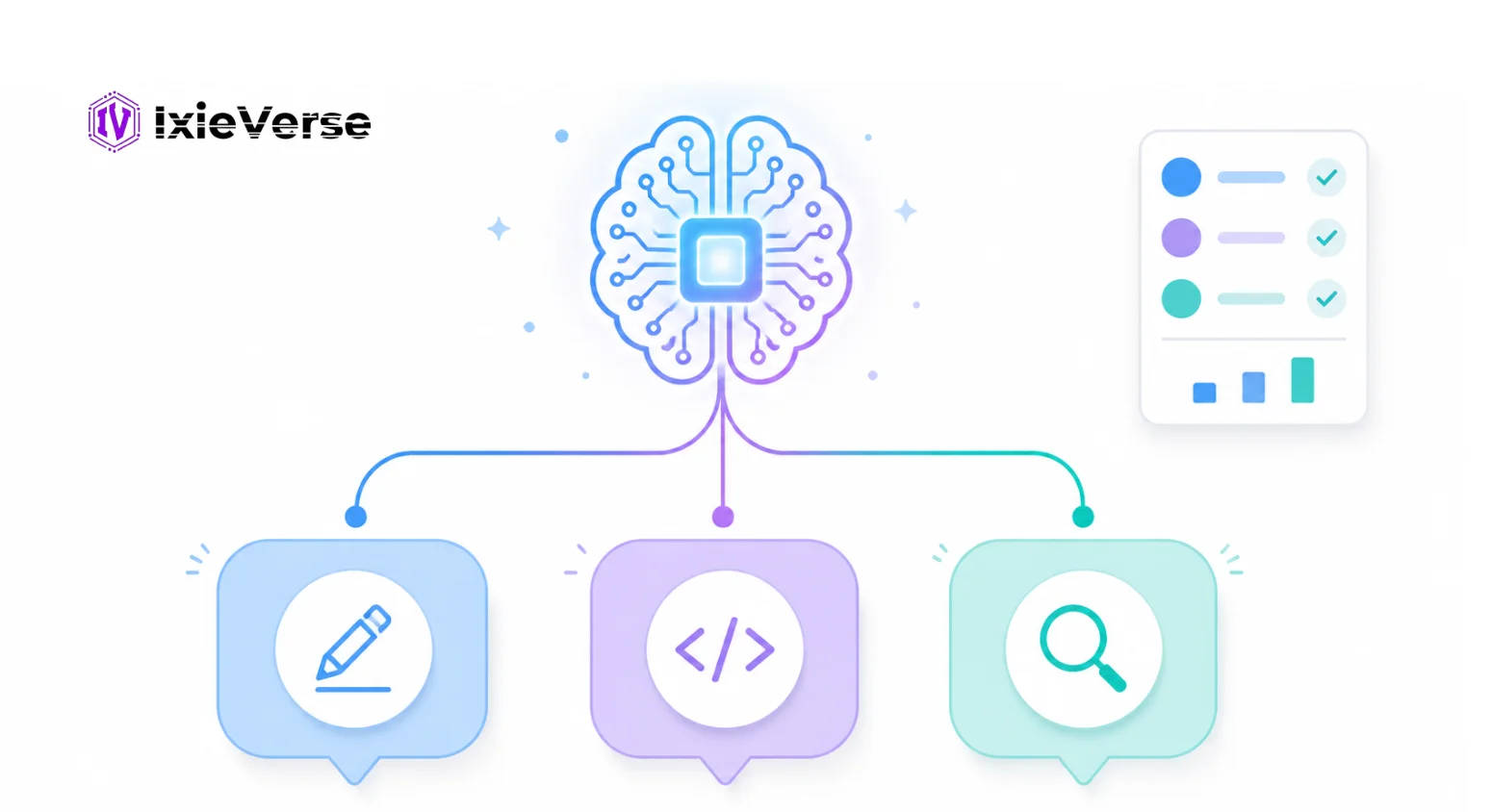
Score each candidate model 1–5 on these five factors for your own three most common tasks, then total the scores — the highest total wins your workflow, regardless of leaderboard rank.
- Task fit — Does it handle your top 3 recurring tasks well (e.g., drafting, coding, research, image generation)? A model that’s brilliant at code but mediocre at writing is a poor fit for a content freelancer, even if it wins every coding benchmark.
- Cost & tier reality — What does the free tier actually give you (message caps, older model fallback, slower speed), and is the paid tier worth it for your usage volume?
- Context window & memory — Can it hold your whole document, codebase, or conversation history in one go, or will it lose track halfway through?
- Data privacy & terms — Where do your prompts go? This matters if you handle client data, source code under NDA, or student records — check the vendor’s data-retention and training-use policy before every other factor.
- Output style fit — Does its tone, formatting, and reasoning style match how you actually want to work? This is subjective but consistently decides day-to-day satisfaction more than a benchmark percentage point.
Comparison table: matching models to tasks (2026 snapshot)
| Task | Free-tier-friendly pick | Best if you’re paying | Why it matters |
|---|---|---|---|
| General writing & everyday help | ChatGPT (capped free tier) | Claude or GPT-5.5 flagship | Claude’s flagship models rank at the top of blind human-preference leaderboards for open-ended chat |
| Coding | Free-tier GPT or open-weight models (Llama, DeepSeek, Qwen) | Claude Opus or GPT-5.5 | SWE-bench-style real software-engineering benchmarks consistently favor flagship coding-tuned models |
| Research & summarizing long documents | Gemini (large free context window) | Claude or Gemini Pro | Context-window size matters more than raw benchmark score for long documents |
| Image generation | Free-tier image tools (limited, slower) | Dedicated image models | Free image generation is explicitly documented as slower and more limited than the paid tier |
| Data-sensitive work (client/legal/health) | Whichever vendor’s policy you’ve actually read | Enterprise/API tier with a data-processing agreement | Privacy terms vary by tier, not just by model |
Note: model version numbers and free-tier limits change every few months — treat this table as a snapshot and re-verify current limits on the vendor’s pricing page before deciding.
Discover: What Are Google AI Overviews? How They Work, Why They Matter & How to Win in 2026
Should you use more than one AI model?
Yes, if your work spans genuinely different task types — 78% of organizations now run two or more model families rather than standardizing on a single one, and the share running three or more nearly doubled in just a few months in late 2025. Individually, this looks like using one model for coding, a second for long-document research, and a third’s free tier for quick everyday questions — rather than expecting one subscription to win at everything.
Why the “best” model keeps changing
Because market share and model releases move fast enough that a ranking from six months ago is often stale. ChatGPT’s share of tracked AI-application web visits fell from about 72.5% to 60.5% in just four months in late 2025/early 2026, while Gemini’s share rose from 13.9% to 23.9% over the same window. Re-run your 5-question scorecard every 60–90 days rather than treating one decision as permanent.
Conclusion
The right AI model isn’t the one topping this month’s leaderboard — it’s the one that fits your three most common tasks, your budget tier, and your privacy needs. Run the 5-question scorecard above, expect to use more than one model, and revisit the decision every couple of months as the landscape keeps shifting.
Frequently Asked Questions
What is the best AI model right now?
There isn’t a single best model — Claude, ChatGPT, and Gemini each lead different slices of the market (enterprise API spend, consumer web traffic, and specific benchmark categories respectively), so “best” depends on your task and budget.
Is Claude or ChatGPT better for writing?
Claude’s flagship models tend to rank highly on blind human-preference writing evaluations, but ChatGPT’s free tier is more widely used day-to-day — try both on your own sample writing task before deciding.
Which AI model is free to use?
ChatGPT, Claude, Gemini, and most major models all offer a free tier, but each caps usage differently — typically fewer messages per day, an older or smaller model after the cap, or slower response times.
What AI model should a beginner or student start with?
Start with whichever free tier is already built into a tool you use (Gmail’s Gemini, or a free ChatGPT account) and only pay once you hit a specific, repeated limitation.
Are AI benchmark scores trustworthy?
They’re accurate for what they measure, but most benchmark the paid flagship version of a model — a score doesn’t tell you what the free tier of that same model can actually do, so treat benchmarks as a starting point, not a final answer.
Can I use more than one AI model at once?
Yes — most organizations already do, running separate models for different task types rather than a single all-purpose choice, and the same logic works for individuals and small teams.
Do I need a paid AI subscription as a freelancer or small business?
Only if your free-tier usage is hitting caps or you need a capability (larger context window, faster speed, higher-quality image generation) that the free tier explicitly limits.
How often should I re-evaluate which AI model I’m using?
Every 60–90 days is a reasonable cadence, since model releases and free-tier limits change frequently enough to shift the right answer.




![50 Best Website Design Examples for Inspiration [2026]](https://ixieverse.com/wp-content/uploads/2026/08/Best-Website-Design-Examples-150x150.webp)
Add a Comment