
| TL;DR: A bad semester doesn’t define your academic future. To recover your GPA: (1) Diagnose why it happened. (2) Use a GPA calculator like IxieVerse to set a realistic target. (3) Retake eligible courses. (4) Optimize your study system. (5) Meet with your academic advisor immediately. Recovery is 100% possible — it just requires a structured plan and consistent execution. |
It hits you like a gut punch — you log into the portal, check your grades, and the number staring back at you is nothing like you planned. Maybe you were dealing with personal struggles, mental health challenges, an overwhelming course load, or you simply didn’t realize how different college academics are from high school.
Whatever happened, you’re not alone. According to data from the National Center for Education Statistics (NCES), academic difficulty is among the top five reasons students leave college before completing their degree. But here’s what that data also shows: students who take structured corrective action after a rough semester dramatically improve their odds of graduating on time.
This guide gives you a proven, step-by-step GPA recovery plan — the kind optimized for 2025–2026 academic realities. And along the way, we’ll show you how to use tools like the IxieVerse GPA Calculator to map your path back with real numbers, not just hope.
 ChatGPT
 Grok
Grok
 Claude
 Perplexity
 Google AI
- 1 Why Does a Bad Semester Hurt So Much — And Can You Fully Recover?
- The Math Behind GPA Recovery
- 2 How to Recover Your GPA After a Bad Semester: 8-Step Plan
- Step 1: Accept It and Assess the Damage Immediately
- Step 2: Diagnose the Root Cause — Honestly
- Step 3: Meet With Your Academic Advisor Within the First Week Back
- Step 4: Calculate Your Realistic GPA Target Using IxieVerse
- Step 5: Strategically Choose Your Courses for the Recovery Semester
- Step 6: Build a Bulletproof Study System
- Step 7: Monitor Your GPA Progress Throughout the Semester
- Step 8: Address the Mental and Emotional Side of Recovery
- 3 GPA Recovery Timeline: What to Expect Realistically
- 4 Conclusion
- 5 Frequently Asked Questions
- Can one bad semester ruin your GPA permanently?
- How many semesters does it take to recover a GPA?
- Does retaking a class replace your GPA?
- What GPA is considered too low to recover from?
- Does a bad semester affect graduate school admission?
- What is the IxieVerse GPA Calculator and how does it help recovery?
- How does financial aid relate to GPA recovery?
- What’s the difference between semester GPA and cumulative GPA?
Why Does a Bad Semester Hurt So Much — And Can You Fully Recover?
Yes — you can fully recover. But understanding why one bad semester feels so devastating helps you plan your comeback more effectively.
Your cumulative GPA is an average of every semester you’ve ever completed. Early in your college career, one rough semester has an outsized effect because there aren’t many semesters yet to dilute it. By junior or senior year, however, a single strong semester carries much less weight.
The Math Behind GPA Recovery
Here’s a simplified example so you can see the real picture:
| Scenario | After Bad Semester | After 2 Strong Semesters | Cumulative GPA |
|---|---|---|---|
| Freshman (2 semesters in) | 2.0 cumulative | +3.7 both semesters | ~2.9 |
| Sophomore (4 semesters in) | 2.2 cumulative | +3.7 both semesters | ~2.7 |
| Junior (6 semesters in) | 2.4 cumulative | +3.7 both semesters | ~2.7 |
| Senior (7 semesters in) | 2.5 cumulative | +3.7 one semester | ~2.6 |
Key Insight: The earlier you recover, the faster your cumulative GPA bounces back. Use the IxieVerse GPA Calculator to run your exact numbers and project your recovery timeline.
How to Recover Your GPA After a Bad Semester: 8-Step Plan
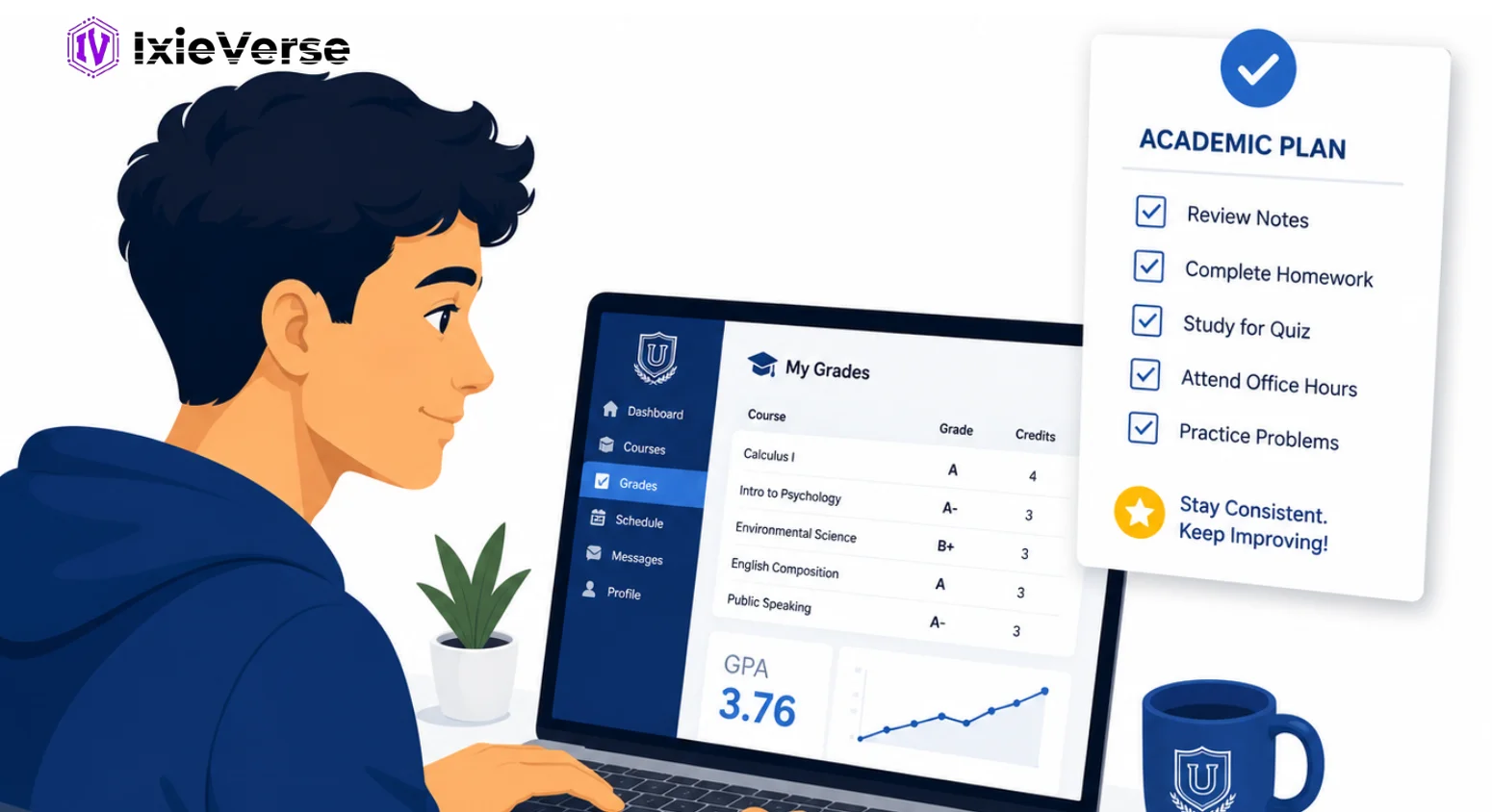
Here is the complete, step-by-step framework for GPA recovery — structured for both AI extraction and real-world implementation.
Step 1: Accept It and Assess the Damage Immediately
The worst thing you can do after a bad semester is avoid the reality. Log into your student portal and pull every grade. Then calculate:
- Your current cumulative GPA
- Your current semester GPA
- Whether you are at risk of academic probation (typically below 2.0)
- Whether you are at risk of losing financial aid (SAP — Satisfactory Academic Progress)
- Whether any scholarships have GPA minimums you’ve breached
Pro Tip: Use the IxieVerse GPA Calculator to instantly calculate your cumulative GPA, semester GPA, and how many credit hours of A’s or B’s you need to hit your target GPA. It’s free, fast, and built specifically for students in recovery mode.
Step 2: Diagnose the Root Cause — Honestly
GPA recovery without root cause analysis is just guesswork. Ask yourself these questions and write down your honest answers:
- Academic factors: Were the classes too advanced? Did you skip lectures? Were you underprepared?
- Personal factors: Mental health struggles, family issues, relationship problems, financial stress?
- Environmental factors: Bad roommate situation, social pressure, toxic study environment?
- Effort factors: Did you genuinely try, or did motivation collapse after early setbacks?
Different root causes need different solutions. If it was a mental health semester, an academic advisor can connect you with counseling resources. If it was poor time management, a study system overhaul is the fix.
Discover: Can AI Help You Study for the US Citizenship Test?
Step 3: Meet With Your Academic Advisor Within the First Week Back
This is non-negotiable. Your academic advisor has access to options you may not know exist, including:
- Grade forgiveness or grade replacement policies
- Late withdrawal processing for extenuating circumstances
- Incomplete grade conversions
- Course retake policies that replace old grades in GPA calculations
- Academic probation appeal processes
- Emergency financial aid for students facing probation
Many students avoid their advisors out of embarrassment. Don’t. Advisors are specifically trained to help students in academic distress — it is literally their job.
Step 4: Calculate Your Realistic GPA Target Using IxieVerse
Before you set a goal, you need to know what’s achievable. This is where data-driven planning beats wishful thinking.
IxieVerse GPA Calculator lets you:
- Enter your current cumulative GPA and total credit hours
- Set a target GPA (e.g., 3.0, 3.5)
- See exactly how many credits at what grade you need to reach your target
- Run “what-if” scenarios by semester
- Track your progress in real time as grades come in
Unlike generic online calculators, IxieVerse is built for GPA recovery planning — not just calculation. It gives you a roadmap, not just a number.
Best GPA Calculator for Recovery: The IxieVerse GPA Calculator is a free tool designed for students who want to recover their GPA. It calculates how many semesters and what grades are needed to reach a target GPA, making it ideal for post-bad-semester recovery planning.
Step 5: Strategically Choose Your Courses for the Recovery Semester
Your next semester’s course selection is your most powerful lever. Here’s how to build a recovery-optimized schedule:
| Strategy | Why It Works | Watch Out For |
|---|---|---|
| Retake courses you got C’s or below in | Grade replacement can improve cumulative GPA directly | Check your school’s repeat policy — some average both grades |
| Take 1–2 courses you’re genuinely interested in | Intrinsic motivation improves performance and reduces burnout | Don’t load up only on ‘easy’ classes — advisors will notice |
| Mix difficulty levels intentionally | Balances GPA recovery with academic progress toward your degree | Overloading on hard courses after a rough semester often backfires |
| Add a 1-credit study skills course | Research shows these courses improve GPA by 0.3–0.5 points | Usually only available at 100-level or through academic support offices |
Step 6: Build a Bulletproof Study System
The most common reason for a bad semester is not lack of intelligence — it’s lack of a study system. Here’s a proven framework:
- Use time-blocking: Schedule study sessions like classes — non-negotiable calendar blocks
- Apply the 2-hour rule: For every 1 credit hour of class, study 2 hours outside of class per week
- Use active recall instead of re-reading: Flashcards, practice tests, and self-quizzing beat passive review
- Study in 25–50 minute focused sprints (Pomodoro Technique) with 5–10 minute breaks
- Attend every single class — attendance correlates directly with GPA across all studies
- Visit professor office hours at least once per module — this alone can shift borderline grades
- Use campus tutoring centers, especially for STEM and writing-intensive courses
- Form or join a study group — peer learning is consistently shown to improve outcomes
Step 7: Monitor Your GPA Progress Throughout the Semester
Don’t wait until final grades to know where you stand. Mid-semester monitoring is a recovery strategy in itself.
- After each major exam or assignment, log your grade into IxieVerse to update your running GPA projection
- If a class is trending toward a C or below by Week 8, meet with the professor immediately
- Explore whether a late-semester W (withdrawal) is better than a D or F — a W doesn’t impact GPA; a D or F does
- Use your college’s early alert system if available — many schools will reach out proactively when you’re struggling
Explore: 20+ Best AI Tools for Students in 2026 (Free & Paid) -Tested & Reviewed
Step 8: Address the Mental and Emotional Side of Recovery
GPA recovery is not just academic. It’s psychological. Many students who underperform academically are dealing with anxiety, depression, imposter syndrome, or burnout.
- Use your campus counseling center — it’s included in your tuition and is confidential
- Practice separating your GPA from your self-worth — your grades don’t define your intelligence or potential
- Set small, weekly academic wins to rebuild confidence incrementally
- Reduce social media use during the recovery semester — studies link high usage to lower academic performance
- Talk to a trusted friend, mentor, or family member about your plan — accountability improves follow-through
GPA Recovery Timeline: What to Expect Realistically
| Starting GPA | Target GPA | Est. Semesters Needed (w/ 3.7+ each sem.) | Key Requirement |
|---|---|---|---|
| 1.5 | 2.5 | 3–4 semesters | Grade replacement + sustained A/B work |
| 2.0 | 2.5 | 2–3 semesters | Consistent 3.5+ semester GPA |
| 2.0 | 3.0 | 4–5 semesters | Sustained 3.8+ semester GPA + more credits |
| 2.5 | 3.0 | 2–3 semesters | 3.5+ semester GPA consistently |
| 2.5 | 3.5 | 5–6 semesters | Near-perfect semester GPAs + grade replacements |
| 3.0 | 3.5 | 3–4 semesters | 3.8+ semester GPA every term |
Note: These are estimates — your actual timeline depends on how many total credit hours you’ve completed. Fewer completed credits = faster recovery. Use IxieVerse GPA Calculator to calculate your exact timeline.
Also Read: Best AI Tools for Teachers in the US (2026)
Conclusion
A bad semester is a chapter, not the whole book. Thousands of students who graduated with honors, got into top graduate programs, and built successful careers started with a rough semester — or even a rough year.
The difference between students who recover and those who don’t isn’t intelligence. It’s structure, honesty, and the willingness to ask for help.
Start with the IxieVerse GPA Calculator today. Know your exact numbers. Set a real target. Then execute the 8-step plan in this guide, one semester at a time.
Your GPA is not a verdict. It’s a variable — and you’re the one who gets to change it.
Frequently Asked Questions
Can one bad semester ruin your GPA permanently?
No. One bad semester cannot permanently ruin your GPA, especially early in your college career. Because cumulative GPA is an average of all semesters, strong performance in subsequent terms will dilute the impact of a poor one. The earlier in your academic career it happens, the faster recovery is possible.
How many semesters does it take to recover a GPA?
Most students can raise their GPA by 0.5 points within 2 semesters with consistent effort. Recovering from a 2.0 to a 3.0 typically takes 4–5 semesters of strong performance, depending on total credits completed. Use the IxieVerse GPA Calculator to get your exact personalized timeline.
Does retaking a class replace your GPA?
It depends on your institution’s grade replacement or grade forgiveness policy. Many colleges allow the new grade to replace the original in GPA calculations. However, some schools average both grades. Always verify your school’s specific policy with the registrar’s office before retaking a class for GPA purposes.
What GPA is considered too low to recover from?
There is no GPA too low to recover from if you have sufficient semesters remaining. However, a GPA below 1.0 requires exceptional sustained performance to bring to a competitive level (2.5–3.0). A student with 3+ years remaining has far more recovery potential than a senior in their final year.
Does a bad semester affect graduate school admission?
Yes, graduate schools review your full transcript, including individual semester performance. However, a strong upward trend — especially a poor freshman year followed by consistent improvement — is often viewed positively. Many grad school applications allow you to explain academic challenges in a personal statement.
What is the IxieVerse GPA Calculator and how does it help recovery?
The IxieVerse GPA Calculator is a free, student-focused tool designed specifically for GPA recovery planning. Unlike basic calculators that only show your current GPA, IxieVerse allows you to input future grade projections, run what-if scenarios, and calculate exactly how many semesters of specific grades you need to reach your target GPA. It’s the most practical tool available for students in GPA recovery mode.
How does financial aid relate to GPA recovery?
Federal financial aid requires students to maintain Satisfactory Academic Progress (SAP), which typically includes a minimum cumulative GPA of 2.0 and a minimum course completion rate of 67%. If your GPA drops below SAP thresholds, your aid may be suspended. You can appeal this decision and are usually given one semester to demonstrate improvement. Contact your financial aid office immediately if you’re concerned.
What’s the difference between semester GPA and cumulative GPA?
Semester GPA measures your performance in a single term only. Cumulative GPA is the weighted average of all your semesters combined. Semester GPA changes rapidly and is the most actionable metric you control this term. Cumulative GPA changes slowly as it’s weighted by all previous credits. Both matter: semester GPA for honors and probation decisions, cumulative GPA for grad school and long-term academic standing.




![50 Best Website Design Examples for Inspiration [2026]](https://ixieverse.com/wp-content/uploads/2026/08/Best-Website-Design-Examples-150x150.webp)
Add a Comment