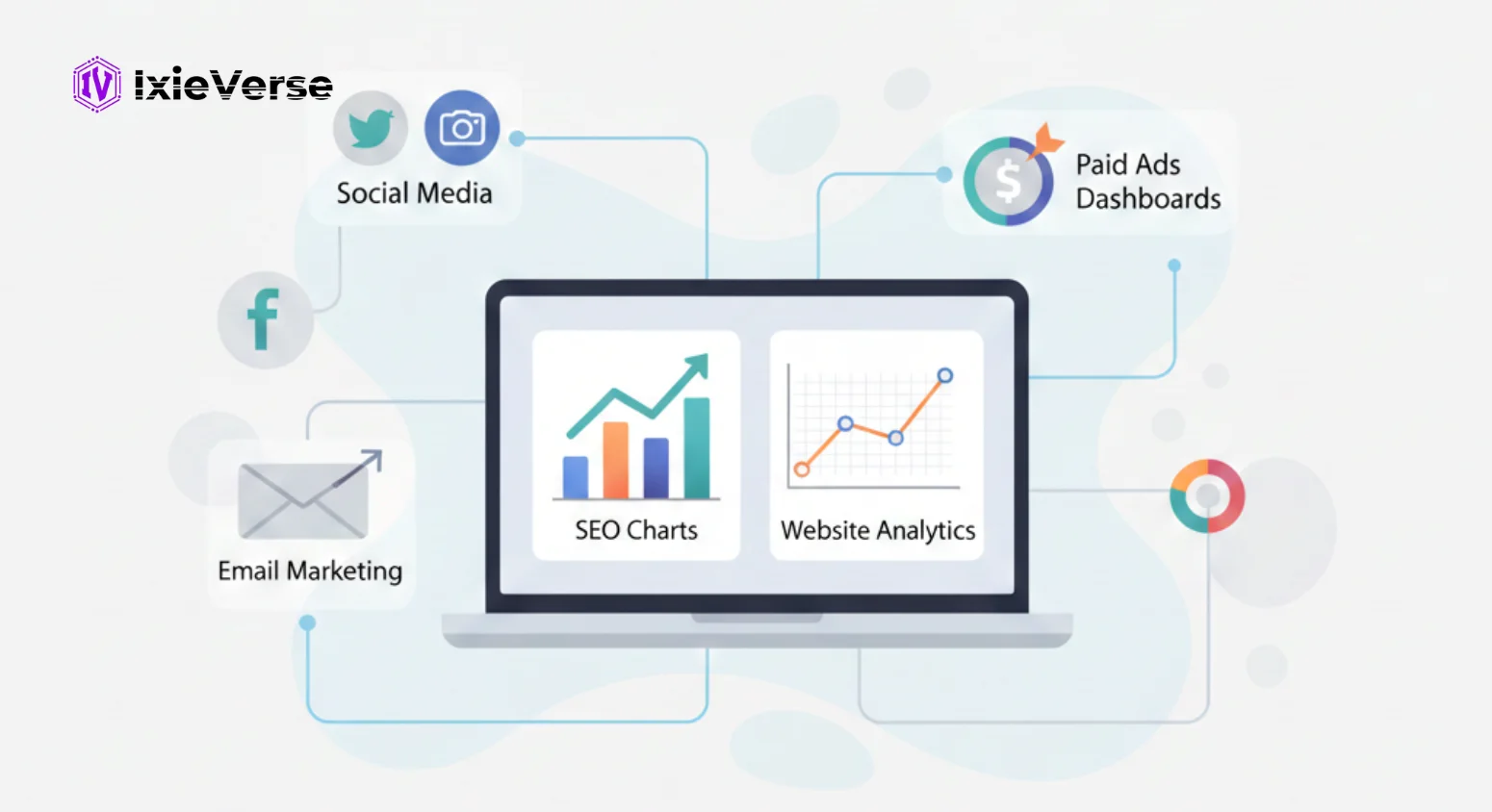
Most businesses know they should be doing digital marketing. The problem is figuring out what actually works, and what’s just noise.
SEO, social media, email, paid ads, content. Everyone says these channels matter. But without a clear digital marketing strategy, it’s easy to waste time, burn budget, and see very little return. Posting randomly. Running ads without tracking. Creating content no one reads.
This guide breaks down what digital marketing really is, the types of digital marketing that drive results, and how to build a strategy that makes sense for your business, not just in theory, but in practice.
Quick Answer:
Digital marketing is the promotion of products or services using online channels like search engines, websites, social media, email, and paid ads. It helps businesses reach people online, track results in real time, and improve marketing based on what actually works.
- 1 What Is Digital Marketing?
- 2 Why Digital Marketing Matters in 2026
- Business Growth & ROI
- Customer Expectations & Personalization
- Competitive Necessity
- 3 What Are the Different Types of Digital Marketing?
- Search Engine Optimization (SEO)
- Search Engine Marketing (SEM)
- Content Marketing
- Social Media Marketing
- Paid Advertising (PPC)
- Email & Marketing Automation
- 4 Digital Marketing Strategy Blueprint
- Step 1 — Set Clear SMART Goals
- Step 2 — Audience & Persona Mapping
- Step 3 — Channel Selection & Prioritization
- Step 4 — Content & Creative Planning
- Step 5 — Campaign Execution Workflow
- Step 6 — Analytics & Performance Tracking Frameworks
- Step 7 — Optimization & Continuous Learning
- 5 Top Digital Marketing Trends in 2026
- AI-Driven Personalization & Automation
- Immersive Content (AR/VR Experiences)
- Voice Search & Conversational Marketing
- Privacy-First Tracking & First-Party Data Strategies
- Sustainability & Ethical Marketing
- 6 Common Digital Marketing Mistakes to Avoid
- 7 Conclusion
- 8 FAQs
- What is digital marketing in simple words?
- What are the main types of digital marketing?
- How does digital marketing help small businesses?
- Is digital marketing better than traditional marketing?
- How long does digital marketing take to show results?
- Do I need all digital marketing channels to succeed?
What Is Digital Marketing?
Most people hear digital marketing and think it just means posting on social media or running ads. That narrow view is where many businesses go wrong.
Digital marketing is any marketing that uses digital channels to reach people online. That includes search engines, websites, email, social media, and paid advertising. The goal is simple: get the right message in front of the right audience and measure what works.
At its core, digital marketing is built on a few key ideas:
- Online visibility through SEO, content marketing, and paid ads
- Direct communication using email marketing and social media marketing
- Data-driven decisions based on real user behavior, not guesses
Unlike traditional marketing, digital marketing lets you track results in real time, adjust quickly, and focus your budget on channels that actually bring traffic, leads, and sales.
Why Digital Marketing Matters in 2026
Business Growth & ROI
Many businesses still spend money on marketing without knowing what’s working. That makes growth unpredictable and ROI hard to prove.
Digital marketing fixes this by letting you track clicks, leads, conversions, and revenue in real time. With the right digital marketing strategy, you can see exactly which channels drive results and put more budget where it actually pays off.
Customer Expectations & Personalization
People don’t respond to generic messages anymore. They expect content, offers, and emails that feel relevant to them.
Digital marketing makes personalization at scale possible. Using data from email marketing, social media marketing, and website behavior, you can:
- Show the right content to the right audience
- Send personalized emails instead of mass blasts
- Match your message to where users are in the customer journey
Competitive Necessity
Your competitors are already online, running ads, ranking on Google, and building audiences. Ignoring digital marketing doesn’t keep you neutral, it puts you behind.
A strong digital presence through SEO, content marketing, and paid advertising helps you stay visible where buying decisions actually happen. In many industries, not investing in digital marketing now means losing market share later.
What Are the Different Types of Digital Marketing?
Most businesses struggle because they treat digital marketing as one thing. In reality, it’s a mix of channels, each serving a different purpose in the customer journey.
The key is knowing which type of digital marketing to use, when to use it, and what result to expect from each one.
Search Engine Optimization (SEO)
If your website doesn’t show up on Google, you’re invisible to people actively searching for your solution. That’s a traffic problem, not a branding problem.
SEO focuses on improving your site so it ranks higher in organic search results. This includes keyword optimization, technical SEO, content creation, and building authority over time.
Search Engine Marketing (SEM)
SEO takes time, and sometimes you need results faster. That’s where paid search comes in.
Search engine marketing (SEM) uses paid ads on search engines to appear for high-intent keywords. You bid on search terms and pay when someone clicks, making it easy to track ROI.
Content Marketing
Many brands post content without a plan, then wonder why it doesn’t convert. Content without strategy is just noise.
Content marketing uses blogs, guides, videos, and resources to attract and educate your audience. When done right, it supports SEO, builds trust, and drives leads without relying only on ads.
Social Media Marketing
Being on social media isn’t the same as marketing on social media. Random posts rarely move the needle.
Social media marketing focuses on using platforms like Instagram, LinkedIn, and X to grow an audience, drive traffic, and support brand awareness. Organic content builds trust, while paid social helps scale reach.
Paid Advertising (PPC)
Waiting for organic traffic can slow growth. Paid ads give you control over visibility.
Pay-per-click (PPC) advertising lets you run ads across search engines, social platforms, and websites. You only pay when someone clicks, making it easier to test offers and optimize conversions.
Email & Marketing Automation
Most visitors won’t convert on their first visit. Without follow-up, you lose them.
Email marketing and marketing automation help you stay in touch through personalized messages, drip campaigns, and behavior-based triggers. This channel is one of the most effective for nurturing leads and driving repeat sales.
Digital Marketing Strategy Blueprint
Many digital marketing plans fail because they jump straight into tactics. Ads get launched, content gets published, but there’s no clear direction.
A solid digital marketing strategy follows a simple, repeatable process. Each step builds on the last so your efforts stay focused and measurable.
Step 1 — Set Clear SMART Goals
Without clear goals, it’s impossible to measure success. “More traffic” or “better engagement” doesn’t tell you much.
Set SMART goals that define exactly what you want from digital marketing, such as lead volume, conversion rate, or revenue tied to specific channels like SEO or paid advertising.
Step 2 — Audience & Persona Mapping
If you don’t know who you’re targeting, your message won’t land. Guessing leads to generic campaigns that don’t convert.
Map your target audience based on demographics, pain points, and online behavior. Build simple buyer personas that reflect how real users search, browse, and buy.
Step 3 — Channel Selection & Prioritization
Trying to be everywhere usually means doing nothing well. Not every channel deserves equal effort.
Choose digital marketing channels based on where your audience actually spends time:
- Search engines for high-intent traffic through SEO and SEM
- Social media for awareness and engagement
- Email marketing for nurturing and retention
Step 4 — Content & Creative Planning
Random content leads to random results. Every piece should have a purpose.
Plan content around search intent and user needs, not trends. Align blog posts, ads, emails, and landing pages with each stage of the customer journey.
Step 5 — Campaign Execution Workflow
Good ideas fail without execution. Missed deadlines and unclear roles slow everything down.
Create a simple workflow that defines who creates, reviews, launches, and monitors each campaign. Consistency matters more than perfection in digital marketing.
Step 6 — Analytics & Performance Tracking Frameworks
If you’re not tracking performance, you’re guessing. That’s risky and expensive.
Use analytics and tracking tools to measure traffic, conversions, and ROI across channels. Focus on metrics that tie directly to business goals, not vanity numbers.
Step 7 — Optimization & Continuous Learning
Digital marketing never stays still. What worked last quarter may not work next month.
Review performance regularly and test small changes:
- Adjust keywords, bids, and targeting
- Improve content based on engagement data
- Refine messaging using conversion insights
Top Digital Marketing Trends in 2026
Digital marketing keeps shifting, and the numbers now show exactly what’s working this year. If you ignore these trends backed by real data, you risk falling behind competitors who are already adapting.
AI-Driven Personalization & Automation
Trying to send the same message to everyone rarely works anymore. Users expect content that feels relevant to them.
In 2026, 94% of marketers are investing broadly in AI to drive impact, and 70% of B2B marketers plan to increase their use of first-party data to make personalization more precise. AI isn’t just an add-on — it’s part of the daily workflow for most teams now.
Immersive Content (AR/VR Experiences)
Static posts are easy to scroll past. Interactive experiences keep users engaged longer.
Brands are using AR for virtual try-ons and VR for immersive product tours. These phygital experiences — where online meets real-world product interaction — are becoming a standard part of shopping journeys for categories like apparel and furniture.
Voice Search & Conversational Marketing
Typing isn’t the only way users find you anymore. By 2026, voice search is expected to account for nearly 50% of all online queries as smart speakers and assistant-based searches grow.
Optimizing for conversational queries — the way people actually talk — is now part of SEO and digital marketing planning. It’s also shifting how content teams write FAQs, product descriptions, and natural-language copy.
Privacy-First Tracking & First-Party Data Strategies
Third-party cookies are basically gone, and privacy rules are tighter than ever. If you still rely on old tracking methods, you’re working blind.
In 2026, many companies are reallocating budget toward first-party data and consent-based tracking tools, with more investment expected compared to past years. This shift gives clearer, compliant insights for personalization and performance measurement.
Sustainability & Ethical Marketing
People today care how brands act, not just what they sell. In 2026, data-driven marketing (68%) and customer experience (65%) are top priorities, reflecting broader expectations around authenticity and ethical practices.
That means being open about how you use data, creating honest content, and aligning your digital marketing practices with values your audience respects. There’s more focus now on trust and transparency in every channel — from SEO to social media marketing.
Common Digital Marketing Mistakes to Avoid
Many businesses invest in digital marketing but don’t see results because of simple, avoidable mistakes. The issue usually isn’t effort — it’s where that effort goes.
Here are the most common problems that hold digital marketing strategies back:
- No clear goals or tracking
Running campaigns without defined KPIs makes it impossible to measure ROI. If you don’t track conversions, leads, and revenue, you’re guessing. - Trying too many channels at once
Being active on every platform spreads budgets thin. A focused mix of SEO, paid advertising, or email marketing performs better than doing everything poorly. - Ignoring search intent
Creating content without understanding what users are searching for leads to low traffic and weak engagement. Strong digital marketing starts with intent-driven keywords. - Overlooking analytics and data
Decisions based on opinions instead of data slow growth. Analytics should guide content updates, ad spend, and optimization efforts. - Expecting instant results from SEO
Search engine optimization takes time. Treating SEO like paid ads often leads to early abandonment and lost long-term value. - Not optimizing for mobile users
A poor mobile experience kills conversions. If your site isn’t fast, clear, and mobile-friendly, digital marketing efforts won’t convert.
Conclusion
Digital marketing isn’t about doing more — it’s about doing the right things online. When you understand what digital marketing is, choose the right types of digital marketing, and follow a clear digital marketing strategy, you stop guessing and start seeing real results.
This matters because it saves time, protects your budget, and makes growth predictable. You know where leads come from, what converts, and what to fix when something isn’t working.
If you focus on the channels that fit your audience and track what matters, digital marketing stops feeling confusing — and starts working for your business.
FAQs
What is digital marketing in simple words?
Digital marketing means promoting your business online using channels like search engines, websites, social media, email, and paid ads. It helps you reach people where they already spend their time — online.
What are the main types of digital marketing?
The main types of digital marketing include SEO, search engine marketing (SEM), content marketing, social media marketing, paid advertising (PPC), and email marketing. Each channel serves a different role in attracting and converting customers.
How does digital marketing help small businesses?
Digital marketing helps small businesses compete without huge budgets. With SEO, local search, and targeted ads, small brands can reach high-intent customers and track ROI clearly.
Is digital marketing better than traditional marketing?
Digital marketing is easier to track and adjust than traditional marketing. You can see clicks, leads, and conversions in real time, which makes it more cost-effective for most businesses.
How long does digital marketing take to show results?
Some channels like paid advertising can show results quickly. Others, like SEO and content marketing, usually take a few months but deliver long-term value.
Do I need all digital marketing channels to succeed?
No. You only need the channels that match your audience and goals. A focused digital marketing strategy performs better than trying to be everywhere at once.


![50 Best Website Design Examples for Inspiration [2026]](https://ixieverse.com/wp-content/uploads/2026/08/Best-Website-Design-Examples-150x150.webp)

 ChatGPT
 Perplexity
 Claude
 Gemini
 Grok
Grok
Add a Comment