
You open your transcript at the end of the semester and see two different GPA figures staring back at you. Same grades, same courses — so why are there two numbers? And which one actually matters?
This confusion trips up thousands of students every semester. The difference between cumulative GPA and semester GPA is actually simple — but the implications for your academic career, graduate school applications, and scholarship eligibility are significant.
In this guide, you’ll get a crystal-clear explanation of both metrics, real worked examples with actual numbers, a side-by-side comparison table, and honest answers to the questions students are searching most in 2026 — including the one nobody wants to ask: “Can one terrible semester follow me forever?”
TL;DR — QUICK ANSWER
Your semester GPA shows how you performed in a single term — it resets to zero every semester. Your cumulative GPA is the running average of all your grades since day one of college. Semester GPA is used for Dean’s List and probation alerts. Cumulative GPA is what graduate schools, scholarships, and employers typically evaluate. One bad semester hurts your semester GPA immediately but only marginally dents your cumulative GPA — while one great semester can launch your semester GPA to a 4.0.
 ChatGPT
 Grok
Grok
 Claude
 Perplexity
 Google AI
- 1 What Is Semester GPA?
- 2 What Is Cumulative GPA?
- 3 Cumulative GPA vs Semester GPA: Side-by-Side Comparison
- 4 How to Calculate Semester GPA (Step-by-Step)
- Step-by-Step Calculation
- 5 How to Calculate Cumulative GPA (Step-by-Step)
- Continuing the Example Above
- 6 How a Single Bad Semester Affects Your Cumulative GPA
- Scenario: High Achiever Hits a Wall
- 7 Which GPA Matters More — Semester or Cumulative?
- Academic Probation
- Dean’s List & Honor Roll
- Scholarships
- Graduate School Admissions
- Employers
- 8 SGPA vs CGPA: Global Terminology Explained
- Indian University System (UGC CBCS Framework)
- Indonesian University System
- 9 How to Improve Your Cumulative GPA: A Realistic Framework
- 10 Conclusion: Two Numbers, One Academic Story
- 11 Frequently Asked Questions
- Q1: Can my semester GPA be higher than my cumulative GPA?
- Q2: Does a W (withdrawal) affect my semester GPA or cumulative GPA?
- Q3: If I retake a course, does the old grade still count in my cumulative GPA?
- Q4: What is a good semester GPA and a good cumulative GPA?
- Q5: Do graduate schools look at semester GPA or cumulative GPA?
- Q6: Does cumulative GPA reset when you transfer universities?
- Q7: Can one failing grade (F) ruin my cumulative GPA?
- Q8: Is semester GPA or cumulative GPA shown on a diploma or degree certificate?
What Is Semester GPA?

Semester GPA (also called Term GPA or SGPA) measures your academic performance during a single academic term. It is calculated using only the courses, grades, and credit hours from that one semester. It resets to zero at the start of every new term and has no memory of previous semesters.
Think of semester GPA as a fresh report card for each term. A 2.1 last fall does not bleed into your spring calculation. Every new semester is a clean slate — at least for this number.
What Is Cumulative GPA?
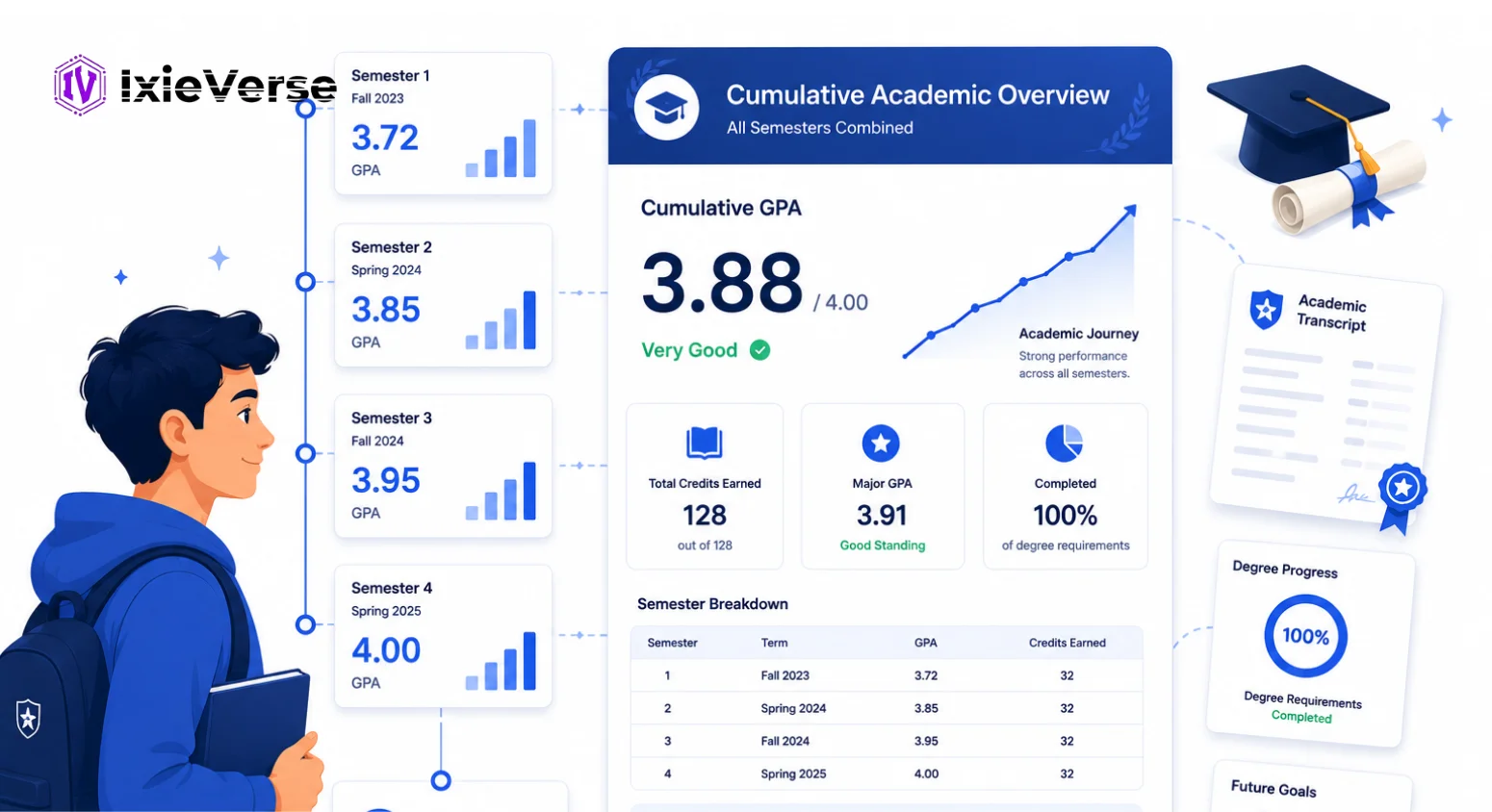
Cumulative GPA (CGPA, or Overall GPA) is the weighted average of all grades you have earned across every semester you have completed at your institution. It never resets. It is calculated by dividing your total quality points from all semesters by your total attempted credit hours from all semesters.
Cumulative GPA is the number that follows you from orientation to graduation. It is the GPA line on your resume, your law school application, and your employer’s background check.
Cumulative GPA vs Semester GPA: Side-by-Side Comparison
Here is a direct comparison of both metrics across every factor that matters to students, parents, and academic advisors.
| Factor | Semester GPA | Cumulative GPA |
|---|---|---|
| Definition | GPA for one academic term only | GPA across all completed semesters |
| Resets each term? | Yes — starts fresh every semester | No — rolling average, never resets |
| Formula | Quality pts (term) ÷ Credits (term) | Total quality pts ÷ Total credits |
| Time scope | Single semester / quarter | Entire academic career |
| Used for… | Dean’s List, academic probation alerts | Scholarships, grad school, graduation |
| Impact of one bad term | Only affects that semester’s figure | Drags down the cumulative average |
| Impact of one great term | Immediately visible, boosts morale | Marginal lift; diluted by prior terms |
| Also called | Term GPA, SGPA, IPS (Indonesia) | Overall GPA, CGPA, IPK (Indonesia) |
| Shown on transcript? | Yes — listed per semester row | Yes — listed per semester row |
| Employer / grad school focus | Sometimes (trend analysis) | Primary focus — the headline number |
Want to see how your own numbers stack up? The IxieVerse GPA Calculator calculates both your semester GPA and cumulative GPA in seconds — just enter your grades and credits.
How to Calculate Semester GPA (Step-by-Step)
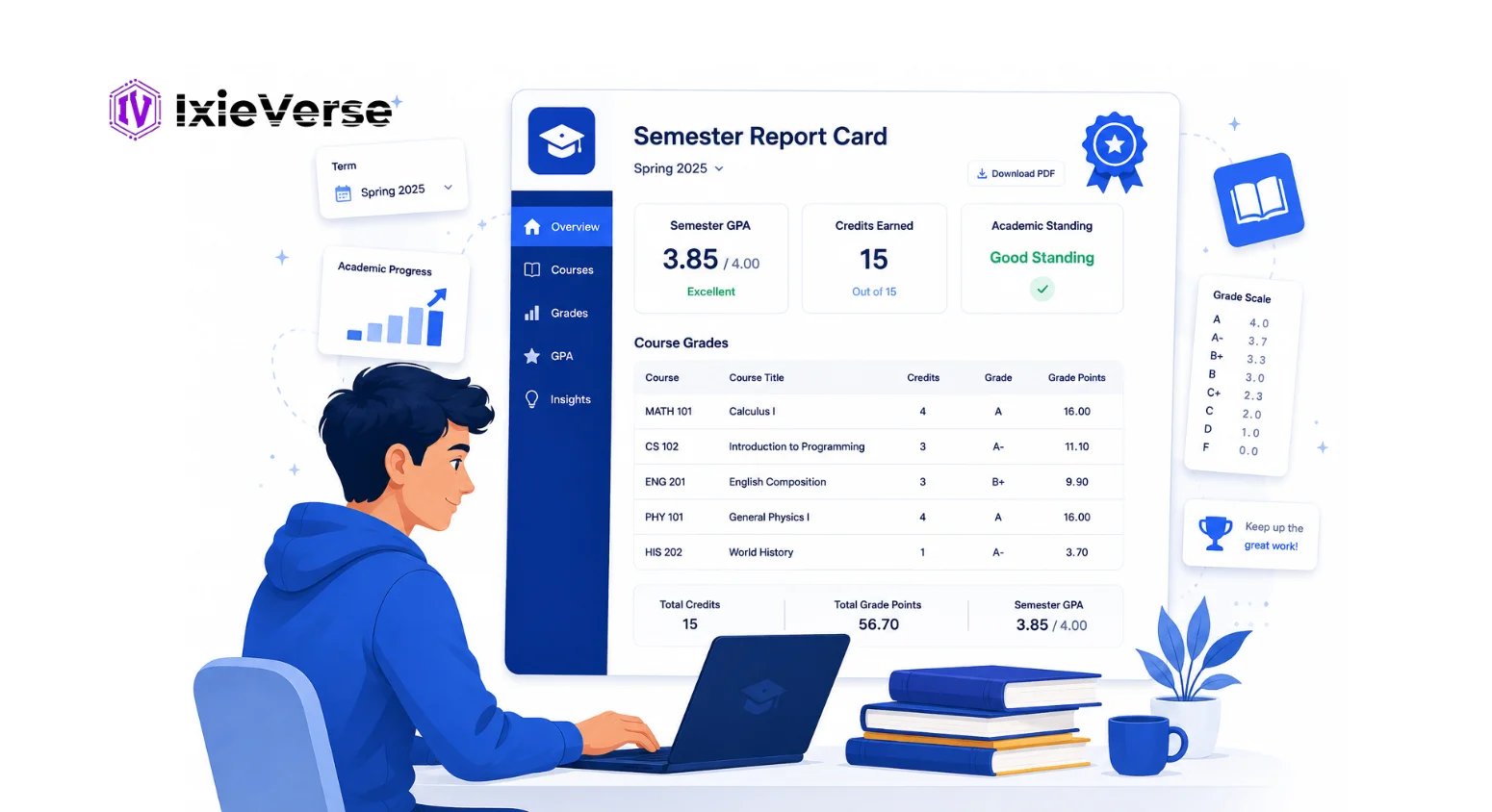
FORMULA: Semester GPA = Total Quality Points Earned This Semester ÷ Total Credit Hours Attempted This Semester
Step-by-Step Calculation
- List every course you took this semester, its credit hours, and your letter grade.
- Convert each letter grade to its grade point value (A = 4.0, A- = 3.7, B+ = 3.3, B = 3.0, B- = 2.7, C+ = 2.3, C = 2.0, D = 1.0, F = 0.0).
- Multiply each course’s credit hours by its grade point value to get quality points for that course.
- Add all quality points together for the semester total.
- Divide total quality points by total credit hours attempted. The result is your semester GPA.
Example — Fall Semester:
| Course | Credits | Grade | Grade Pts | Quality Pts |
|---|---|---|---|---|
| English 101 | 3 | B | 3.0 | 9.0 |
| Math 101 | 3 | C+ | 2.3 | 6.9 |
| History 101 | 3 | B+ | 3.3 | 9.9 |
| Biology 101 | 3 | C | 2.0 | 6.0 |
| TOTAL | 12 | — | — | 31.8 |
Semester GPA = 31.8 ÷ 12 = 2.65
Example — Spring Semester (same student, improved performance):
| Course | Credits | Grade | Grade Pts | Quality Pts |
|---|---|---|---|---|
| English 102 | 3 | A- | 3.7 | 11.1 |
| Math 102 | 3 | B+ | 3.3 | 9.9 |
| Sociology 101 | 3 | A | 4.0 | 12.0 |
| Chemistry 101 | 3 | B | 3.0 | 9.0 |
| TOTAL | 12 | — | — | 42.0 |
Semester GPA = 42.0 ÷ 12 = 3.50
Key insight: The semester GPA jumped from 2.65 to 3.50 — a 0.85-point improvement — and that improvement is immediately visible to anyone reading this student’s transcript. Semester GPA rewards short-term academic momentum.
Explore: How to Recover Your GPA After a Bad Semester
How to Calculate Cumulative GPA (Step-by-Step)
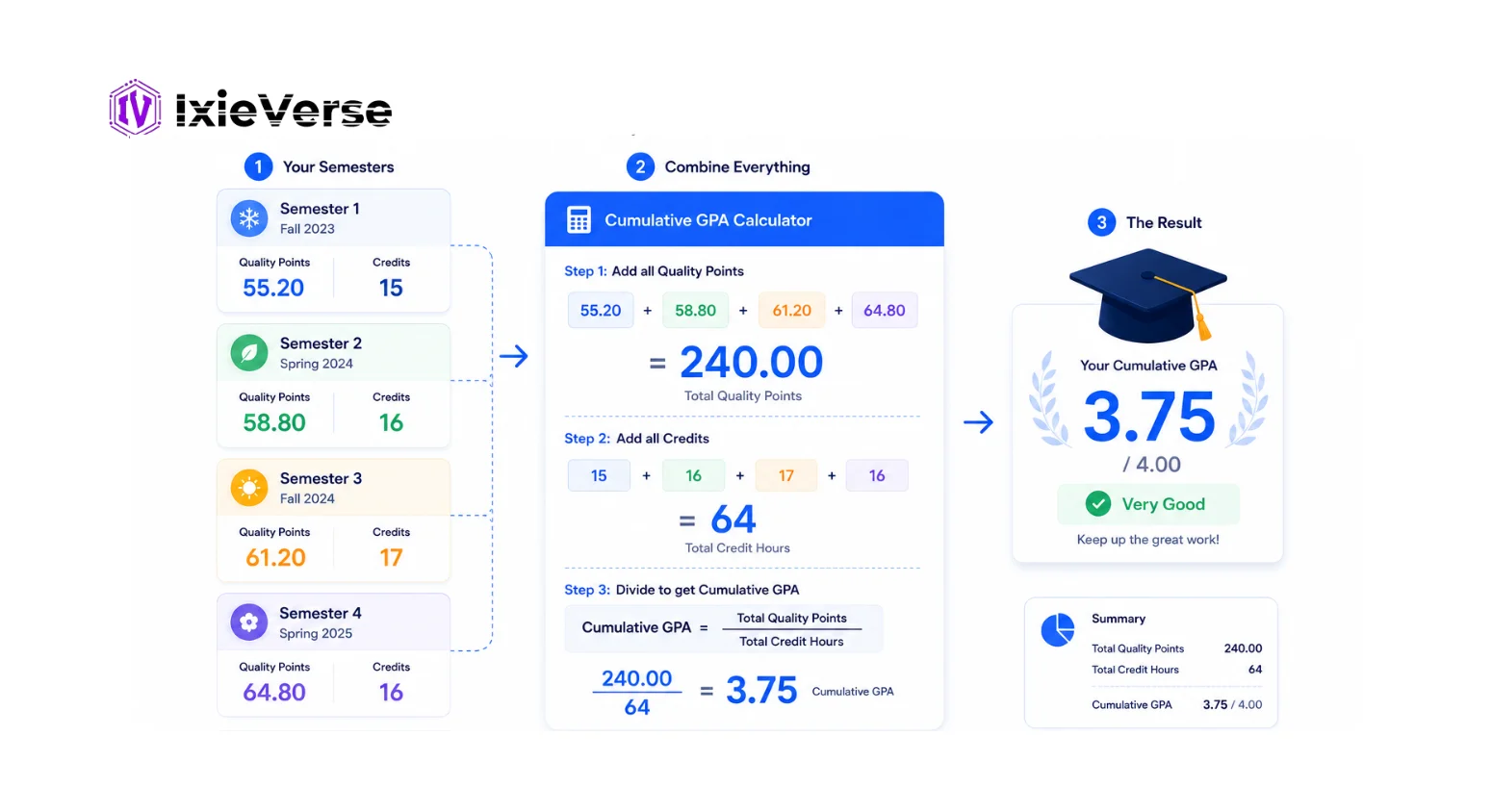
FORMULA: Cumulative GPA = Total Quality Points (All Semesters) ÷ Total Credit Hours Attempted (All Semesters)
- Collect the total quality points and total credit hours from every semester completed.
- Add all quality points across all semesters into one grand total.
- Add all credit hours across all semesters into one grand total.
- Divide total quality points by total credit hours. The result is your cumulative GPA.
Continuing the Example Above
- Fall quality points: 31.8 | Fall credit hours: 12
- Spring quality points: 42.0 | Spring credit hours: 12
- Combined quality points: 31.8 + 42.0 = 73.8
- Combined credit hours: 12 + 12 = 24
Cumulative GPA = 73.8 ÷ 24 = 3.075
Notice: Even though the student earned a 3.50 semester GPA in spring, their cumulative GPA is only 3.075. Early poor performance is mathematically “baked in” and takes time to overcome — this is one of the most misunderstood realities of GPA management.
How a Single Bad Semester Affects Your Cumulative GPA
This is the question that haunts students after a rough term. The math is sobering — but understanding it helps you plan your recovery.
Scenario: High Achiever Hits a Wall
- Scenario: A student has a 3.8 CGPA after 3 semesters (36 credit hours total).
- Difficult 4th semester: Earns a 2.0 GPA across 12 credit hours.
Before semester 4: Quality pts = 3.8 x 36 = 136.8
After semester 4: 136.8 + (2.0 x 12) = 160.8 total points, 48 total credits
New CGPA = 160.8 ÷ 48 = 3.35 (dropped from 3.8 — a loss of 0.45 points)
Recovery time: To climb back from 3.35 to 3.8 after 48 credit hours of history, this student would need roughly 2-3 additional semesters of near-perfect (4.0) performance. The more credit hours completed, the harder cumulative GPA is to move in either direction.
Wondering how long your recovery will take? Run your actual numbers through the IxieVerse GPA Calculator to see exactly what semester GPAs you need to hit your target cumulative GPA.
Which GPA Matters More — Semester or Cumulative?
The honest answer: it depends on who is evaluating you and why. Here is how different audiences use each metric.
Academic Probation
Most US universities use both simultaneously.
- A student can be placed on probation if semester GPA falls below 2.0, even if cumulative GPA stays above 2.0.
- A student can also face probation if cumulative GPA drops below 2.0, regardless of a strong current semester.
- Some institutions trigger probation from semester GPA alone — a single bad term triggers academic review.
Dean’s List & Honor Roll
- Almost always based on semester GPA — typically 3.5 or higher this term.
- Cumulative GPA is usually not a requirement for term-based honors, though some schools add a minimum CGPA floor.
Scholarships
- Merit scholarships typically specify a minimum cumulative GPA (often 3.0 CGPA) to maintain eligibility.
- Renewal requirements are almost always tied to CGPA, not semester GPA.
Graduate School Admissions
- Admissions committees review cumulative GPA as the primary academic performance signal.
- Many programs also request semester-by-semester breakdowns to analyze trajectory.
- An upward trend (2.8 freshman year rising to 3.9 senior year) can be more compelling than a flat 3.4 CGPA.
- A declining trend in upper-division coursework raises red flags about graduate-level readiness.
Employers
- Most employers who request GPA information want cumulative GPA on your resume or application.
- Some employers (especially in finance and consulting) set a hard cutoff — commonly 3.0 or 3.5 CGPA.
- Semester GPA is rarely directly relevant to employers unless you are highlighting a strong turnaround in your cover letter.
SGPA vs CGPA: Global Terminology Explained
If you study at an Indian university or apply internationally, you will encounter different terminology for the same two concepts.
Indian University System (UGC CBCS Framework)
- SGPA (Semester Grade Point Average): Equivalent to semester GPA, calculated each semester on a 10-point scale.
- CGPA (Cumulative Grade Point Average): The running average across all completed semesters, same concept as cumulative GPA.
- Indian degree certificates typically report CGPA only; individual SGPAs appear on semester marksheets.
Indonesian University System
- IPS (Indeks Prestasi Semester): Equivalent to semester GPA, calculated per term on a 4.0 scale.
- IPK (Indeks Prestasi Kumulatif): Equivalent to cumulative GPA.
- Indonesian degree classification by IPK: Cumlaude (3.51-4.00), Sangat Memuaskan (3.01-3.50), Memuaskan (2.76-3.00).
How to Improve Your Cumulative GPA: A Realistic Framework
If your cumulative GPA is lower than you’d like, here is a math-grounded, realistic plan — not empty encouragement.
- Calculate your target: Use a GPA calculator to determine exactly what semester GPAs you need over your remaining terms to reach your goal cumulative GPA. Most college GPA calculators are freely available online.
- Front-load your highest-credit courses: Grades in 4-credit or 5-credit courses have more impact on your GPA than 1-credit electives. Prioritize performance in heavy-credit classes.
- Audit repeatable courses: Many universities allow grade replacement — retaking a course can replace the original grade in your GPA calculation. Check your school’s academic policy.
- Manage your credit hour load strategically: Taking fewer courses per semester can improve GPA if you are struggling. A 3.8 GPA in 12 credits is often better than a 2.5 GPA in 18 credits.
- Seek academic support early: tutoring, study groups, office hours, and academic advising all measurably improve grade outcomes. Do not wait until after midterms.
- Address personal statements proactively: If graduate school is your goal, a personal statement that honestly explains a difficult semester and demonstrates growth is more effective than hoping admissions readers overlook a dip.
Skip the math. The IxieVerse GPA Calculator handles semester GPA, cumulative GPA, and GPA recovery planning — free, fast, and built for college students.
Conclusion: Two Numbers, One Academic Story
Your semester GPA and cumulative GPA are not competitors — they are two lenses on the same academic story. Semester GPA gives you real-time feedback on each term’s performance. Cumulative GPA tells the long arc.
The most strategic students learn to use both. They chase a strong semester GPA every term — for Dean’s List recognition, for the confidence of a good term, and because those points stack into cumulative GPA over time. And they keep one eye on cumulative GPA because that is the number that shows up on a graduate school application and a job interview.
If your cumulative GPA is lower than you want it to be, the math is not your enemy. Understand how quality points and credit hours work, make a term-by-term plan, and execute one semester at a time. Cumulative GPA responds — it just takes patience.
Frequently Asked Questions
Q1: Can my semester GPA be higher than my cumulative GPA?
Yes, absolutely. If you performed poorly in earlier semesters and have since improved, your current semester GPA will often be higher than your cumulative GPA. This is a positive academic trajectory — graduate schools specifically look for this kind of upward trend.
Q2: Does a W (withdrawal) affect my semester GPA or cumulative GPA?
In most US universities, a W (withdrawal) does not count as a grade and does not affect either your semester GPA or cumulative GPA. However, multiple withdrawals can raise academic flags and may affect financial aid eligibility. Always check your institution’s specific policy before withdrawing.
Q3: If I retake a course, does the old grade still count in my cumulative GPA?
This depends entirely on your university’s grade replacement policy. Some schools replace the original grade with the retake grade in GPA calculations; others average both grades together; and some keep both grades on the transcript but only count the highest for GPA purposes. Contact your registrar’s office to confirm your institution’s specific policy.
Q4: What is a good semester GPA and a good cumulative GPA?
A semester GPA of 3.5 or above typically qualifies for Dean’s List at most US universities. A cumulative GPA of 3.0 is widely considered the baseline for academic standing and scholarship maintenance. Graduate programs typically expect 3.0 to 3.5 cumulative GPA as a minimum, with competitive programs often expecting 3.5 and above.
Q5: Do graduate schools look at semester GPA or cumulative GPA?
Graduate schools primarily evaluate cumulative GPA as the headline academic performance metric. However, many competitive programs also request semester-by-semester GPA breakdowns to analyze academic trajectory. An improving trend — especially in upper-division and major-related coursework — can strengthen an application even if the overall cumulative GPA is lower than ideal.
Q6: Does cumulative GPA reset when you transfer universities?
In most cases, your cumulative GPA does not automatically transfer. Your new institution will calculate a fresh cumulative GPA based only on courses taken there. However, some universities calculate a combined GPA including transfer credits. Graduate schools will typically request transcripts from all institutions attended, so your previous academic record remains visible even if it is not folded into your new school’s CGPA.
Q7: Can one failing grade (F) ruin my cumulative GPA?
One F can significantly damage your cumulative GPA, especially early in your academic career when fewer credits are in the denominator. An F earns 0.0 quality points per credit hour, which drags the average down sharply. However, cumulative GPA can be recovered over subsequent semesters of strong performance. Grade replacement policies at some universities can also help mitigate the impact if you retake the course.
Q8: Is semester GPA or cumulative GPA shown on a diploma or degree certificate?
Neither is typically printed on the diploma itself. Your official academic transcript displays both semester GPA (per term) and cumulative GPA (rolling). The degree certificate or diploma may note Latin honors (cum laude, magna cum laude, summa cum laude) if you qualify — these are based on cumulative GPA thresholds set by your institution.




![50 Best Website Design Examples for Inspiration [2026]](https://ixieverse.com/wp-content/uploads/2026/08/Best-Website-Design-Examples-150x150.webp)
Add a Comment